
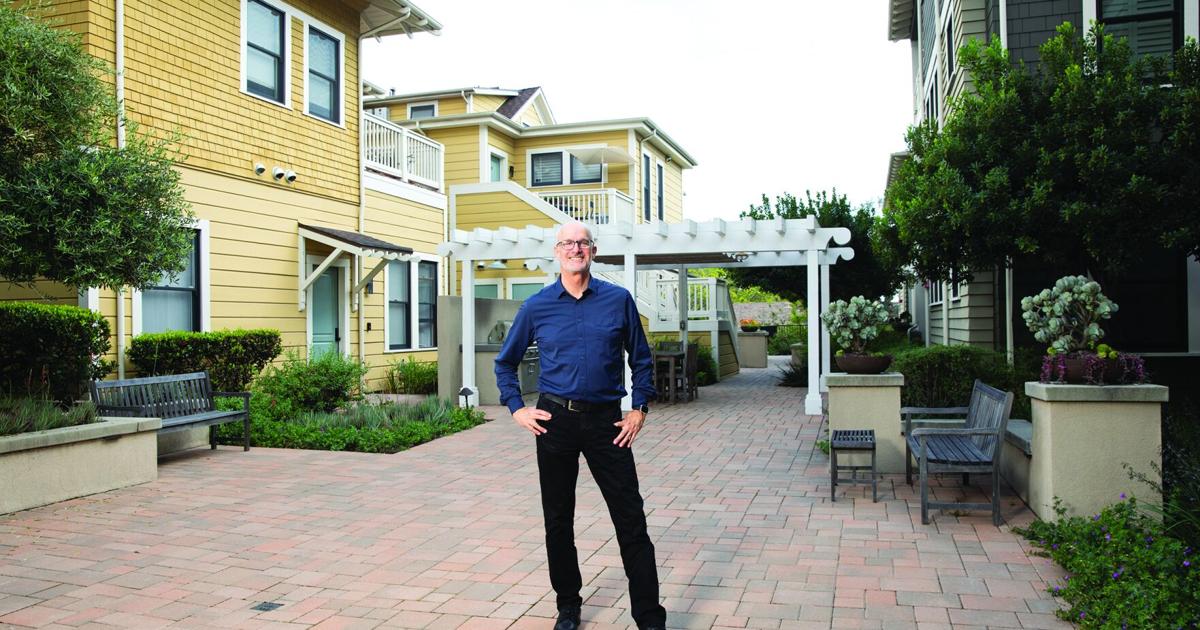
John Arnold’s fingerprints are all across the San Gabriel Valley, most notably on the blueprints of the more than 1,000 housing units that his architecture/landscape firm, KFA, has designed.
KFA’s greater-Pasadena projects include Mayfield Senior School and the redesign of the Historic Register-listed Evanston Inn into 10 residential units. Arnold is currently leading the residential expansion of the Downtown Women’s Center, adding 97 units of supportive housing to Skid Row.
Arnold liked the Evanston Inn project so much that he recently moved into the court’s penthouse.
“We just moved in 6 months ago,” Arnold said. “The construction was finished in 2017, and my spouse and I were driving by over the holidays right before it was finished, and I said, ‘Let’s, take a look.’ It was coming out really nice. We bought a unit in 2017, and it has been a rental. Last year the penthouse became available, so we figured out how to buy it because that’s the place we wanted to be.”
Arnold relayed some of the history of the Evanston Inn. It is the last remaining wood-framed structure from the days when Pasadena was a resort community in the late 19th century. The first building was constructed in 1897 and the second one in 1898. One is Victorian, and the second is leaning into Early Craftsman. It was once an apartment building, or more like a rooming house, and fell into disrepair in the latter half of the 20th century. By the time KFA started working on it, it was in bad shape.
The developer, Heritage Housing Partners, and KFA have built a combination of market rate and affordable housing and a parking garage.
“I’ve always been interested in a built environment and how human beings interact with the earth, whether it’s farming, cities or towns,” said Arnold. “My original degree is in landscape architecture because I like the relationship of spaces and objects, whether they’re trees or buildings. I switched over to architecture because I wanted to be more in the mix of the big picture of how things get arranged in the buildings. I always get my landscape architects in early. I like to collaborate with them because it’s all about, not dressing up the space with plants, but forming the spaces around buildings. If there’s anything that drives me in architecture, it’s that. I love buildings, but I like the spaces that they create.”
Arnold received a Bachelor of Science in environmental design from University of Massachusetts and a master’s in architecture from University of Washington. When he moved to Southern California, he landed at KFA—it was his first job out of graduate school in 1999, and he has been there ever since, becoming part of the firm’s second-generation leadership in 2015.
Arnold purchased and is currently restoring the original USC-area home of Paul Revere Williams, the country’s preeminent black architect, whose work includes homes for Frank Sinatra and Lucille Ball and The Beverly Hills Hotel (the logo is Williams’s handwriting).
“In 1921, Williams bought a bungalow in South L.A., very close to USC, and moved there with his wife,” Arnold said. “It was in that house that he became a very well-known architect. In 1937, he wrote an article, “I Am a Negro,” for American Magazine about how he’s an architect for wealthy people, and he was wealthy himself, but he couldn’t move out of his home in South L.A. because of racial covenants. Long story short, in 1949 the Supreme Court lifted all the racial covenants across the country and Williams quickly moved into a house of his own design in Lafayette Square in Central L.A. The city of Los Angeles has determined his original house to be a city cultural landmark.”
“There’s a building in the back that he built, 600 square feet,” Arnold continued. “He called it a playroom. We realized it was his entertainment building. About a year and a half ago, a journalist in Chicago contacted us and was researching Jackie Robinson, and he had photographs of Williams entertaining Tom Bradley and Jackie Robinson in this back building.”
Arnold has always been interested in historic preservation. In his words, he does not like erasing history. He enjoys working with what’s on the site and making it better. Most of KFA’s work
is in urban adaptive reuse, which is working with existing sites within cities.
“KFA has never been ego driven,” he said. “We’ve never been centered around one architectural visionary. I think we’re all visionaries. We like to listen to our clients and to our staff. We like to listen to our sites, and just see what is appropriate for the sites. I feel lucky that I found KFAs because it’s people oriented.”
“I’ve always been interested historical architecture and neighborhoods and how cities grow and evolve,” he continued. “I love trying to figure out how to make greater Los Angeles better. Southern California has so much potential to be better than it is and heal the wounds of the past, whether that’s parking lots or sprawl. A lot of cities, whether it’s Monrovia, Arcadia, Glendale, Burbank, they all have to meet their housing mandates from the state, and they’re all grappling with how to get more density in a place that wasn’t necessarily built or scaled for it. That is what’s happening now, and we are trying to guide cities in how to do it, and it takes listening, and it takes design that’s right for the future.”