
Californians have marked both our successes and our struggles with icons.
The Bay Area has its Golden Gate Bridge. The flashy and resilient California Poppy is our state flower. The Hollywood sign has recognizable star power around the planet, in any language. The grizzly bear enshrined on our flag has served as a powerful reminder of our independence and strength.
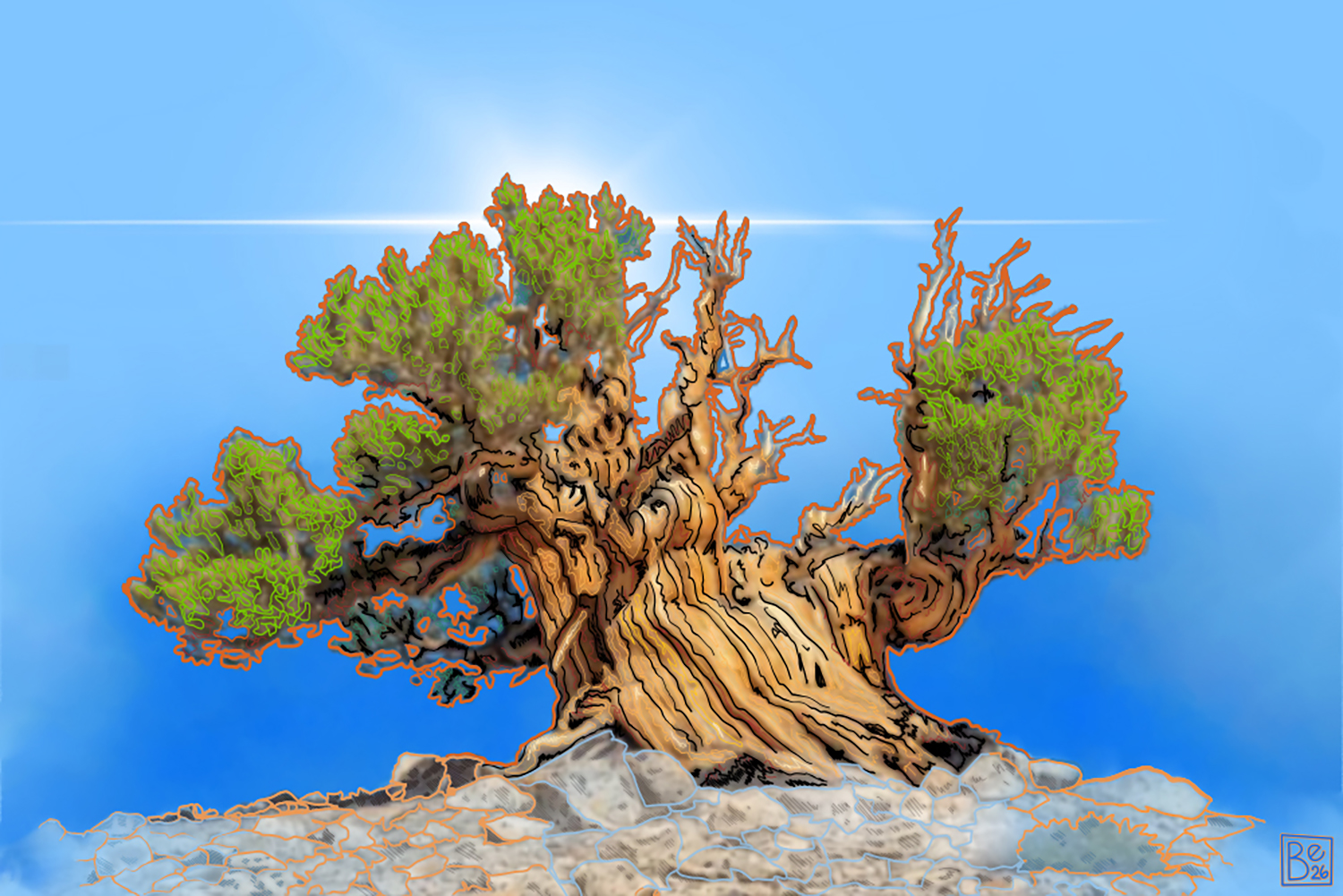
But there’s one icon that best marks California’s tenacity, and our pure, ornery insistence that California remain home: the bristlecone pine, Pinus longaeva.
Admit it: We are stubborn bastards, us Californians.
We’ve endured more than many, and perhaps more than most: the smallpox epidemic in the early 1870s, which was disproportionately lethal to Native Californians and Chinese communities. The 1906 San Francisco earthquake and fire, which took out 3,000 Californians. Two pandemics a century apart; the collapse of a massive engineering structure, the Saint Francis Dam; and our nemesis, fire, which has savaged the state over a long century and a half.
Through all of this, our numbers have only grown. California’s population has risen, increasing every decade since statehood in 1850. We’ve been a demographic outlier, outpacing growth elsewhere in the country. People love to trash-talk California, but we continue to expand and thrive. It’s meant hunkering down under turbulent political and environmental disasters. It’s also been about celebrating our persistence and our power. We’re propagators, casting ourselves and our work out into the wider world.
The bristlecone pine has rooted high in the White Mountains in eastern California for more than 5,000 years, before the invention of the written word. No one knows how old the oldest bristlecone might be, but some of these trees have seen close to 2 million dawns and dusks. They are squat, twisted refugees, growing only at high altitude in cold, windy, and often icy conditions, and in poor soil.
The bristlecone, like California, is full of contradictions. Its height is limited: The bigger and taller it grows, the more exposed it is to drying winds. Some old pines on windy summits are shaped into spectacular positions by incessant winds, which can turn a branch so that it’s pointing toward the ground rather than skyward.
The bristlecone’s capacity to twist into gnarled forms in response to environmental forces has meant that humans can’t use it for lumber, or for much else. However, like California, it still faces numerous threats. Although it has a long relationship with fire, it can be killed by excessive flames. Porcupines sometimes girdle the bristlecone by eating a full ring through its bark, which can kill the tree. Bark-beetles can cause extensive damage beneath the pine’s outer layers. Lightning strikes on high mountain ridges can burn down a tree, or severely damage it; endless freeze-thaw cycles crack limbs and roots. But the effects of age and brutal conditions on the bristlecone make it breathtakingly, sculpturally beautiful. The Golden State has been shaped in much the same way: stress-testing against difficult conditions, enduring over the long years, and morphing or adapting with each boom and bust.
It’s not wrong to call the bristlecone pine quietly ferocious. Sometimes, Californians have expressed a brutal form of optimism. It’s not all shimmering sunsets, and things don’t always pan out. We normalize failure sometimes, and we’ve had our share of spectacular collapses. Really, we expect catastrophe, much like the bristlecone does, because we must. Life is untidy business, and success is a moving target. Perhaps more than anything else, we’ve learned to resist.
You Might Also Like
We’re the queens and kings of the informal network, forging alliances outside of the usual political or corporate channels, and we’ve used it in powerful ways. We learned early to bypass legislatures. At the start of the 20th century, progressives used initiatives to break railroad power. Witness the dispossessed agricultural worker fights, where Dolores Huerta and others helped to push back, and push forward. Grassroots tax revolts in the 1970s rewired the state economically and politically. There’s a long list of ways we’ve worked both quietly and raucously to effect change at the same time we’ve confronted great difficulties.
The giant metropolises of California are frequently described as fragmented and kaleidoscopic. But that’s one of our greatest assets: We form tribes, communities, groups, identities that distribute their bounty, like seeds, to the rest of the state and the rest of the world.
The bristlecone manifests many pluralities, too—these trees tend to grow in clusters and their roots form symbiotic partnerships with underground fungal communities. But few of its allies are more important than Clark’s nutcracker, a bird that has also been part of California’s ecosystems for thousands of years, evidenced by both modern distribution and fossil records.
The Clark’s nutcracker loves to eat bristlecone pine seeds. When collecting them, it engages in what’s known as scatter-hoarding: a caching strategy that involves gathering up thousands of seeds, usually during the warmer summer months while the trees are germinating, and carting them off in a pouch under its tongue. A single Clark’s nutcracker can stash its hoard of bristlecone pine seeds in up to five thousand different locations that can sprawl across hundreds of square miles.
Although the seeds are not the birds’ offspring in the usual sense, the survival strategy is the same: Just as a frog lays thousands of eggs in hopes of shielding some of them from predation, the nutcracker overreaches in its seed-hiding tactics to avoid having its meal stolen by opportunists such as squirrels or other birds. (Small wonder it loses track of a few, which can grow on the spot into a tree.)
The bristlecone’s wingless seeds, which can’t be borne along by the wind like many other pines’, are evidence that the tree and the bird probably co-evolved: the tree benefitting from the nutcracker’s distribution strategy, and the bird benefitting from the enormous nutritional bounty of the tree’s seeds. They’ve worked it out.
As it turns out, all of that hoarding and scattering creates stupendous genetic variety. Move a tree’s seeds around a lot, and they grow in varying conditions that exert differing influences on the tree’s evolution, favoring seedlings (and their offspring) that can survive in a variety of microclimates, in subtly or dramatically different soil conditions, and so on. As a rich mixture of bristlecone DNA makes its way around the state, likely thanks to its “collaboration” with the Clark, new trees reveal startling variety: differences in cone shape, needle arrangement, and branch architecture. This chain of varying populations has confused taxonomists and foresters for a century.
As California’s mosaic of people and environs further mix and mold, the state will continue its growth much like the bristlecone pine: twisted, stubborn, beautiful, and pushing on into an uncertain future.
Daniel Lewis is the Dibner Senior Curator for the History of Science and Technology at the Huntington Library in San Marino, California. He is the former company historian for the Los Angeles Times and the author of Twelve Trees: The Deep Roots of Our Future.
This piece publishes as part of California 175 — What Connects California?, a suite of free Zócalo programs and essays, bringing together leaders and thinkers from all walks of life to envision California’s next 175 years.
Primary editor: Talib Jabbar | Secondary editor: Eryn Brown