
This photo is at least 108 years old, yet the two women pictured look as alive as you and I.
The swimmers pose in bathing suits and caps at Idora Park, an amusement park in North Oakland that once boasted rollercoasters, a Ferris wheel and stage performances. The image was taken around 1917, but their demeanor is startlingly modern and uninhibited. Unlike most staid portraits of the era, they seem to be in the middle of a laugh.
The image is one of nearly 1,500 recently rediscovered negatives from 1910 to 1920, slowly being digitized at SFMemory.org. All are the work of Samuel Marmaduke Crow, a professional photographer whose more personal collection had been lost for generations.
Among the photos that have been published so far are rare images of Sutro Baths, the California “Grizzlies” U.S. Army regiment training for World War I at Tanforan Racetrack and Katherine Stinson, a barnstorming female pilot who preceded Amelia Earhart. But even more important than the content is the photographic approach. Crow was an innovator and pioneer in flash photography, but his greatest talent may have been putting everyday citizens at ease.
Article continues below this ad
Army men washed dishes in a bucket at Tanforan Racetrack in San Bruno in September 1917 with the racetrack grandstand in the background. The U.S. Army’s California 2nd Field Artillery, the Grizzlies, trained at Tanforan during WWI from August to October 1917.
Samuel M. Crow/sfmemory.org
Photo collector David Gallagher, who has been scanning the four-by-five glass negatives, is stunned how comfortable the subjects appear.
San Francisco Chronicle Logo
Make us a Preferred Source to get more of our news when you search.
Add Preferred Source
“They’re technically excellent,” Gallagher said. “But they capture a casualness and humanity that you very rarely see in posed portraits of that era. They’re just wonderful.”
Article continues below this ad
Crow was no mystery, but isn’t widely known. The photographer was born in rural Willows, Calif., in the Sacramento Valley, worked for newspapers including the San Francisco Examiner, wrote essays for Camera Craft magazine and once photographed antiquities collected by William Randolph Hearst for his San Simeon estate. (The photographer, who died in 1947, appears in several self portraits in the collection.)
The photographer Samuel M. Crow sitting on a boat and showing off his socks circa 1912. Crow documented daily life in the Bay Area in the early 1900s.
Samuel M. Crow/sfmemory.org
But these images seemed to be personal. Hundreds of the negatives picture Crow’s wife Esther and young son Andrew, often appearing in the background as if Crow was taking a photo test.
Photographer Samuel M. Crow’s son Andrew, born in 1904, dressed in a baseball uniform in 1912. Andrew served as a model for many of his father’s photographs.
Samuel M. Crow/sfmemory.org
Danville resident David Okimoto acquired the collection decades ago without knowing the photographer, and had long been looking for a home for the work. Gallagher met Okimoto through a mutual friend, and was stunned from the moment he picked up the first negative: In it a woman has draped herself over the Lands End rocks wearing a “Sutro Baths” bathing suit and a relaxed, no-care-in-the-world smile. More images showed the baths’ buildings clearly visible in the background.
Article continues below this ad
Eight men sit in an open car along the Great Highway near Balboa Street in San Francisco in 1914. Cliff House is visible in the background.
Samuel M. Crow/sfmemory.org
“Any time we get a funky picture of the outside of Sutro Baths, I’m sold, because those are rare,” Gallagher said. “… This collection had so much more.”
The images feature less documented corners of San Francisco and the Bay Area in an era that’s mostly lost in time. (The great majority of the Chronicle archive is made up of images from 1930 forward.) Oakland’s Idora Park and Alameda amusement park Neptune Beach are featured prominently, as are Sutro Baths and the Santa Cruz Beach Boardwalk.
Front gate staff at the Panama-Pacific International Exposition in 1915 including a traffic director (with baton), gate man at center and inspector at right
Samuel M. Crow/sfmemory.org
The collection also includes more than a hundred clear images from the Panama-Pacific International Exposition, which took place in 1915 where the Marina District is now. There are rarities — including some of the best existing images of Ewing Field, a mostly forgotten 14,000-seat Richmond District ballpark that burned to the ground in 1926 — and slices of daily life in Golden Gate Park, along Market Street and at the Ferry Building.
Article continues below this ad
Left: Los Angeles Angels pitcher Howard Ehmke, sitting on the baseball field at Ewing Field in the visitor bullpen during a game against the San Francisco Seals in 1914.
Top right: Los Angeles Angels players seated in the bullpen down the left field line at Ewing Field in San Francisco.
Bottom right: Baseball writers in a press box photographed by Samuel M. Crow circa 1915.
Samuel M. Crow/sfmemory.org
Top: Los Angeles Angels pitcher Howard Ehmke, sitting on the baseball field at Ewing Field in the visitor bullpen during a game against the San Francisco Seals in 1914.
Middle: Los Angeles Angels players seated in the bullpen down the left field line at Ewing Field in San Francisco.
Bottom: Baseball writers in a press box photographed by Samuel M. Crow circa 1915.
Samuel M. Crow/sfmemory.org
But what’s most striking are the facial expressions and body language Crow captured. Most surviving photos from that time are posed, with subjects either looking very stern, very stiff or both. Crow clearly had a gift with people. The candid photos are sometimes silly — the heads of two models for Liberty war bonds break through a poster — often joyful and almost always unguarded.
Oakland women Virginia Arnold and Lenore Bredull promote the sale of Liberty Bonds to help fund the United States’ participation in WWI in 1917. In total, roughly 20 million Americans invested more than $21 billion in Liberty Bonds to support the war effort.
Samuel M. Crow/sfmemory.org
The swimming pool photos and some pin-up shots that Crow took (G-rated in 2026, but racy for the time), are particularly eye-catching. The women, likely strangers to Crow, look a bit mischievous and self-assured. Gallagher says he can tell the photographer was charming just by seeing his results.
“He clearly put his subjects at ease,” Gallagher said. “He was a professional that could take a great picture without forcing his subject into anything.”
Article continues below this ad
An unidentified woman in a Sutro Baths swimsuit, poses at the Sutro Baths settling pond, which helped remove sand and debris from the water before it flowed into the swimming tanks circa 1915. Lands End is visible in the background
Samuel M. Crow/sfmemory.org
Uploading the images so they can be enjoyed by current viewers has been slow work. Gallagher has tracked down early 20th century license plate registrations to learn the identities of people in cars and includes a map with the location most images were taken. He’s hoping the San Francisco Public Library History Center eventually accepts the heavy glass negatives, which weigh more than 120 pounds, and that the photographer’s descendents come forward to see their family history.
But mostly he wants Samuel M. Crow to get a little publicity, and for Bay Area residents to appreciate these exceptionally candid images and feel connected to a generation that’s all but gone.
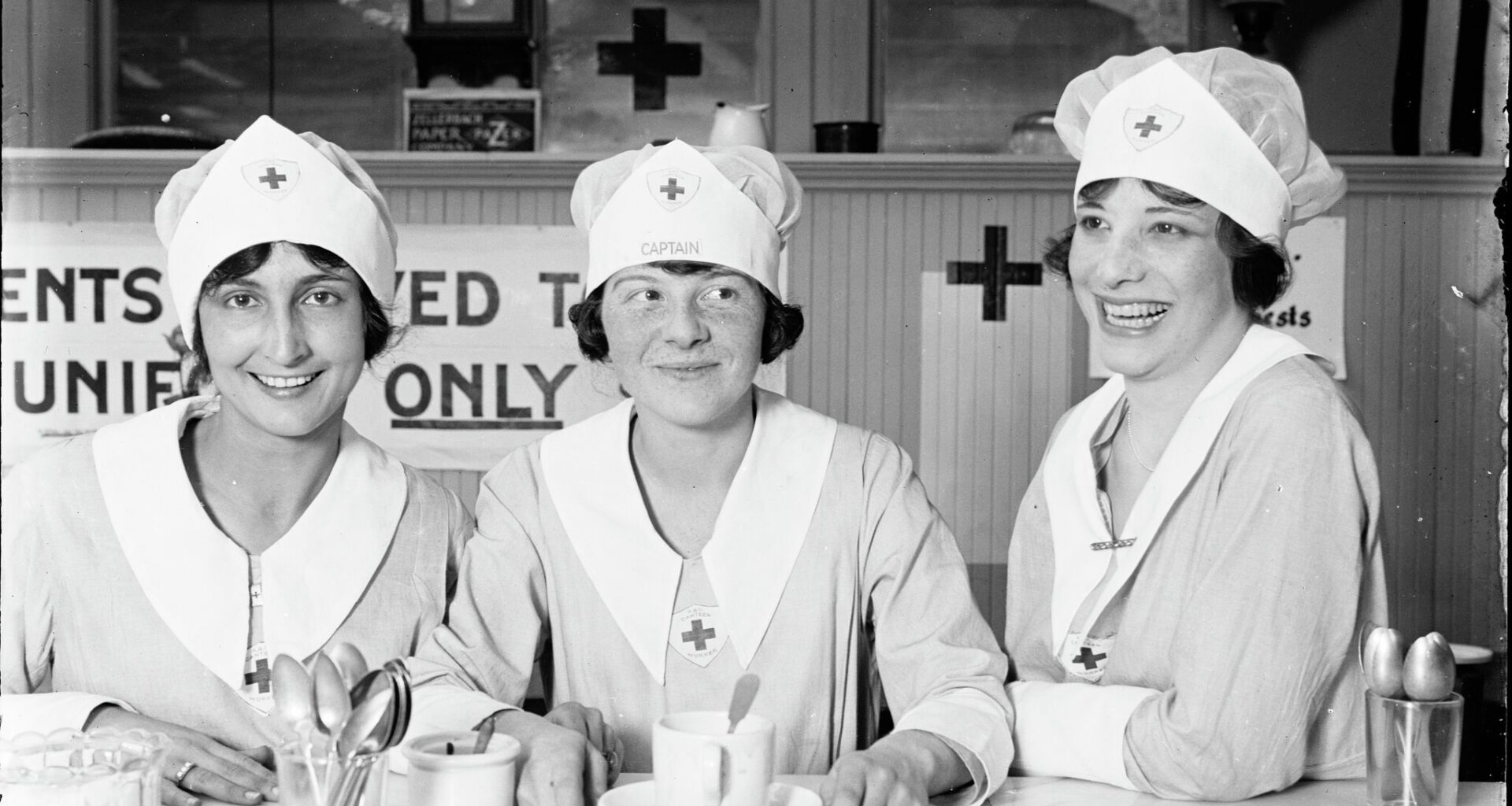
Three women volunteers pose in the Red Cross Canteen near the Ferry Building in San Francisco in 1919.
Samuel M. Crow/sfmemory.org
“What he did mattered,” Gallagher said. “There’s stuff in here we can relate to today. You look at these pictures and go, ‘Wow, I think I saw this woman walking down Haight Street the other day.’”