
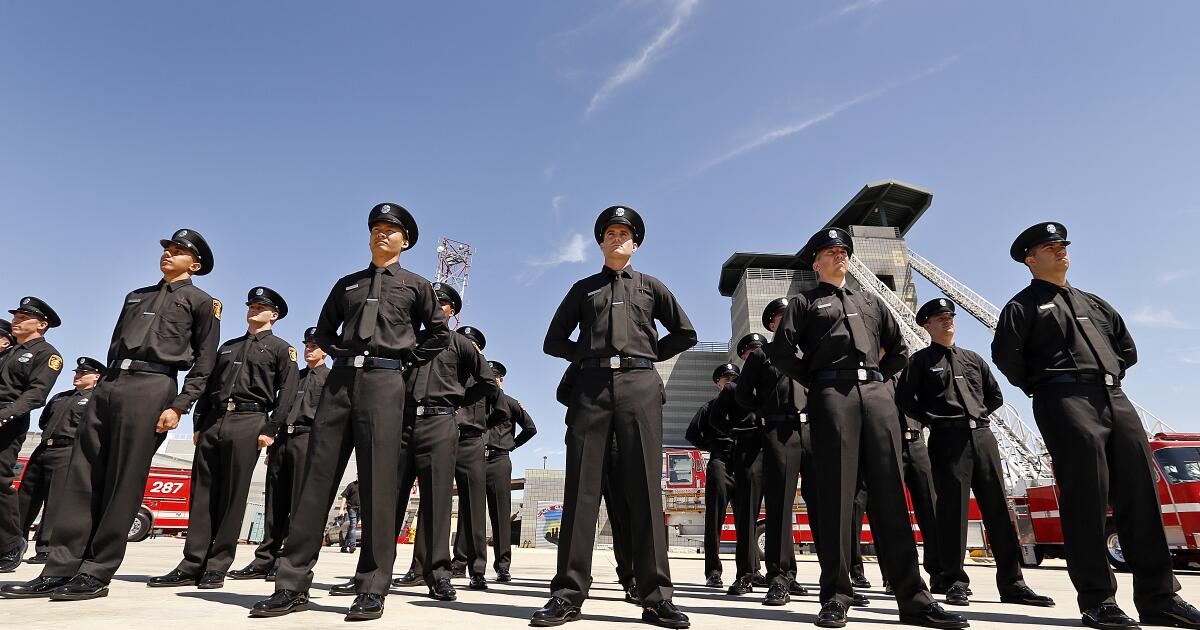
As firefighter after firefighter testified about their actions during the Lachman fire, a clear theme emerged — the Los Angeles Fire Department’s culture of absolute obedience.
One told a boss about red hot coals and smoldering ash. Another warned that warm weather increased the risk of a flareup. After taking their concerns to superiors, they gave up — it was not their job to make decisions like when to pack up their hoses and leave a fire that had mostly been put out.
Days later, that fire reignited into the Palisades fire, destroying thousands of homes and leaving a dozen people dead.
“I could’ve possibly prevented a lot of stuff if I would’ve been more outspoken, right?” firefighter Scott Pike testified in a lawsuit brought by Palisades fire victims. “But that’s not the right thing to do. The captains don’t want to hear that.”
Pike’s attitude reflects deep-rooted norms within the LAFD not to question orders — or to push back against higher-ups when something feels wrong, or even dangerous — because doing so could invite retribution. Several current and former firefighters told The Times that it’s often easier to keep their mouths shut than deal with the ramifications of speaking up.
Similar to law enforcement, fire departments are paramilitary organizations handling fast-moving, life-and-death emergencies where there’s often no time for debate.
What’s more, firefighters typically work 24-hour shifts and live with their crew at the station, cooking, eating, sleeping and exercising together. Being ostracized isn’t just losing the camaraderie of co-workers — it’s losing a family.
The culture of silence within the LAFD is common to fire departments around the country, said Laura Kavanagh, former head of the New York City Fire Department.
“They become like your second family. And so I think that loyalty is much greater,” Kavanagh said. “Being on the outs can be truly detrimental to one’s career but also to one’s health and ability to have a community.”
For those who don’t stay silent, retaliation from bosses can come in the form of “highway therapy,” she said — when firefighters are reassigned to a station far from home. They may be passed up for promotions or labeled as troublemakers.
Sharon Delugach, who recently stepped down after about three years as a Los Angeles fire commissioner, said that changing the LAFD’s culture comes down to better training for those in charge.
“The captain needs to model respectful behavior, which may include understanding that asking questions isn’t automatically insubordinate,” she said. “I do think that culture can be changed through training and accountability.”
LAFD spokesperson Stephanie Bishop said last week that retaliation against firefighters who report misconduct or refuse unlawful orders is prohibited by department policy and California law.
Fire Chief Jaime Moore made it clear when he took the job less than six months ago that “fostering a culture where every member of the Los Angeles Fire Department feels respected and supported is a top priority,” Bishop said in an email responding to questions about firefighters’ fear of speaking out.
“This won’t happen overnight, and our personnel understand that,” she continued. “A comprehensive review of department policies and procedures is underway. LAFD leadership is committed to doing the work and delivering lasting change.”
Doug Coates, acting president of the United Firefighters of Los Angeles City, the union representing LAFD rank and file, declined to comment.
In a 2022 audit into internal sexual harassment investigations, the LAFD’s top watchdog found that firefighters were discouraged from reporting misconduct and encouraged by supervisors and others to withhold information during investigative interviews. Some were told to keep problems “in-house” instead of reporting them to supervisors, said the audit by the Office of the Independent Assessor.
“‘Plead the 5th, it doesn’t involve you,’” one probationary firefighter said that multiple co-workers advised him before an interview with internal investigators, according to the audit. “‘And say you can’t recall when answering questions from investigators.’”
According to the audit, the probationary firefighter — who is white — said he witnessed crews mistreat a Black female firefighter based on her race and gender. He said he wanted to quit the department because “these guys are the most racist people I’ve ever met.”
Female and minority firefighters have long complained about an enduring “frat house” culture, with co-workers bullying and harassing them.
But Capt. Freddy Escobar, a former president of the firefighters union who was suspended by the union’s parent organization over allegations of missing receipts, said that the family culture at fire stations fosters an open-door environment. He denies the allegations.
“You’re supposed to take care of one another,” he said. “Just like at home, you feel comfortable going to the front office.”
Kavanagh estimated that fire departments are about two decades behind law enforcement agencies in terms of reforms, largely because police are under much more public scrutiny and are often subjected to more rigorous oversight, in part because of their use of deadly force.
“The fire service is just so enmeshed. It is such a brotherhood, and there isn’t that scrutiny on it,” she said. “The downsides for speaking up are so immense, I almost can’t imagine why anyone chooses to do it.”
She added: “It’s imperative that we find a way to speak up.”
Connie Rice is a longtime civil rights attorney whose work has largely targeted what she described as a similar culture within the Los Angeles Police Department. She said LAFD firefighters have told her that the code of silence exists because complaining about the leadership could end careers.
“LAFD is a kill-the-messenger cult,” Rice said. In terms of penetrating the code of silence, “the police are easier to crack than firefighters,” she added.
The paramilitary command structure that allows for orders to be executed quickly during a fire or other emergency also reinforces respect for rank, said a retired LAFD battalion chief who asked not to be identified because he still has family in the department.
“There’s a hierarchy, and the more time you get on, the less you expect people to question you,” he said. “Most firefighters, unless they got 10, 15, 20 years, they’re not going to go up against a captain, or a chief.”
“There is some payback in our culture,” he added. “They hold grudges.”
LAFD’s rules and regulations say that members shall “under no circumstances” exceed their authority in giving orders and are protected against penalties if they follow improper orders. The National Wildfire Coordinating Group’s Incident Response Pocket Guide, another set of guidelines followed by the LAFD, says firefighters are obligated to report safety issues and that supervisors are “expected to give these concerns and ideas serious consideration.”
The guide offers instructions for how to refuse an assignment a firefighter feels is unsafe, though the retired battalion chief said it would be a stretch to apply those instructions to a mop-up scenario like the Lachman fire, where there’s no immediate danger.
“The bottom line is, if he says we’re leaving, you’re leaving,” the former battalion chief said of supervisors at the Lachman fire.
But where does that leave firefighters?
“Honestly, I’ll never bring anything up,” said an LAFD firefighter who said that superiors targeted him after he spoke out against what he thought was an unethical billing practice for fire inspections. “Good, bad or indifferent. Anything I said on behalf of the public … all it did is get me in trouble.”
The firefighter — who was not involved in the Lachman fire — asked to remain anonymous because he feared retaliation.
Jimmie Woods-Gray, a former fire commissioner who stepped down last month, said that fear of retaliation prevents firefighters from reporting racial or sexual harassment and other bad behavior.
“They don’t just think they’ll get retaliated against — they will get retaliated against,” she said.
Arson investigator Robert McCloud, who recently lost a retaliation and racial discrimination lawsuit against the city, said that at the LAFD, investigations into wrongdoing are done in-house — and the results are often personal. He said his dissatisfaction with that system long predated the outcome of his lawsuit, which he brought with five other Black arson investigators.
“If our kids play soccer together, of course I’m not going to get in trouble,” he said. He added later: “If you didn’t like me as a rookie, or you didn’t like me as a firefighter, I gave you a hard time … This is your time to be revengeful.”
In the lawsuit, the arson investigators alleged that they were targeted with sham investigations, passed up for promotions and other opportunities and subjected to excessive criticism and increased workloads. A jury awarded two of the plaintiffs more than $600,000 each in damages.
Cynthia Sato, another arson investigator, filed a lawsuit last year alleging that she faced retaliation and gender discrimination after refusing a chief’s order to arrest an arson suspect without probable cause.
According to Sato’s lawsuit, the chief initiated a complaint against her for insubordination, and she was disciplined with a reprimand. Her schedule was changed to prevent run-ins with the chief, which made it difficult for her to obtain child care and prevented her from working overtime, she said in the lawsuit.
Neither Sato nor her attorneys responded to a request for comment.
Despite Pike’s warnings that the fire was still smoldering, the orders from above did not change, and crews continued packing up their hoses at the Lachman burn scar on the morning of Jan. 2, 2025, according to testimony in the Palisades fire victims’ lawsuit. LAFD leaders have refused to explain who made the decision to leave prematurely, and why.
Those in charge that day have deflected blame, while other firefighters testified that they didn’t question what they were assigned to do.
“I was told to pick up hose from my captain, which is a common assignment for us to get,” one firefighter testified. “I just listen to orders.”
Eventually, after voicing his concerns with three people, Pike decided he had pushed back enough and that whatever happened next wasn’t his responsibility.
He testified: “It’s tough to go against the gradient with command and be the only one.”
Former Times staff writer Paul Pringle contributed to this report.