
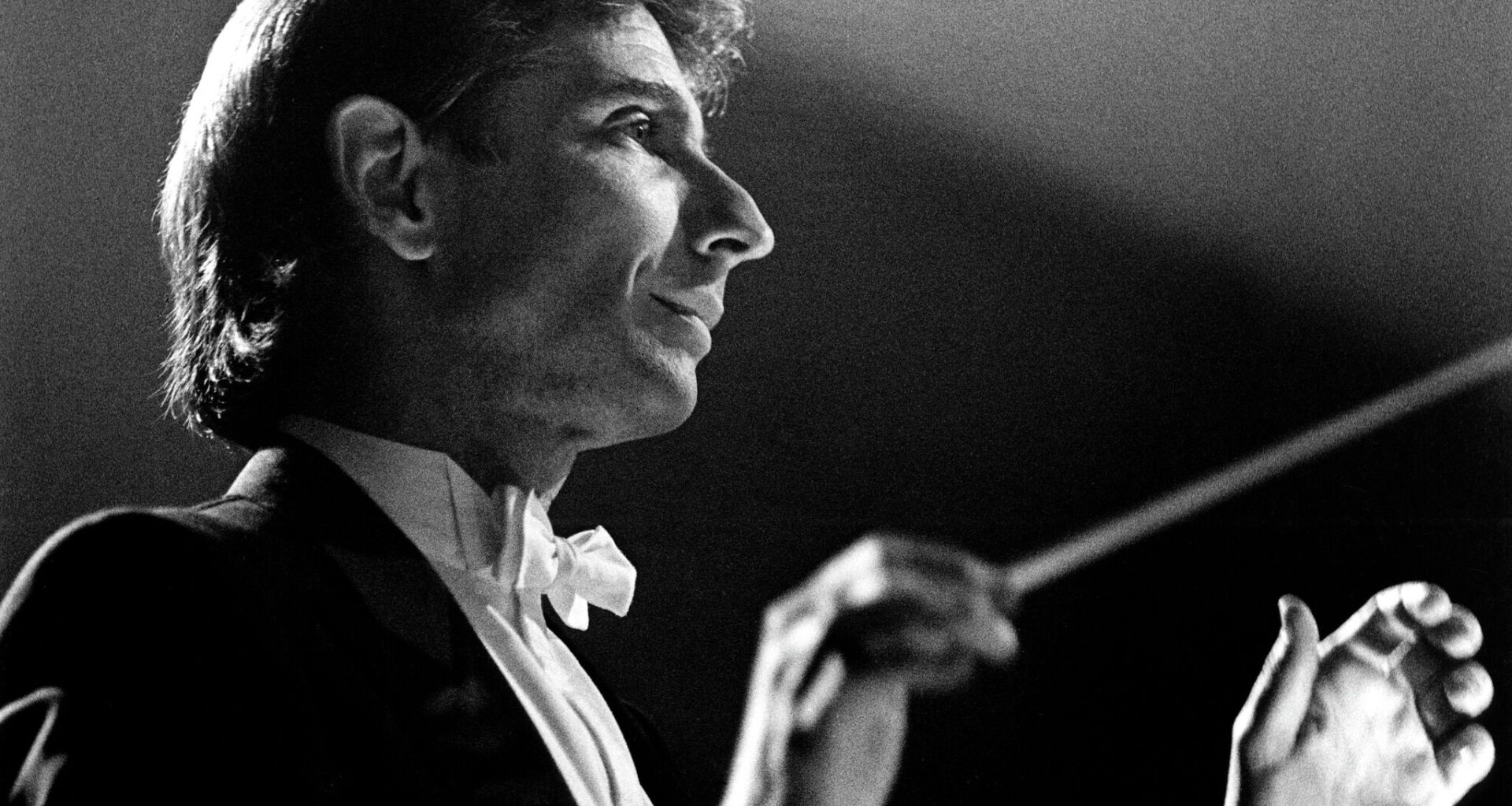
Michael Tilson Thomas circa January 1993.
David Farrell/Redferns
Michael Tilson Thomas leads the audience in a stirring rendition of the national anthem during the San Francisco Symphony Opening Gala of the 1996-1997 season. SAN FRANCISCO CHRONICLE PHOTO BY CHRIS STEWART
Chris Stewart /The Chronicle
Michael Tilson Thomas at his San Francisco home using computerized software to notate and manipulate his scores. His dog, Sheyna is by his side.
Deanne Fitzmaurice/The Chronicle
Music Director Laureate Michael Tilson Thomas conducts his final concert with the orchestra during the “MTT 80th Birthday Concert” at Davies Symphony Hall in San Francisco on April 26, 2025.
Jana Ašenbrennerová/For the S.F. Chronicle
Music Director Laureate Michael Tilson Thomas conducts his final concert with the orchestra during the “MTT 80th Birthday Concert” at Davies Symphony Hall in San Francisco on April 26, 2025.
Jana Ašenbrennerová/For the S.F. Chronicle
For a quarter of a century and more, Michael Tilson Thomas and San Francisco were practically synonymous in the world of classical music. To speak of either Thomas or the San Francisco Symphony was to speak of the other, and doing so almost always meant celebrating the unique artistic partnership that emerged in Davies Symphony Hall over the decades.
Thomas’ 25-year tenure as the orchestra’s music director, from 1995 to 2020, was a golden age of musical achievement in the Bay Area, during which his prodigiously versatile gifts as a conductor, pianist, composer and educator helped to create a nexus of excitement around Davies Hall that could be felt throughout the region — even by those whose interest in orchestral music was limited or nonexistent. Thomas also remained an outsized presence even after he stepped down in the midst of the COVID-19 pandemic, taking on the title of the orchestra’s music director laureate.
Now that presence is gone. Thomas died at home on Wednesday, April 22, nearly five years after first being diagnosed with a brain tumor that was later identified as glioblastoma multiforme, an aggressive form of brain cancer. He died surrounded by family and friends, according to a Symphony spokesperson. He was 81.
Article continues below this ad
His death comes just two months after the death of his husband and business manager, Joshua Robison, who died on Feb. 24 from complications following a fall in their Pacific Heights home.
Micahel Tilson Thomas and his husband, Joshua Robison, at the San Francisco Symphony Opening Night Gala on Sept. 3, 2014.
Alex Washburn/The Chronicle
“MTT didn’t just lead the Symphony,” Board Chair Priscilla Geeslin said in a statement. “He became part of the cultural fabric of San Francisco itself, expanding what it meant to be an orchestra in a city like ours. His impact reached far beyond the concert hall, touching the life of the city in ways both visible and deeply personal. We were, quite simply, so lucky to have him.”
San Francisco Chronicle Logo
Make us a Preferred Source to get more of our news when you search.
Add Preferred Source
Symphony leaders also emphasized the breadth of his impact, both within the institution and across the wider musical world.
Article continues below this ad
“He was a brilliant conductor, a generous teacher, and a deeply original human being,” Symphony CEO Matthew Spivey said in a statement. “He reimagined what this orchestra — and classical music in a city like ours — could be. San Francisco and the musical world are better for his life.”
The sense of connection extended to the musicians who worked closely with him.
“His commitment to reaching deep into the hearts and minds of his musician colleagues and his listeners up to the very last row of the balcony will always be present in those of us lucky enough to have shared the stage with him,” Barbara Bogatin, a longtime member of the orchestra’s cello section, said in a statement.
Over the course of a long and richly varied career, Thomas established himself as one of the preeminent figures in late 20th- and early 21st-century classical music, as persuasive in the standard repertoire as in the more arcane corners of the landscape.
Aside from opera, where his forays were comparatively rare, Thomas commanded a vast swath of musical terrain. He was an early champion of the music of Charles Ives, Carl Ruggles and Henry Cowell, at a time when those thorny American pioneers were still too little known to the general public.
Article continues below this ad
Michael Tilson Thomas rehearsing Gershwin’s “Rhapsody in Blue” with the San Francisco Symphony.
Liz Hafalia/The Chronicle
In his performances with the Symphony, as well as with other orchestras around the world, he illuminated the music of Debussy, Stravinsky, Beethoven and many other composers — Mahler above all.
He was a tireless advocate for contemporary music as well, from Steve Reich and John Cage in the 1970s to Steve Mackey and Mason Bates in more recent years.
Throughout it all, Thomas remained committed to an aesthetic of spontaneity, freedom and exploration. His performances of even a well-worn score could vary subtly from night to night, and widely from year to year. He remained open — and encouraged his musical collaborators to remain open — to the rewards of sudden inspiration.
“I’m happiest when I feel the music gets to a place where no one is really quite sure who is making the music,” he told the Chronicle in 2020. “It just seems to be happening wonderfully, miraculously, rather than as a result of someone who’s saying, ‘Follow me.’”
Article continues below this ad
Thomas’ relationship with the San Francisco Symphony dated back to 1974, when he made his debut conducting Mahler’s Ninth Symphony. He returned regularly to the Bay Area in the subsequent years, leading the orchestra in a range of repertoire, and twice planning and conducting a summer Beethoven Festival.
But it was his appointment as music director in 1995, succeeding Herbert Blomstedt, that began what would eventually emerge as the single most important chapter in the Symphony’s more than century-long history.
The appointment also marked a homecoming of sorts for Thomas, who was born Dec. 21, 1944, in Los Angeles, and grew up there amid the hothouse cultural milieu created by postwar European emigres, including Stravinsky, Schoenberg and others.
People arrive at Davies Symphony Hall for the “MTT 80th Birthday Concert” of the San Francisco Symphony to celebrate the 80th birthday of Music Director Laureate Michael Tilson Thomas. Davies Symphony Hall, San Francisco, on Saturday, April 26, 2025.
Jana Ašenbrennerová/For the S.F. Chronicle
Show business was the family business. Thomas’ paternal grandparents, Boris and Bessie Thomashefsky, had been the leading figures in the world of the New York Yiddish Theater in the early decades of the 20thcentury. Although Boris died before his grandson was born, Bessie was an influential figure throughout his childhood.
Article continues below this ad
Thomas’ father, Ted Thomas (who had changed his name from Thomashefsky), was a theatrical stage manager. He and Thomas’s mother, Roberta, helped inculcate their only child in the ways of musical theater.
As a teenage musician — first a pianist, then increasingly a conductor — Thomas became a fixture in the Los Angeles world of experimental and concert music. He took part in the city’s famous Monday Evening Concerts series, helping to premiere works by Stravinsky, Pierre Boulez, Karlheinz Stockhausen and Aaron Copland. He served as a piano accompanist for such old-world figures as violinist Jascha Heifetz and cellist Gregor Piatigorsky.
Michael Tilson Thomas on March 19, 1985.
Eric Lus/San Francisco Chronicle
After graduating in 1967 from the University of Southern California, Thomas won a conducting fellowship at Tanglewood, the summer home of the Boston Symphony, where he won the coveted Koussevitzky Prize, named for the orchestra’s legendary music director Serge Koussevitzky. It was as a result of that success that Thomas first got to know the conductor and composer Leonard Bernstein, who became a lifelong friend, mentor and role model.
In 1969, at just 24, Thomas was appointed assistant conductor of the Boston Symphony. Within weeks, he was called on to step in for the orchestra’s ailing music director, William Steinberg, in a dramatic last-minute substitution that called to mind Bernstein’s similar career-making appearance in 1943 with the New York Philharmonic.
Thomas became associate conductor in Boston in 1970, and the following year began an eight-year stint as music director of the Buffalo Philharmonic. Between 1981 and 1985, he was the principal guest conductor of the Los Angeles Philharmonic, and he served as principal conductor of the London Symphony Orchestra from 1988 to 1995.
Along with the San Francisco Symphony, Thomas’ major institutional affiliation was with the New World Symphony, the Miami Beach training orchestra that he founded in 1987. Over the ensuing decades, it has become an essential feeder for most of America’s major symphony orchestras.
Michael Tilson Thomas is given flowers by then-San Francisco Mayor London Breed after the opening night performance of the 2019 San Francisco Symphony on Sept. 4, 2019.
Gabrielle Lurie/The Chronicle
Thomas’ appointment in the San Francisco Symphony marked a significant turning point for the orchestra, and he lost no time in establishing new artistic directions. For the season-opening concert, he commissioned a fanfare from the great American experimentalist Lou Harrison — a longtime resident of Santa Cruz County whose music had never been performed by the Symphony — and concluded his inaugural season with a two-week celebration of American music that included a performance of music by Cage featuring members of the Grateful Dead.
In between those two bookends, Thomas made a point of featuring at least one work by an American composer on every program he conducted.
As the ensuing seasons unfolded, the orchestra’s programming grew ever broader, with a blend of new music, standard repertoire and little-known historical gems. Operas by such composers as Richard Wagner, Benjamin Britten and Nikolai Rimsky-Korsakov appeared in Davies Hall in semi-staged productions, and each season brought a plentiful helping of premieres.
But the single unifying thread running throughout Thomas’ tenure was the music of Mahler, whose symphonies and song cycles appeared on the schedule every year, often more than once. The ongoing exploration of the Austro-Bohemian Late Romantic composer’s body of music — culminating in a complete recording cycle that won no fewer than seven Grammy Awards — taught an entire generation of Bay Area audiences to love and appreciate Mahler’s work.
Michael Tilson Thomas speaks to the audience after receiving an arm full of flowers following the opening night performance of the 2019 San Francisoc Symphony on Sept. 4, 2019.
Gabrielle Lurie/The Chronicle
The same educational and evangelizing impulse was evident in “Keeping Score,” the massive multimedia project Thomas envisioned and undertook. Its videos, radio broadcasts and audio recordings served as both an introduction to classical music for the eager beginner and a detailed plunge into that world for more experienced travelers.
Midway through his time as the Symphony’s music director, Thomas began to revive his interest in composition, an activity that had long been relegated to the background. He introduced orchestral song cycles based on the poetry of Emily Dickinson and Walt Whitman, as well as quirkier projects such as the contrabassoon concerto “Urban Legend.” “Grace,” a four-disc box set released in October 2024 on the Pentatone label, offered a collection of his major compositions.
In 2017, Thomas announced his decision to step down as music director at the end of the 2019-20 season. But the celebrations that were planned to attend the final months of his valedictory season were wiped away by the COVID-19 pandemic. No sooner had musical life begun to return to normal than Thomas’ cancer diagnosis caused him to withdraw from public appearances.
Yet with almost miraculous stamina and longevity, Thomas continued to conduct, record and teach — as if the sheer act of making music was enough to keep him healthy and active.
Michael Tilson Thomas, left, and Nancy Pelosi watch the unveiling of the street sign of Michael Tilson Thomas Way during a ceremony for the commemorative renaming of Grove Street in San Francisco on Dec. 15, 2023.
Michaela Vatcheva/Special to The Chronicle
He guest conducted widely, across the United States and Europe, in addition to making return visits to Davies Hall to lead performances of Beethoven’s Ninth and, in his final subscription program with the Symphony, Mahler’s Sixth. In 2023, the block of Grove Street between Franklin Street and Van Ness Avenue, which runs between Davies Hall and the War Memorial Opera House, was renamed MTT Way in his honor.
“Michael Tilson Thomas was a visionary leader in San Francisco’s music and arts community and helped shape our entire city’s cultural identity. In his time leading the San Francisco Symphony, Michael elevated the city’s music scene onto the global stage through innovative performances and a passion for bringing music to more people,” Mayor Daniel Lurie said in a statement. “His legacy will live on for generations to come.”
Thomas’ last subscription program with the Symphony, in January 2024, was characteristically devoted to Mahler’s Fifth Symphony. His final public appearance was in April 2025, when he led the orchestra in music by Britten and Respighi during an event celebrating his 80th birthday the previous December.
The Symphony’s scheduled June performances of Beethoven’s Ninth Symphony will be dedicated to Thomas. The Symphony plans to announce details of a special celebratory concert at a later date.
Joshua Kosman is the Chronicle’s former classical music critic.