
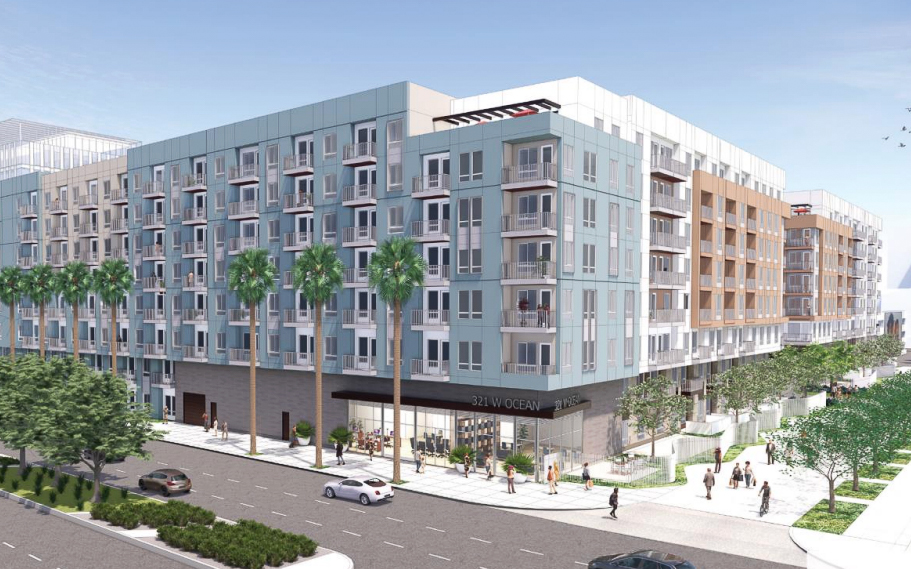
Long Beach is moving forward with a housing development project on the former city hall site, 321 W. Ocean Blvd., which has remained vacant for several years because of various delays, such as increasing construction costs and changing market conditions, among other reasons.
The City Council unanimously approved an updated design for the Mid Block project – which gets its name from being in the middle of Lincoln Park and the Civic Center – during this week’s meeting. The housing development will bring more than 700 housing units to the downtown area.
This approval enters the city into a continued agreement with Plenary Properties Long Beach, LLC, for the design, build, finance, operation and maintenance of the new housing development and transfers the property from the city to MCRT Investments LLC, according to the staff report. The Mid Block site is also the final step in completing the city’s Civic Center Master Plan.
“This is a project long time in the making,” Mayor Rex Richardson said during the meeting. “This is the middle block of our Civic Center, so the hole next to City Hall where the old City Hall used to stand is finally going to be filled with something that we actually need – 700 units of housing in our community. This is a moment that we’re very proud of to finally see this project move forward.”
The Civic Center Master Plan, which the City Council approved in 2015, is a public-private partnership that helped build the new City Hall, port administration building, Billie Jean King Main Library, Lincoln Park, a residential building at 230 W. Third St., and the public safety garage – and now, more housing at 321 W. Ocean Blvd.
Plenary received the rights to develop the Mid Block site, said Scott Kinsey, senior planner and acting zoning administrator for the Community Development Department. The original 2020 design, which the Planning Commission had been approved, consisted of two eight-story residential buildings with 580 units, and 58 of those would be at the moderate income level.
The 2020 version of the project also included a ground-floor commercial area and two subterranean levels of parking. It also included a vehicular east-west extension of First Street between the project buildings that could be closed for special events and a fully vehicular connection of Cedar Avenue between Broadway and Ocean Boulevard, Kinsey said. And the project planned to make heavy use of high-end architectural materials, such as metal panels as the primary exterior covering.
But after several delays because of changing market conditions, increasing construction costs and the high cost of the selected architectural materials, the project became financially unviable, Kinsey said.
So the project had to be modified, removing excess retail space for a weak retail market and lack of prospective tenants, removing the two full levels of subterranean parking that had a high construction cost, changing construction materials and redesigning pedestrian connections to other facilities, according to the staff presentation during the Tuesday, April 21, council meeting.
The modified project, which the Planning Commission approved last month, keeps the same general building design – the two eight-story residential buildings – but the unit count has increased to 729 units, with a mix of studios, and 1-, 2- and 3-bedroom units.
The developer also agreed to convert both the Cedar Avenue alignment and the First Street alignment to be fully pedestrian environments, Kinsey said, which reclaims significant space that would have been lost as roadways. The expensive architectural metal panels were eliminated, and were replaced with primarily plaster and more feasible wood composite accent materials.
The project will maintain moderate-income level affordable units, which increased to 73, according to the staff presentation. But parking was slightly reduced.
“The developer is requesting approval of an alternative compliance option under the inclusionary housing ordinance for 73 affordable units at the moderate income level, instead of the requirement of 12% at the low- and very low-level, because it’s a modification to an existing project and not a new project,” Kinsey said, “and because the city has existing contractual obligations to deliver the project under the 2016 project agreement, the Planning Commission recommended that the city council approve this alternative compliance measure.”
During public comment, Long Beach residents expressed concern about the lack of low- or very low-income housing.
But Long Beach’s regional housing needs allocation process and the housing element process require the city to meet housing at four different levels in the aggregate, said Community Development Director Christopher Koontz, not that every project has to meet all of those on a single project. Those levels are very low-, low- and moderate-income housing, and market rate.
Long Beach has used inclusionary housing to bring very low- and low-income units primarily to the downtown area, but in the last two years, that has expanded citywide, Koontz said. The city also uses other tools to allow more affordable housing, such as using money from the Los Angeles County Affordable Housing Solutions Agency to subsidize projects, he added.
“Those are primarily very low- and some low- income projects, and that’s where the bulk of our affordable housing comes from,” Koontz said. “You put that all together with market-rate projects, and that’s how, in the aggregate, we attempt to meet our housing needs. We’re actually furthest behind on the moderate category.”
The project will be built in two phases, with the southern building fronting Ocean Boulevard going up first and the northern building near the Broadway Garage built after that, according to the staff report.