
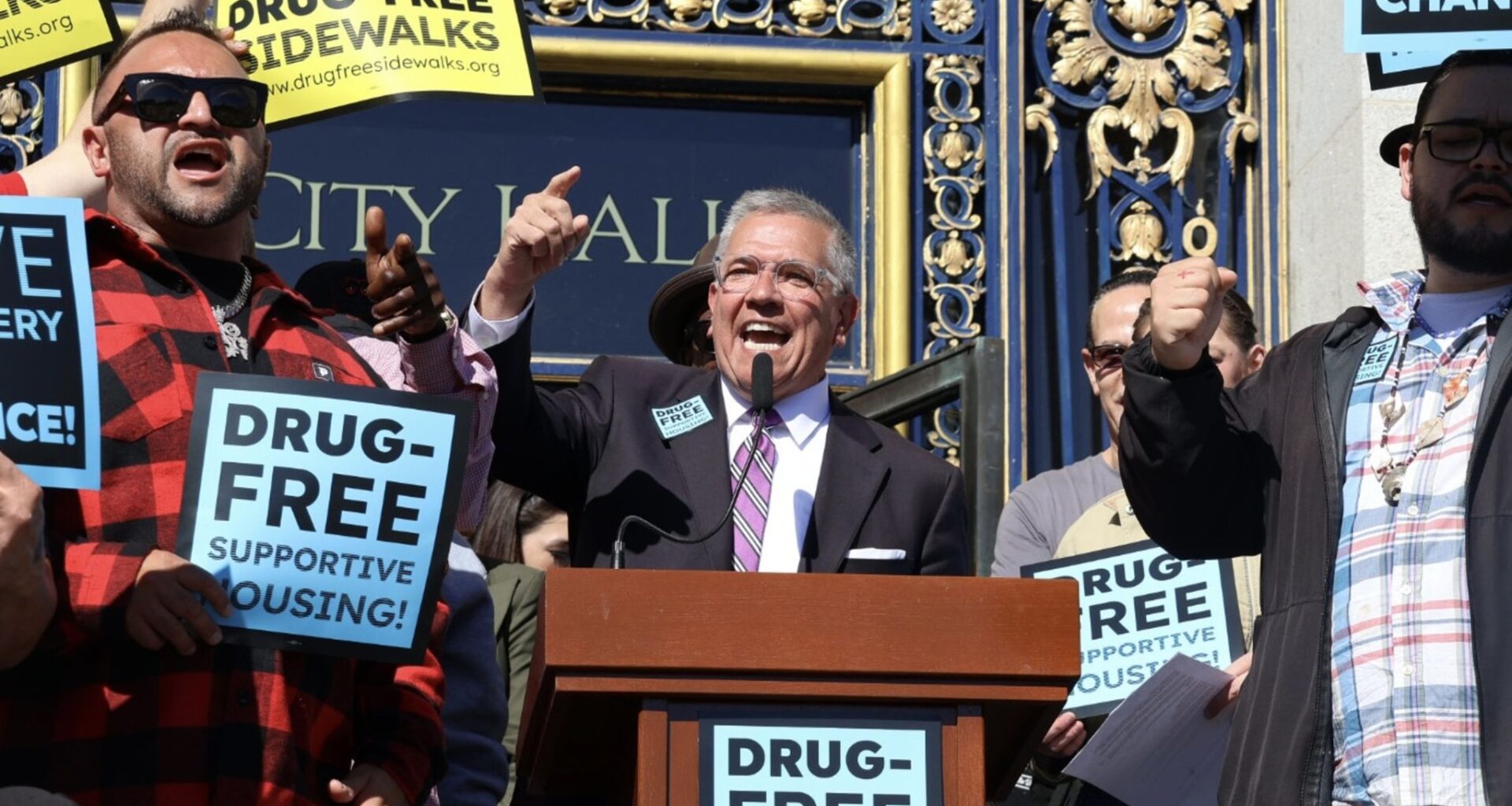
in San Francisco, Calif., on Thursday, April 23, 2026. (Alise Maripuu/Bay City News)
Alise Maripuu/Bay City News
Around 100 members of San Francisco’s addiction recovery community rallied on the steps of City Hall on Thursday to advocate for legislation proposing that new permanent supportive housing facilities be drug-free.

“It is a right to have clean living environments from drugs and alcohol abuse,” said District Attorney Brooke Jenkins in a speech. “I am tired, as we all are, of seeing San Franciscans die each and every day on our streets and in permanent supportive housing.”
Article continues below this ad
Supervisor Matt Dorsey, who is personally in recovery for addiction, introduced the legislation as a policy to provide an alternative housing option for those who want to live in a drug-free environment.
“The current ‘one-size fits all’ model does not meet the needs of all people,” Dorsey said.
The legislation proposes preventing the city from funding new “site-based” permanent supportive housing that prohibits eviction solely due to on-site drug use. Site-based permanent supportive housing is subsidized rental housing where all of the units are for those with a history of homelessness.
On-site illicit drug use would be grounds for eviction, with exceptions for alcohol and marijuana.
Article continues below this ad
“If someone is trying to get sober and stabilize their life, the city should be willing to offer housing that supports that goal,” said Supervisor Alan Wong, a co-sponsor of the legislation.
Most of San Francisco’s permanent supportive housing sites follow the state’s “Housing First” model, which states that drugs or alcohol on the premises cannot be a sole cause for eviction.
Of San Francisco’s roughly 9,000 site-based permanent supportive housing units, only 42 are designated as drug-free, Dorsey said.
Between June 2024 and July 2025, 26% of overdose deaths in the city occurred in permanent supportive housing, according to data from the San Francisco Medical Examiner’s Office.
Article continues below this ad
“Too often, when we are taking people off of the streets still actively using and putting them into these units, we are condemning them to die,” said Board President Rafael Mandelman at the rally.
Steve Adami, an advocate for recovery and reentry who was formerly incarcerated, held up a list of the hundreds of names of people who died from drug overdose in permanent supportive housing facilities in San Francisco over the past five years.
“Our city needs to stop being the largest enabler and funder of active addiction,” he said.
After the rally, the legislation was discussed at the Board of Supervisors’ Public Safety and Neighborhood Services Committee, where supporters and critics spoke out. The three-member committee includes Dorsey as chair as well as Wong and Supervisor Danny Sauter.
Article continues below this ad
Most of the speakers opposing the legislation agreed that drug-free housing is important, but were concerned that the model could exacerbate homelessness if people are evicted for relapsing.
Chirag Bhakta is the director of community engagement at Mission Housing Development Corporation , a nonprofit that develops and manages affordable housing facilities in San Francisco. He and other speakers said that permanent supportive housing should offer better support for those who relapse instead of eviction.
“This policy will likely lead to people being back on the street,” Bhakta said during public comment. “Supportive housing works when it is adequately funded and resourced with deeply supportive services on site, not when it is based on compliance or shaped by punishment.”
Dorsey tried clarifying that a single relapse would not lead to an automatic eviction unless the resident’s behavior “substantially disrupts” the community where the resident lives. Residents who do relapse and are not disruptive would first be offered resources for support, according to the legislation.
Article continues below this ad
He also pushed back against statements that the policy could lead to more homelessness, saying that those who are evicted will still have other options through state-funded permanent supportive housing that is not drug-free.
The three-member committee expressed their support for the legislation and voted to send it to the full Board of Supervisors for consideration. Including Dorsey, the legislation has six sponsors out of 11 supervisors, meaning that it has majority support to get passed.
“We’re going to get this legislation passed,” said Mandelman at the rally.
Article continues below this ad
Copyright © 2026 Bay City News, Inc. All rights reserved. Republication, rebroadcast or redistribution without the express written consent of Bay City News, Inc. is prohibited. Bay City News is a 24/7 news service covering the greater Bay Area.