
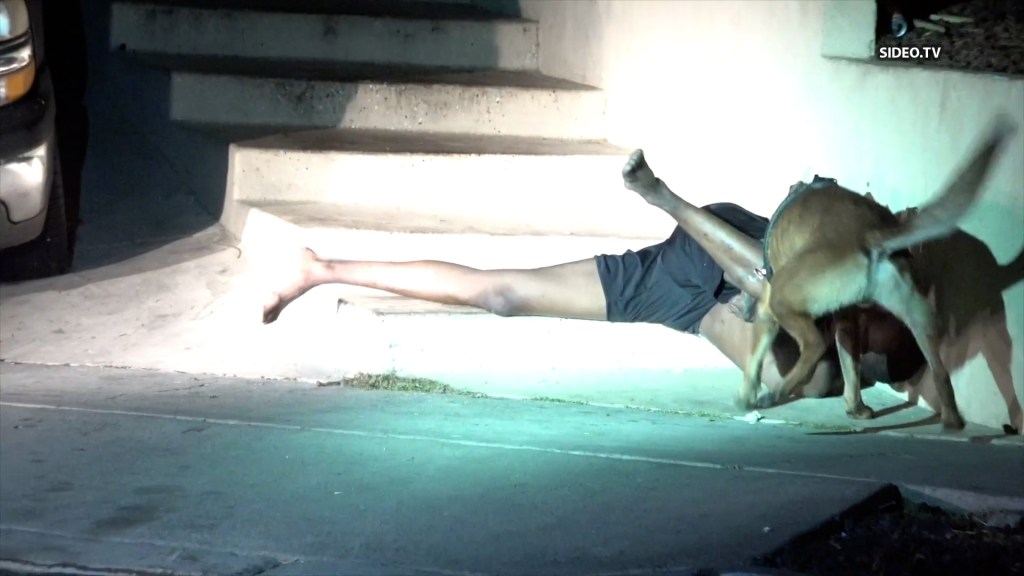
A San Diego legal organization sent a letter Thursday to California Attorney General Rob Bonta requesting that his office investigate and prosecute the San Diego police officers who in 2024 shot an unarmed man with multiple bean bag rounds and twice sicced a police dog on him.
The letter, sent to Bonta by the president of the Earl B. Gilliam Bar Association, claimed that District Attorney Summer Stephan’s office “refused to prosecute the officers” who used force against Marcus Evans. That, in turn, prompted Stephan’s office to release video of the incident and a document Thursday stating that prosecutors from her office had reviewed the police officers’ actions and determined the officers were not criminally liable.
But that document raised serious questions about recent assertions made by the city in a related lawsuit. In that litigation, which has to do with the withholding of records in the case, a deputy city attorney and a San Diego police captain claimed on March 16 that the incident was still under review by the district attorney’s office for potential prosecution of the involved officers. But the district attorney’s office had closed its investigation more than a month earlier, on Feb. 12, and sent the police chief a letter that same day informing him the officers wouldn’t be prosecuted.
The bar association’s investigation request and the district attorney’s response Thursday brought renewed attention to a case that had appeared mostly resolved after the city agreed last year to pay Evans $875,000 to settle a lawsuit he filed alleging that police officers and the city had violated his civil rights.
Evans alleged in his lawsuit that he was seriously injured during the encounter with police on Oct. 24, 2024, outside an Encanto home. The incident was captured on camera by a freelance news videographer and appeared to show Evans acting calm and raising his hands in the air when an officer fired a bean bag round that struck him in the stomach, dropping him to the ground. While on the ground, officers fired additional bean bag rounds at Evans, including one that allegedly broke his leg, and twice sent a police dog at him. The video showed that during the second time, the dog latched onto Evans’ left forearm and violently thrashed as Evans cried out in pain. Officers then moved in and arrested him.
André Bollinger, president of the Earl B. Gilliam Bar Association, said that even though Evans settled his lawsuit, it was important that the officers be held criminally liable for what he and his organization viewed as the “flagrant violation” of his constitutional rights.
“As a community organization whose principal mission is protecting African American interests throughout San Diego, we are deeply disturbed by the facts” of the case, Bollinger wrote to Bonta. “This case presents your office with an opportunity to act with integrity and demonstrate that the State of California will uphold the law without partiality, even when the alleged perpetrators are law enforcement officers.”
Bollinger wrote that the video of the incident and Evans’ injuries showed that an independent investigation by Bonta’s office was necessary.
“Accountability in this matter is essential not only for Mr. Evans and his family, but also for restoring public trust in the rule of law and the institutions sworn to protect our communities,” Bollinger wrote. “When excessive force goes unpunished, it erodes confidence in the justice system and undermines the legitimacy of lawful policing.”
Bonta’s office did not immediately respond Thursday to questions about whether it would open the requested investigation. Under state law, the attorney general’s office is required to investigate fatal police shootings of unarmed individuals, but can also investigate non-lethal use-of-force incidents.
The district attorney’s office released a lengthy statement Thursday saying it completed a thorough review of the facts and evidence and determined the officers who used force against Evans “bear no criminal liability for their actions.” The office said it conducted that review at the request of the Earl B. Gilliam Bar Association, which it accused of only telling a “fragment of a story” without key context about the domestic violence call that led police officers to the home where the incident occurred.
“It is troubling that this association, which is supposed to care about justice, showed no concerns over the abuse of women and decided to tell a partial narrative to its members and the public,” the district attorney’s office said in its statement.
The body-worn camera footage released by Stephan’s office Thursday generally showed what the freelancer’s video showed, with the added context of the 911 call that led police to the home. During that call, a woman claimed that her friend’s boyfriend — she didn’t know Evans’ name — had pointed a gun at multiple people. Evans also allegedly assaulted his then-girlfriend with a metal object, according to investigators.
Police responded to the home and coaxed three people to come out, according to video footage and official accounts of the incident. Evans then exited the home barefoot and shirtless, wearing athletic shorts. He did not surrender to police, but the freelancer’s video and the police body-worn camera footage showed that he appeared calm as he tried to speak with officers from a distance, at times while seated on a retaining wall and at times while standing. For most of the time, his hands were raised.
It was while he was seated on the retaining wall with his hands in the air that he was shot with the first bean bag round.
“The officers were at a tactical disadvantage due to the raised position of the house,” the district attorney’s office said in its statement, adding that “unidentified individuals” were still in the house, and the officers couldn’t predict what actions they might take. “Domestic violence incidents are among the most volatile and dangerous situations to which police respond, and in this case, officers determined that the safest option for all was to have Evans come to them. Ultimately, the officers arrested Evans by implementing non-lethal force.”
The office said it was confident in its review of the case, but that it would welcome the attorney general’s office “to review potential charges against any participants, including the officers or against Marcus Evans, for his felony domestic violence and assault with a gun conduct towards the women that led to the initial police response.”
The district attorney’s office also provided the Feb. 12 letter informing San Diego Police Chief Scott Wahl that his officers had been cleared of criminal liability in the case.
But that letter, and the date it was sent, raised questions about recent court filings by the city attorney’s office in a case filed by the First Amendment Coalition seeking the release of all video footage and other records related to the police use of force against Evans.
On March 16, more than a month after the district attorney’s office concluded its review and notified the police chief, Senior Chief Deputy City Attorney Stacy Plotkin-Wolff filed a motion in the records lawsuit stating the city was seeking to delay releasing the records until the district attorney’s office had concluded its review. Plotkin-Wolff referred to the “ongoing review by the DA’s office.”
That same day, Plotkin-Wolff filed a declaration by San Diego police Capt. Julie Epperson, who declared under penalty of perjury that the district attorney’s office was still reviewing the matter. “The City has not received a written prosecutorial decision regarding (whether) the DA’s office will file (charges) as of the date I signed this declaration,” Epperson wrote in the document that was signed and dated March 16.
A spokesperson for the city attorney’s office said Thursday afternoon his office was working on a response to questions about the court filings, but he did not provide that response by deadline. The Police Department did not immediately respond to questions about Epperson’s declaration.
David Loy, the legal director of the First Amendment Coalition, the organization suing the city to obtain the records in the Evans case, said the discrepancy in the court filings “only confirms the city has no legal basis to withhold the body-worn camera footage and other records” in the case.
“Now that it’s undisputed that no charges will be filed, the city’s weak argument for withholding the records is even weaker,” Loy said.
Dante Pride, who represented Evans in his lawsuit that the city settled last year, did not immediately respond Thursday to a request for comment on Evans’ behalf.
Bollinger and other members of the Earl B. Gilliam Bar Association held a small news conference Thursday outside the downtown Hall of Justice. They said they were horrified by the video showing the use of force against Evans, and after being informed in February that Stephan’s office would not prosecute the officers, they voted at their March meeting to request that Bonta’s office investigate.