
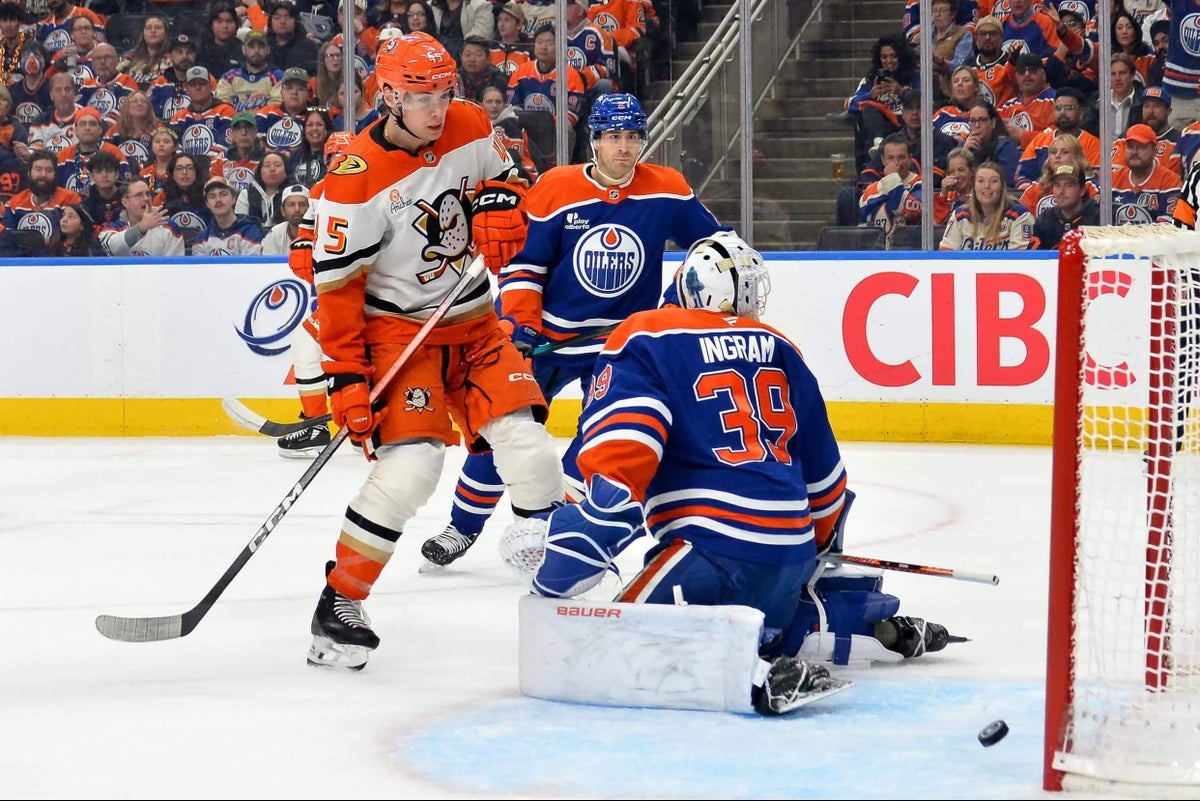
The Edmonton Oilers split two home games to start their first-round playoff series against the Anaheim Ducks. Hockey wisdom says you’re not in trouble during a playoff series until you lose at home. So, the Oilers are theoretically in trouble. However, the solutions are clear. Here are five areas the Oilers must improve, individually and as a team, to win this series.
Special teams
The Oilers’ penalty-killing issues are threefold: some of the preferred PK men are injured, those who remain are not defending well, and goalie Connor Ingram is allowing generous rebounds while not stopping enough pucks.
Coach Kris Knoblauch’s penalty-killers during the regular season included Jason Dickinson (an average of 1 minute, 51 seconds, per game) and Adam Henrique (1:39). Both centres missed Game 2 due to injury. That brought two new players into the mix, and PK units rely on familiarity and communication. So far in the Anaheim series, the Edmonton PK has allowed three goals, while the Ducks (whose PK was not strong in the regular season) have allowed zero goals and scored once short-handed.
Bet on an improved Oilers team while short-handed during games 3 and 4 in California. This has been an ongoing issue for the Oilers going back to the 2024 playoffs, but it is often solved by using top-flight players more frequently in the game state.
Connor McDavid
Last spring’s first-round series against the Los Angeles Kings saw captain Connor McDavid struggle at five-on-five. When playing without Leon Draisaitl, his line posted 1-3 goals in 33 minutes at five-on-five. The captain made up for it on the power play, as Edmonton posted five power-play goals in only 17 minutes. All goals count the same. The Oilers won the series in six and went all the way to the final.
So far this spring, McDavid has zero points through two games against the Ducks. On the power play, the team has zero goals and has surrendered one goal, on a play that featured a misguided back pass by McDavid to start the play. At five-on-five, McDavid’s line is 1-1 goals through two games (both while playing away from Draisaitl).
What does it mean? The biggest takeaway is McDavid going two games without scoring a point. The most prolific offensive player of his generation, a two-game dry spell is rare and is often followed by a series of impressive games. Oilers fans are safe to assume McDavid will impact the scoresheet in the remaining games of this series.
Connor Ingram
Ingram’s five-on-five save percentage (.905) ranks No. 9 among the 15 NHL goaltenders who have played 30-plus minutes in the discipline this playoff spring. That’s a quality total, and is well clear of Anaheim’s starter (Lukas Dostal is at .860, No. 14).
On the penalty kill, Ingram has faced 10 shots, stopped seven and his .700 save percentage ranks last in the NHL. The team has not played well in front of him, but Ingram’s rebound control has been poor.
Fortunately, it’s a small sample and should regress in a good way. His regular-season save percentage on the PK was .864, good for No. 21 among goalies with 90-plus short-handed minutes in the crease. Ingram played well down the stretch, posting a .918 five-on-five save percentage in his final eight appearances. In those same eight games, from late March through the end of the season, Ingram’s save percentage on the penalty kill (.935) was all-world.
The Oilers should be able to count on Ingram based on his performances during the regular season.
Evan Bouchard
During the regular season, Oilers defenceman Evan Bouchard scored 1.88 points per 60 (No. 2 among NHL defencemen over 500 minutes) at five-on-five, while helping his team score 56 percent of the on-ice goals. He did those things while playing significant minutes against elite competition, via Puck IQ. Bouchard was truly dominant on the power play, scoring 6.64 points per 60 in 2025-26.
A player who impacts so much of Edmonton’s regular-season success can be counted on during a long postseason. So far, Bouchard’s goal share at five-on-five (33 percent) and his expected goal share (44 percent) are the worst on the team. However, it’s just 36 minutes of playing time, and the large regular-season sample screams positive regression.
It’s worth pointing out that Edmonton’s five-on-five defence is high quality through two games. Darnell Nurse and Mattias Ekholm are 3-1 goals, Jake Walman is 4-2 goals, Connor Murphy is 3-2 goals, and Ty Emberson is 2-0 goals. Only Bouchard, at 1-2 goals five-on-five, is under 50 percent.
All of the evidence available suggests this is an outlier start. Bouchard will impact the rest of the series and playoff season in a positive way.
Coaching decisions
The Oilers badly need Knoblauch to find the right lines and penalty-killing units in the aftermath of the Dickinson and Henrique injuries. Dickinson could be back in the lineup as early as Game 3, but his mobility seemed off in Game 1 (although he scored twice). During the regular season, via NHL Edge, Dickinson’s max speed (36.15 kph); in his one playoff game, Dickinson was clocked at just 34.37 kph. It could be indicative of the injury issue, and would mean his effectiveness would be less than normal.
Knoblauch may also want to make a switch on the McDavid line. The current lineup has veteran Zach Hyman and rookie Matt Savoie on the wings, and the coaching staff may feel that playing on the No. 1 line might be too much for the rookie. Knoblauch could place veteran Nugent-Hopkins back on left wing with McDavid and Hyman, reuniting one of the team’s most famous trios of this era.
That would allow Savoie to check down to a trio with Josh Samanski at centre and Jack Roslovic on wing. That line had success in a small regular-season sample (4-2 goals in 39 minutes five-on-five) and then teamed up for a big goal in Game 2 from Samanski. It would be a seamless transition, with both lines possibly benefiting from the change.
The Draisaitl line (with wingers Vasily Podkolzin and Kasperi Kapanen) has been the team’s top unit so far this postseason, and should see big minutes the rest of the way.
Knoblauch hasn’t been able to use his physical wingers (Trent Frederic and Colton Dach) as often as hoped, partly due to injury. The club could slide Curtis Lazar into the middle or run with Dickinson if he’s healthy. Frederic-Dach have played just 10 total minutes at five-on-five through two games.
Bottom line
Few Oilers fans expected a sweep by Edmonton, but losing at home in Game 2 was an unsettling experience. This edition of the team is carrying rookies (Savoie, Dach, Samanski) in prominent spots, and some older players who are not completely proven in their current roles (specifically Ingram).
The positive regression will come for McDavid, Bouchard and the special teams. Ingram and the rookies will be tested as long as the Oilers are playing games this spring. Perhaps the biggest questions surround Knoblauch’s decisions. He has guided the team to the final two years in a row, but NHL coaches need to prove themselves in every playoffs. It’s time for Knoblauch and his roster to stand and deliver.