
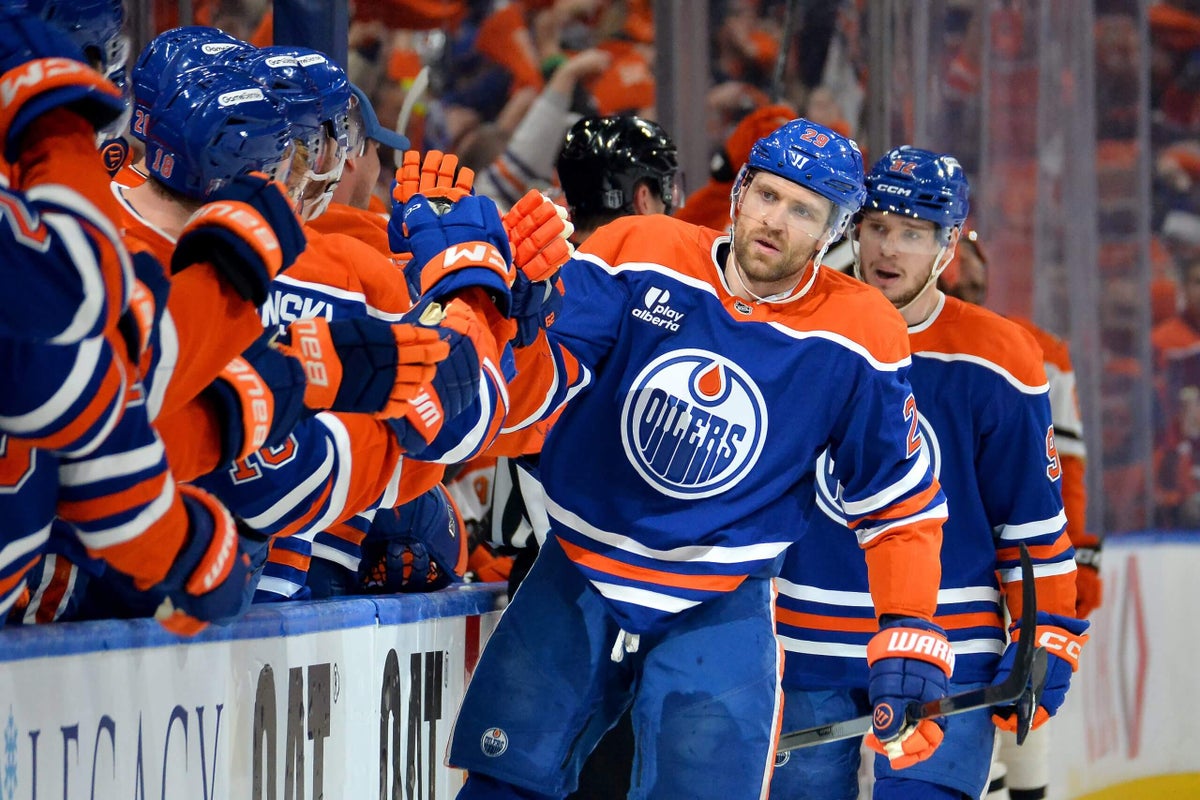
ANAHEIM, Calif. — The Edmonton Oilers put on a power-play horror show in Game 2 on Wednesday night, and their first-round playoff series against the Anaheim Ducks is tied 1-1-because of it. We’re not here to argue otherwise.
It wasn’t that Connor McDavid, Leon Draisaitl and co. failed to score in 7 minutes, 50 seconds with the man advantage (though they did); it’s that McDavid nearly went out of his way to create a third-period short-handed goal by Ryan Poehling, one that put the Ducks up 4-2 on their way to a a 6-4 victory. There’s garden-variety discombobulation, and then there’s whatever led to McDavid throwing a blind backhand pass to nobody, deep in his own zone.
Anaheim, before that sequence and before McDavid briefly left Game 2 with what appeared to be an ankle issue, had done as good a job denying McDavid on his patented cruises through the neutral zone. It’s fair to wonder whether Ducks assistant coach Jay Woodcroft had something to do with that. Woodcroft, of course, was Edmonton’s head coach for two seasons and part of a third.
In any case, it was problematic stuff from a unit that has steam-powered the Oilers’ larger success over the last several seasons. Once again, Edmonton’s power play led the league in expected and actual scoring in the regular season. In two games against the Ducks, they’re 0-for-6 in 11:50 of ice time with the man advantage, and McDavid’s miscue might’ve decided Game 2.
Has it been ugly? Sure. Still — and we’ll say this gently — two games of subpar performance does not an existential threat make.
Some more on that, plus a few other observations heading into Game 3 on Friday night at Honda Center:
• The Oilers, for all their issues entering the zone on the power play, are generating expected goals (11.93) at a nearly identical per-60 rate as they did in the regular season. Shot volume is the issue; they’ve taken nearly seven fewer per 60 against the Ducks (62-55) and attempted about 21 fewer (112-91). That’s not good, but they’ve still managed to mix in some quality looks with all that ineptitude.
“Sometimes you just need the first one to drop,” Zach Hyman said. “We’ve had looks, we’ve had chances, but we can be sharper and much cleaner.”
• After Game 2, McDavid and Hyman both blamed at least of their issues on rust, and there’s probably some truth to all that. Hyman missed five of Edmonton’s last six regular-season games, and Draisaitl returned to the playoffs after about a month on the shelf.
“People forget Leon’s just back,” McDavid said. “As good as the power play is, it’s still a work in progress. We haven’t ran our normal routes and had our normal routes for some time. It’s not just a light switch, so we’re working at it obviously and we’ll be a part of this series. We will be.”
It’s a reasonable assertion. McDavid, Draisaitl, Hyman, Evan Bouchard and Ryan Nugent-Hopkins have played fewer than 10 minutes together across games 1 and 2.
• Apart from the short-handed goal, the Oilers gave a similar performance early in their first-round series against the Los Angeles Kings last spring. In games 1 and 2, the power play came up empty in 9:03 as the Kings took a 2-0 series lead. In Game 3, Edmonton scored two power-play goals in 13 seconds, won 7-4 and finished off Los Angeles in six games. Things can change quickly, especially when players such as McDavid and Draisaitl are involved, and the Ducks know it.
“I don’t think we get too confident with that,” Ducks forward Alex Killorn said. “I think we realize who we’re playing against. We’re happy with the way things are going, but we understand how much potential and how much star power they have.”
• If you’re an Oilers fan searching for a reason to worry, the penalty kill is a wiser bet. Adam Henrique didn’t make the trip to Anaheim, Knoblauch said on Thursday, because of the lower-body injury he sustained in Game 1. The Oilers’ short-handed goal differential in his minutes is significantly better than that of any of their other top penalty-killers, and he’s Knoblauch’s go-to guy on short-handed faceoffs.
Jason Dickinson would seem an option to replace Henrique, though he’s dealing with an injury of his own that caused him to miss Game 2. Rookie Josh Samanski, who spent the regular season earning Knoblauch’s trust on the bottom six, was the PK center on Wednesday, clearly to mixed results.
“Missing Henrique is a big hole for us,” Knoblauch said. “He just stabilizes everything.”
Clearing the net front was a problem for Edmonton’s penalty-killers in Game 2. In the first period, with Evan Bouchard distracted by what appeared to be a missed high-stick call in the corner, Beckett Sennecke slipped behind Mattias Ekholm and stood untouched in Connor Ingram’s eyeline, setting up a goal by Cutter Gauthier. On Anaheim’s second power-play goal, it was Gauthier setting the screen and Jake Walman failing to budge him.
It’s not just that the Ducks are scoring. They’re generating more shots (89 per 60) than any other team in the playoffs, and they’re second in attempts (142 per 60) and third in expected goals (12.1 per 60).
• Draisaitl played some bully ball on Ducks defenseman Jackson LaCombe in Game 1, muscling past him to the inside (with Leo Carlsson) and shielding the puck as he looped behind Anaheim’s net to set up Vasily Podkolzin’s game-winning goal. No shame in that — it’s Drasaitl. Stuff happens. LaCombe bounced back in Game 2, setting up three goals and generally looking like an menace in all three zones. Earlier in his career, LaCombe was an under-the-radar, nerd-approved stats darling. These days, though, his game seems to be popping on a different level — one Edmonton needs to be aware of at all times.