
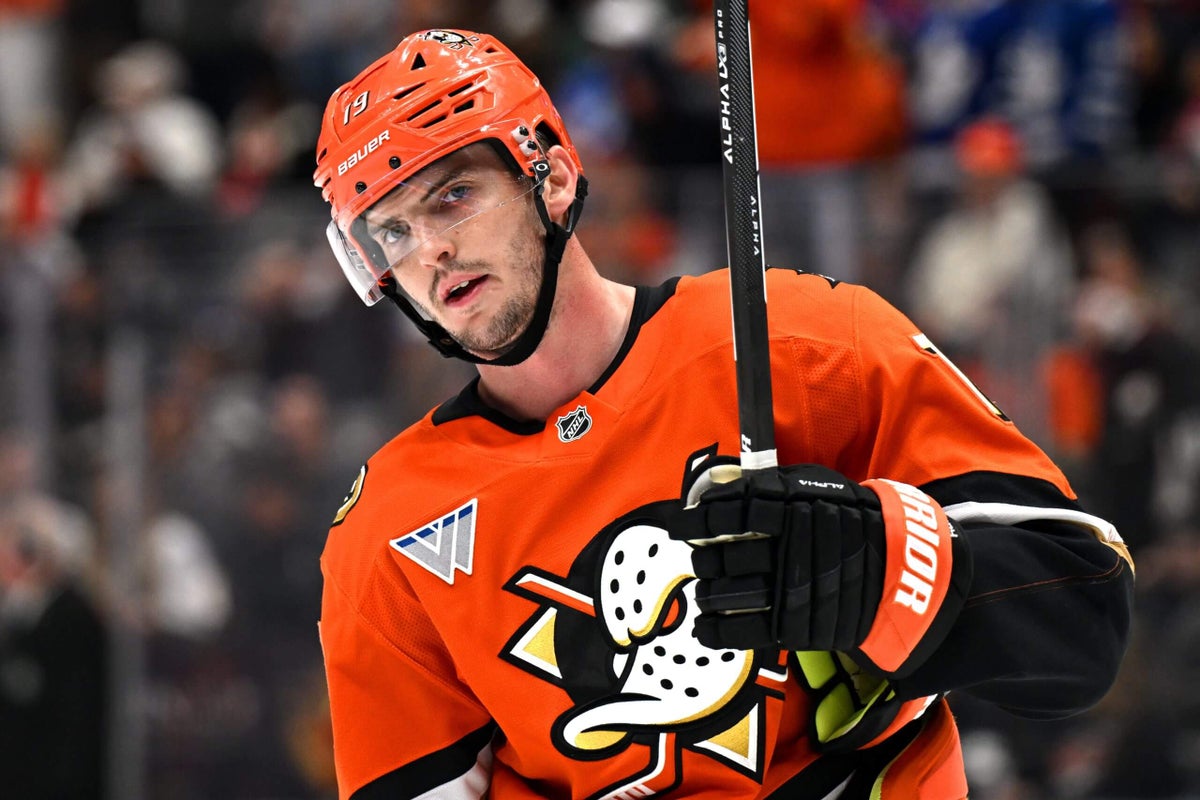
ANAHEIM, Calif. – Troy Terry now has a battle-tested look. There is an old scar under his left eye and a more recent one near his right eye. His front teeth aren’t so aligned anymore. The first sketches of a beard are emerging.
The boyish look from when he joined the Anaheim Ducks in 2018, after an accomplished NCAA career, has been replaced by one that’s a little more worn, a lot more mature. In short, Terry looks like a hockey player going through the playoffs. But this is his first postseason, and after a terrific Game 1 performance and a victorious Game 2 over the Edmonton Oilers, he is back to playing games in which a season could be on the line.
It is something he has been craving.
“Not to talk about my accomplishments, but I did play a lot of meaningful games and I won a lot coming into pro hockey,” Terry said. “And it’s like you try and hang your hat on being a good player in big moments and in those big games. And then you’re kind of deprived of those moments for eight years. You’re still playing in the NHL every year and it’s great, but at the end of the day you want to compete in these types of games.
“I’d say deprived felt like a good word. Just kind of missing out. It’s just been exciting for me, and I hope our fan base feels the same way.”
The Ducks have a momentous Game 3 on Friday night. The Ducks’ Game 2 win on Wednesday was the franchise’s first playoff win since the 2017 Western Conference final against the Nashville Predators. Honda Center now will host its first playoff game since 2018, since a four-game sweep by the San Jose Sharks.
Shortly after, a delayed rebuild turned into a full-fledged one under general manager Pat Verbeek, but now they’ve emerged with a revamped roster. with a blend of exciting young core pieces and experienced veterans. Game 3 is a reward to a fan base that persevered.
“There’s been a lot of enthusiasm in the area there, (in the) OC, and I think at the games all year long,” said coach Joel Quenneville, whose team had a league-high-tying 26 comeback victories. “It’s been a fun place to be. They say the support back there has been outstanding in the two games. And we’re excited about getting back home and getting that excitement behind us.
“It’s been a long time. I think they’ve been passionate. They’ve won. They know what it feels like. They know what playoff hockey is all about. And they’ll get a couple big games coming in here in a couple days.”
That has Terry anticipating what it will be like when he and his teammates leave their locker room and jump onto the ice.
“Even this year, you could feel the atmosphere felt different in the building because we were winning games,” he said. “I mean I felt a different atmosphere in Honda this year and it was fun to play there all year. I know they’re as excited as I am for this opportunity. Yeah, I expect it to be loud. I expect them to give our team a big boost.”
The Ducks grabbed home-ice advantage Wednesday behind two Cutter Gauthier goals. But it was a collective effort, with unsung third-line center Ryan Poehling also scoring twice. Experienced playoff performers such as Alex Killorn, Jacob Trouba, Mikael Granlund and John Carlson contributed on the scoreboard or helped fend off Connor McDavid and the dangerous Oilers.
Part of the balanced dynamic is Terry, whose two goals and one assist triggered a Game 1 rally that almost allowed the Ducks to steal the game. He followed that in Game 2 with an assist on Trouba’s goal.
Terry is doing this while not being nearly 100 percent. No player is fully healthy at this time of the year. But the winger has been dealing with upper-body and lower-body issues that limited him to 61 games this season, his fewest since the NHL resumed with full seasons in the post-COVID-19 era. He’s had to skip out on some morning skates and practices for treatment, including the morning of Game 2. He has seen the posts on social media making a big deal about the first hit he registered all season, in an April game against Vancouver. If only people knew how much pain he was in after that.
Teams are often vague with injuries that don’t keep a player out over a long term. Players mostly stay on script when asked. Terry doesn’t want to divulge what has ailed him this season. “I would say it takes a bit to get it going,” he said. “Like especially just on days we have games. Instead of doing that twice, just making sure everything is to focus on the game.
“It’s been a bit of a process. But I’m doing OK now. It’s mostly just – managing is like the best word, I’d say. I think I’m not the only one going through stuff right now. Honestly, if anything, it’s almost fun for me. Obviously, I don’t want to be dealing with anything, but this is what you battle for, this time of year. It’s nice to know it’s all for a good reason. Yeah, it’s just kind of managing it.”
When in the lineup, Terry has formed a fruitful partnership with star center Leo Carlsson on the Ducks’ top line. He had 19 goals and 38 assists, and his 0.93 points per game were his best over nine seasons. Gauthier, who was put with the pair on Wednesday, said the playmaking ability of Terry and Carlsson make things easy for him as a goal scorer.
Quenneville said Terry gives the Ducks another offensive option to draw the opponent’s attention. “His puck possession game is as good as there is and we appreciate that as well,” the coach said. And the makeup of Anaheim’s lineup has allowed Terry to thrive, since he isn’t the sole focal point for opponents.
Instead, the Ducks have their deepest forward group in years. It wasn’t long ago when Terry, Trevor Zegras and Mason McTavish were at the top of Anaheim’s flow chart. Now the ceiling has risen. Carlsson and Gauthier are set to become highly paid, highly productive offensive forces. Beckett Sennecke was one of the NHL’s top rookies and could mature into their next great weapon. They’re supported by capable vets Granlund and Chris Kreider.
The roster evolution has allowed Terry to slide in as an important secondary scorer who can still have a star turn on a given night, as he did in Game 1.
“It’s nice to see him get a chance to play in the playoffs and right off the bat, he answered that question very well,” Quenneville said. “I think, in a short amount of time, we’re going to need him. And that line was dangerous. Him and Leo did a great job of generating for us. But at the same time, usually it moves around your team each and every night. It could be a different group, a different line or a different guy. But certainly a good start.”
At 28, Terry almost acts as a bridge between the Ducks’ skilled youngsters and the seen-it-all veterans. Quenneville said Terry “kind of fits right in that sweet spot.” Terry is also the longest-tenured Ducks player, a loose connection to the team’s last successful period. He was a “Black Ace” in the 2018 playoff series against the San Jose Sharks after he made his NHL debut in March.
At the time, Terry was accustomed to winning. He starred for college powerhouse Denver, which got to two Frozen Fours during his three seasons and won an NCAA title in his sophomore year. In 2017, he had four goals and seven points for the United States in its victorious run at the World Juniors. His shootout prowess in that tournament drew widespread attention, as he scored three times to beat Russia in the semifinals and had the only score to beat Canada for the gold medal in front of a full house at Montreal’s Bell Centre.
Terry, a fifth-round pick in 2015, saw his NHL career take off with a 37-goal season in 2021-22, but then went through two coaching changes. Only the Sharks and Chicago Blackhawks had more regulation losses over the seven-year period that Anaheim missed the postseason. The nadir came in 2022-23 with an NHL-worst 23-47-12 record and 58 points.
That did land them the No. 2 pick in the following draft, and the Ducks took Carlsson after Chicago selected Connor Bedard. The following January, Verbeek acquired Gauthier from the Philadelphia Flyers. Important pieces were being put in place. Terry knew that but it didn’t alleviate the pain of losing.
“It’s hard to see all the moves, especially when you’re trading for pieces that aren’t coming to your team immediately,” Terry said. “Whether it’s draft picks, whether it’s prospects. There’s definitely times where it’s been hard, and I’m just happy that I’ve been here through it all and I’ve seen the whole thing.
“Even two years ago, I know we got Cutter and you can see what he is now and he’s an elite player, but he wasn’t joining our team right away. … There’s been certain times where it’s been frustrating, but you just have to know that there’s a bigger plan and you’re starting to finally see that. And I’m just happy to be a part of that.”
Once a fresh-faced 19-year-old, Terry now wears battle scars that have been collected through Anaheim’s plunge and rebirth. They’re visible but also exist within, after watching teammates he looked up to leave town, whether by retirement (Ryan Getzlaf) and trades (Hampus Lindholm, Adam Henrique).
He’s now a husband and a father to two young boys. And, in 2022, he made a seven-year commitment to the Ducks, the first long-term extension that Verbeek signed as GM. He’s found personal fulfillment – “It’s the best part of my life, being a dad,” he says – and now the Ducks’ upward path and return to the postseason has quenched the professional side.
“I’m loyal,” Terry said. “I was a late draft pick to a team that has been nothing but great to me. The organization, the fans. Yeah, there’s been times it’s been hard, but I’ve just always wanted to play in the playoffs for the Ducks and experience all that with the Ducks.”