
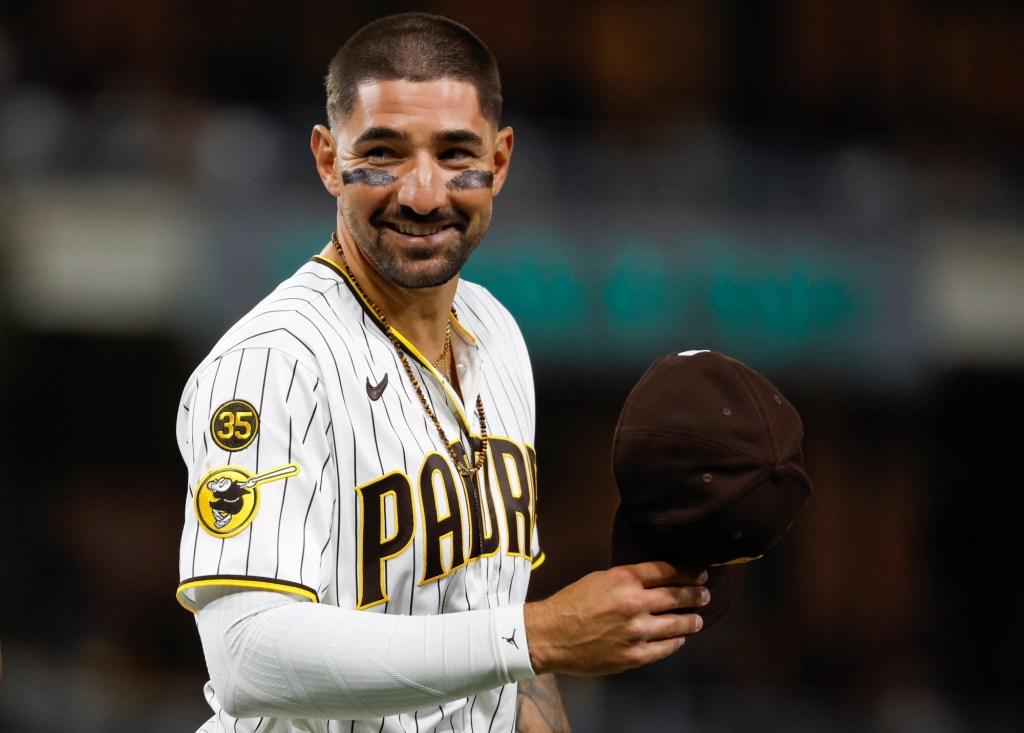
The Padres signed Nick Castellanos in February after the Philadelphia Phillies released him with one year remaining on his five-year contract. Days before the signing, a story in The Athletic made headlines, detailing a dugout incident between Castellanos and manager Rob Thomson, as well as purported periods of clubhouse dissent.
Castellanos, 34, owns a career .271/.320/.463 slash line and has reached the postseason six times, including a World Series run with Philadelphia in 2022. He embraced a move from right field to first base with the Padres and has been reunited with Manny Machado, with whom he grew up playing baseball in Florida.
This interview has been lightly edited for length and clarity.
You live in a rural area outside Miami and your property includes an equestrian ranch that you own, though you don’t ride. Can you tell us more about the ranch and who does ride the horses?
A: My city’s police officers ride the horses. They’re mounted unit horses, so technically they (belong to) the police officers. So I get to look at them, pet them, give them a carrot, but I can’t ride them.
Your mom is an educator and your dad is a doctor. He pushed you with baseball. Some kids might grow up resenting that, but it doesn’t sound like you did. Why do you think you didn’t?
A: I’m not sure. I guess it’s just a personality trait, right? My dad was — and can still be — a lot. But I think I have the personality of, intense people don’t bother me because I feel like I know where they stand, so I know how to respond. For me, it’s easier like that.
You seem like someone who really values bluntness and honesty when it comes to communication. Is that correct? If so, why?
A: Yes. I just feel like it’s simpler when lines are clear. When lines are blurred, people aren’t speaking how they feel but in time, people always act how they feel. So I think that there can be a lot of wasted time in just not speaking matter-of-fact.
You spent seven years with Detroit. What did that organization mean to you and how did it shape you as a player?
A: It was pretty much like my college, you know? The first time ever being by myself away from home was in their dorms and climbing up the ranks through their minor league organization. I owe so much to not just the baseball personnel, but the personnel there in general, because there were a lot of loving teaching moments that were given to that 18-year-old kid.
What kind of rookie were you?
A: I think a happy-go-lucky, very green behind the ears — they’d say — rookie.
Did you do a lot of listening to the veterans?
A: I think my mouth moved too much for me to be able to listen back then. But it never was malicious. It was always coming from a good place.
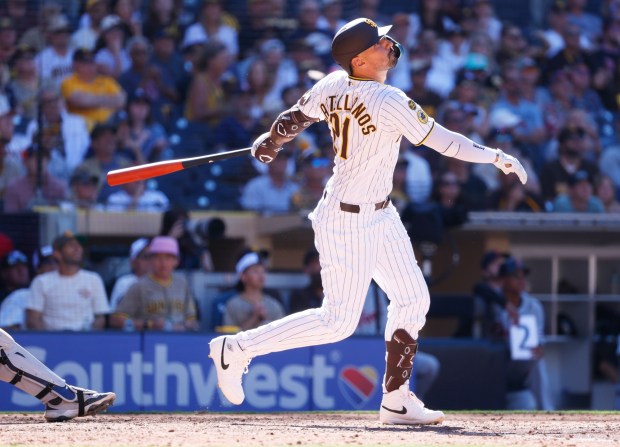 Nick Castellanos of the San Diego Padres pops out against the Detroit Tigers on opening day at Petco Park on March 26, 2026 in San Diego, CA. (K.C. Alfred / The San Diego Union-Tribune)
Fourteen seasons now in the big leagues, which is impressive. What has allowed you to play this long?
A: Well, first, unless you’re extremely talented, you need to have some sort of work ethic. And this game is played every day, so you need to kind of be stubborn to work, I guess. Preparation. That’s something that I feel like I kind of figured out at the age of 24, the first time that I had a real injury, when I broke my hand. That was my first wake-up call of, ‘Hey, your body is not going to last forever.’ So as an athlete, you need to take care of it. And then I think adaptability (is important). The game is always changing and you have to be able to change with it. Very few guys — I mean ideally, you’d always want to be like Derek Jeter, where you get to come up and play shortstop for one team and organization and you’re just doing the same thing at a high level for two decades. Not everybody’s career is like that. So you have to be able to adjust, adapt, change.
Do you remember when you first encountered real adversity, when things just weren’t going your way?
A: I’d probably say my first month in the minor leagues. Being away from home. I think I was probably, like, the worst hitter in the Midwest League. First time facing that level of competition. There definitely is that (moment) of the first time you meet that monster of, ‘Can I do this?’ You have to meet doubt at the front door.
What do you do to mentally recenter yourself? Meditation, breathwork, binge-watching TV?
A: I definitely don’t binge-watch TV. I find that whenever I binge-watch TV, I’m running from something. But yeah, I do a little bit of everything. I make sure to be able to have some stillness throughout the day and prioritize myself. I try to have a clear vision of what I want to accomplish that day. I have times where I’m doing that really well, and I have times where I’m not doing it so well. Consistency is key.
Your work ethic is impressive. You can often be seen getting extra practice. Where does that come from?
A: I would say probably my parents. Both of my parents are intense individuals. And I don’t have a lot of interests, but if I do something, I submerge myself in it. I’m not a “one foot in, one foot out” kind of guy. If I do something, I’m going to do it to the best that I know how.
After you left Detroit, you made stops with the Cubs and the Reds before landing a five-year deal with Philadelphia. Now that you’ve had a little distance from your time in Philly, how do you look back on it and how it ended?
A: I mean, other than us not winning a World Series, there was a lot of winning. We went to the playoffs four years in a row. You know, were there ups, were there downs? I think, also, I learned about myself that I have the ability to hold on to a grudge. Like, to not forget things if I feel that things were done wrong. So just kind of encountering (those things) for the first time in my professional career. I think Philadelphia also was the first time where there were times where it really felt like a job — baseball, you know? And that was a new space, because now, OK, you might not have the same childhood enthusiasm to get up and play, but you still have a responsibility to the person that’s signing your checks to show up, work and take pride in your job. That was something I had to learn how to do because up until that point, I’ve never had a job before.
So it didn’t feel like a job to you with the other teams you played for?
A: No. It was a passion project.
Was it because of the big contract, or because of the city? Why did it feel more like a job?
A: I think it was just a combination of a lot of different circumstances. I didn’t feel like I had control. With my previous representation, I didn’t have a lot of control even on the choice of going there. It was kind of just like, ‘This is your option, you need to do this,’ and it was a rushed decision. But I did the best I could to make the most of it. I also really don’t have much regrets about the way that I went about things, because I did my job as best I could. I definitely didn’t handle everything perfectly, but I know that always my emotions were in the right place about winning. And I think sometimes a healthy environment is not always singing Kumbaya. I think that it’s having passionate people running the same direction and still being able to talk after feelings are shared.
Did you read The Athletic article that came out about you over the offseason?
A: Matt Gelb’s? Yeah.
Was there a lot of noise around you about it, like people texting you and calling you?
A: I had friends of mine on the (Phillies) reach out to me and let me know that (Gelb) had been sitting on this for a long time, and he was just waiting for me to get traded or released to release it. So that was what prompted me to put my (explanation) letter (on Instagram). But that just kind of shows, for me, the character of the media that’s over there. Because that (incident) happened seven months (before the article was published). And the only reason why I didn’t tell the media the next day was because I was instructed by the organization not to. I wanted to. I remember sitting in Rob (Thomson’s) office saying that I take pride in being authentic. I don’t want to lie. I don’t want to hide. And it was from their instruction that they wanted it to be, ‘We’re just gonna say this and then we’ll go from there.’ And I think that we played well after that. We won the next day and it was fine. But the media, just with other incidents I had … They all have jobs to do. But the information that I got was, they thrive off of controversy and they’d rather be controversial than truthful. One of the things that was hard for me was to just pretend like I didn’t absorb that.
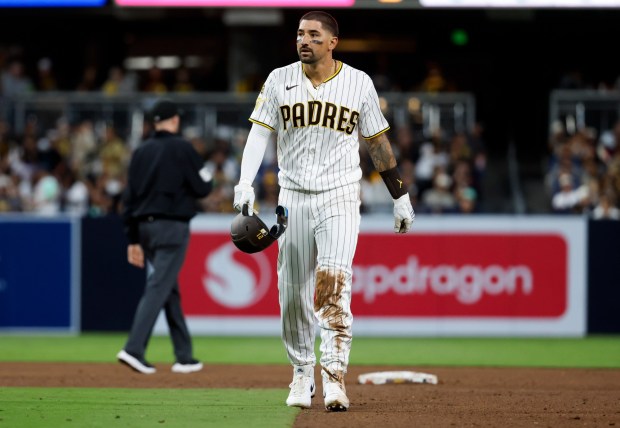 Nick Castellanos of the San Diego Padres walks back to the dugout during the fifth inning against the Colorado Rockies at Petco Park on Saturday, April 11, 2026 in San Diego, California. (Meg McLaughlin / The San Diego Union-Tribune)
That story blew up the baseball world for a little while, with questions raised about your reputation as a teammate and clubhouse presence. Was it difficult to go through that?
A: I’m lucky that I have a ridiculous support system. I think it’s also more media-driven than it is actual people and teammates-driven. Because I had 90% of that clubhouse and staff all reach out to me, saying that I’m going to be missed and ‘Best of luck.’ Like, no hard feelings. My wife still talks to the majority of all those players’ wives, too. And retired players that have been there still come out and say that they love that I did what I did. So I think that the media might have made it seem like it was some big deal and I was some huge villain, but honestly, it never felt like that through my communication with the other players. … I definitely would consider those guys in my old clubhouse (as) my friends. If some people over there ever had issues with me and the way I went about things, they definitely never told me.
Do you think your time in Philly just wasn’t a good fit?
A: I was fully prepared to go back there (for the fifth year of the contract). I never made any demands. … There were articles coming out, saying — again, from media — that I will be traded or I will be released. So I remember, I have a relationship with (president of baseball operations) Dave Dombrowski that goes back to my teenage years. I said, ‘Hey, I’m seeing these articles. Just know, no hard feelings if this is something you need to do.’ Like, I can use a fresh start. It’s not something that he’s gonna feel like he cut my legs out from under me. But that being said, if he said, ‘No, we see you as a platoon guy. We need you in there.’ Then I would have (said), ‘All right.’ At the end of the day, I’m the one that signed that contract, so as a professional, I’m going to honor that contract. But apparently. there were probably conversations in the organization that they thought that it would be best for that organization if my personality — because even though I don’t think I ever produced as much as I would like to, I never thought that I was a complete black hole of production — but they probably thought that my personality was not a productive one for the organization. And they have the right to think that. It’s not my organization. It’s Mr. (John) Middleton’s organization, and Dave has been given the keys to run it as he sees fit.
Would you say your chapter in Philly changed you in any way?
A: I think that it probably made me grow up a little bit more. It probably hardened me a little bit on the outside. But I think definitely so many productive lessons … I think that those four years, there’s a tremendous amount of lessons and wisdom and things that can come through that. I definitely do not think that all my time in Philly was negative, and there’s so many things that I’m grateful for and appreciate.
What have you thought of this fresh start in San Diego so far?
A: I mean, great. I think that we have a great group. We have an entire staff that is excited about their jobs. I think Craig (Stammen) is very excited about his opportunity to be a manager for San Diego. We’ve also done a great job staying focused as a unit, with all the uncertainty and selling the franchise and all the unknowns that are kind of swirling around us. I think we’ve done a pretty good job of staying unified and learning ourselves as a unit and how we fit together and how we are going to score more runs than the other team every night.
You have three sons but we see Liam, 12, around the most. He plays baseball. What are you like as a baseball dad?
A: My biggest thing is: If he wants to do it, I’ll give him all I got. But I also know that as glorious as it may seem on the outside, there’s a lot of rough stuff that goes on in the inside. It’s definitely not easy. So that being said, as long as he loves it and he wants to do it and he wants to pursue it, yeah — how can I not give back everything I know?
What does your life look like when you’re not at the field?
A: It depends on when. … The offseason, I’m a pretty standard dad. My life revolves around keeping the household in order and my kids’ activities. Off days in baseball, if I don’t have the family, I do enjoy museums and galleries and live music. And also movies.
I’ve seen you dance a little during batting practice. You’ve got some skills. Have you taken lessons formally, or is this natural rhythm?
A: I would say the latter. I’ve taken a little bit of — just from family members and stuff when I was younger — like, salsa dancing lessons. When I was in elementary school, I was Prince Charming in a play, so I had to learn how to waltz and things like that.
A few years ago, you ditched your smartphone for a flip phone. What takeaways did you have from doing that for a year?
A: It definitely makes your world small not to have it. I don’t have a flip phone right now, but I have a Galaxy Wisephone. It allows phone calls, messages, Spotify, maps. But that’s it. I’ve realized I have an extremely curious mind, and I think the worst thing that a curious mind can have is endless information.
The recurring “Nick Castellanos, deep to right field” moments — where your home runs seem to coincide with somber or unusual events — have become a viral phenomenon. Do you find that amusing or annoying?
A: I think me and my friends have all had some really good laughs at it. Also a little bit sad, you know, that it started because (Reds announcer) Thom Brennaman lost his job because of it (for using a derogatory term toward homosexuals in a hot-mic moment). Which, nobody’s perfect. If I had a microphone in front of my mouth all hours of the day, I would be canceled. But also, to know the work that he’s done for the homosexual community after the fact, like, if you want to look into that and give him some love, is very remarkable. But so we’ve had some laughs. Obviously feel bad for Thom, for him having to go through that. Happy that he was able to come out more well-rounded and successful at the other end. But then also, too, the internet does what the internet does, and they run with it. So there’s a lot of home runs that I’ve hit and then they splice them together where I didn’t actually hit a home run that day. Like, I didn’t hit a home run the day the Queen of England died and whatever. So they’ll take it and they’ll try to make it into a bigger thing, because that’s what the internet and media can do. I’d say the only thing that I would be annoyed by is more, like, it would get to a point where even if my wife would post something about the kids, you have the internet … saying, ‘Well, there’s a deep drive to left field.’ Which I’m sure there will be comments underneath this saying. But it is what it is.
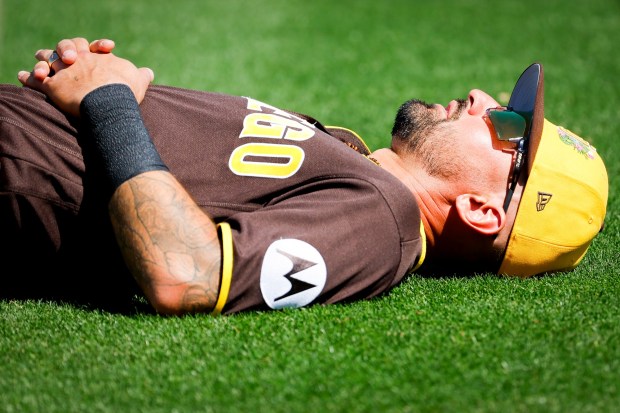 Nick Castellanos #21 of the San Diego Padres stretches before their spring training game against the Seattle Mariners at the Peoria Sports Complex on Thursday, March 5, 2026 in Peoria, Ariz.(Meg McLaughlin / The San Diego Union-Tribune)
You’re very aware of who you are and you are unapologetically you. Have you always been this way?
A: I think that there was a part of me that was always like this, but maybe not mature enough to lean into it. And I think as I get older, I just become more comfortable with leaning into things that might be not common or unorthodox. I think that’s just always the journey one has with being comfortable with who they are.