
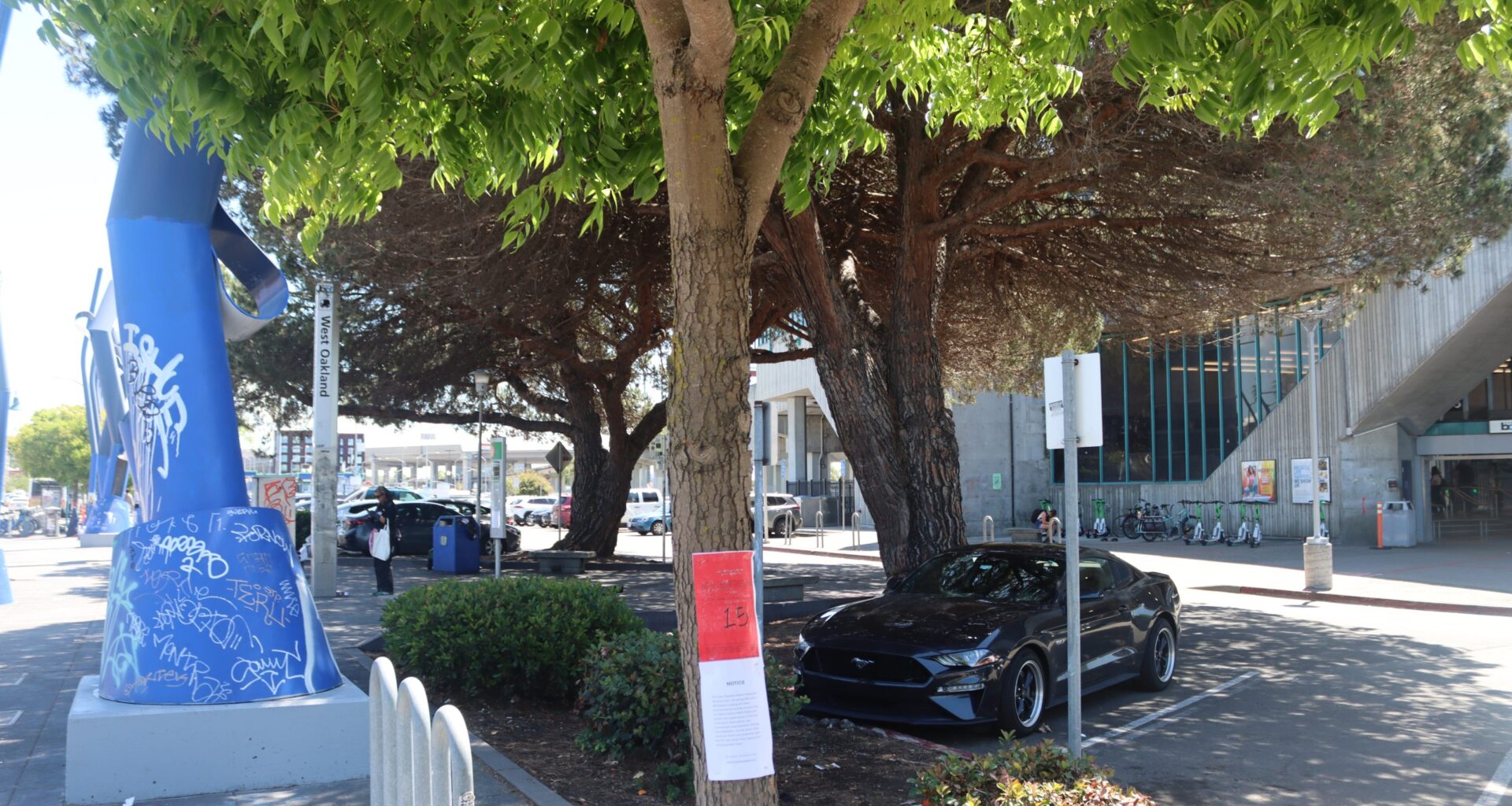
Last Saturday afternoon, people who live near the West Oakland BART station began seeing a sea of red tags on the tulip trees, pines, and other trees that line 5th and 7th streets near Mandela Parkway.
On April 20, West Oakland artist Loove Moore posted a video on Instagram showing a large number of the red-tagged trees — a sign that they had been flagged for removal.
“They are about to cut these trees down,” Moore said in the video. “We can’t go for that. It’s not happening.” He said he walked along 7th Street and said he counted 72 trees set for removal. “Do what you gotta do, internet,” he said.
The trees in question border a 5.8-acre BART-owned lot that was approved by the city for an extensive housing development in 2020. The project will replace 400 parking spaces with more than 760 units of housing, a third of which, 240, will be affordable. The plan also includes 350,000 square feet of office and retail space.
Neighbors The Oaklandside spoke to said they felt blindsided by the developer of the Mandela Station Project and its proposal to remove dozens of trees near the West Oakland BART station in the coming weeks. While residents such as Moore counted 72 red tags, documents the developer has filed with the city list 63 trees targeted for removal.
The developer, Mandela Station Partners, LLC, said that they’d done extensive community outreach about their plans, dating back to 2014. Yet some neighbors told The Oaklandside they never received any notices about the project and found out about the planned tree removals only when they saw the red tags.
Now Jean Walsh, the city’s public information officer, has told The Oaklandside the city has put review of the developer’s tree permit application on hold in the wake of public outcry. The developer plans to submit a revised application and hold a community meeting, though no date has been finalized yet.
Walsh said in an email to The Oaklandside that the final number of trees removed may “fluctuate a bit” from what was in the original proposal.
 The trees border a 5.8-acre BART-owned lot that was approved by the city for an extensive housing development in 2020. Credit: Azucena Rasilla/The Oaklandside
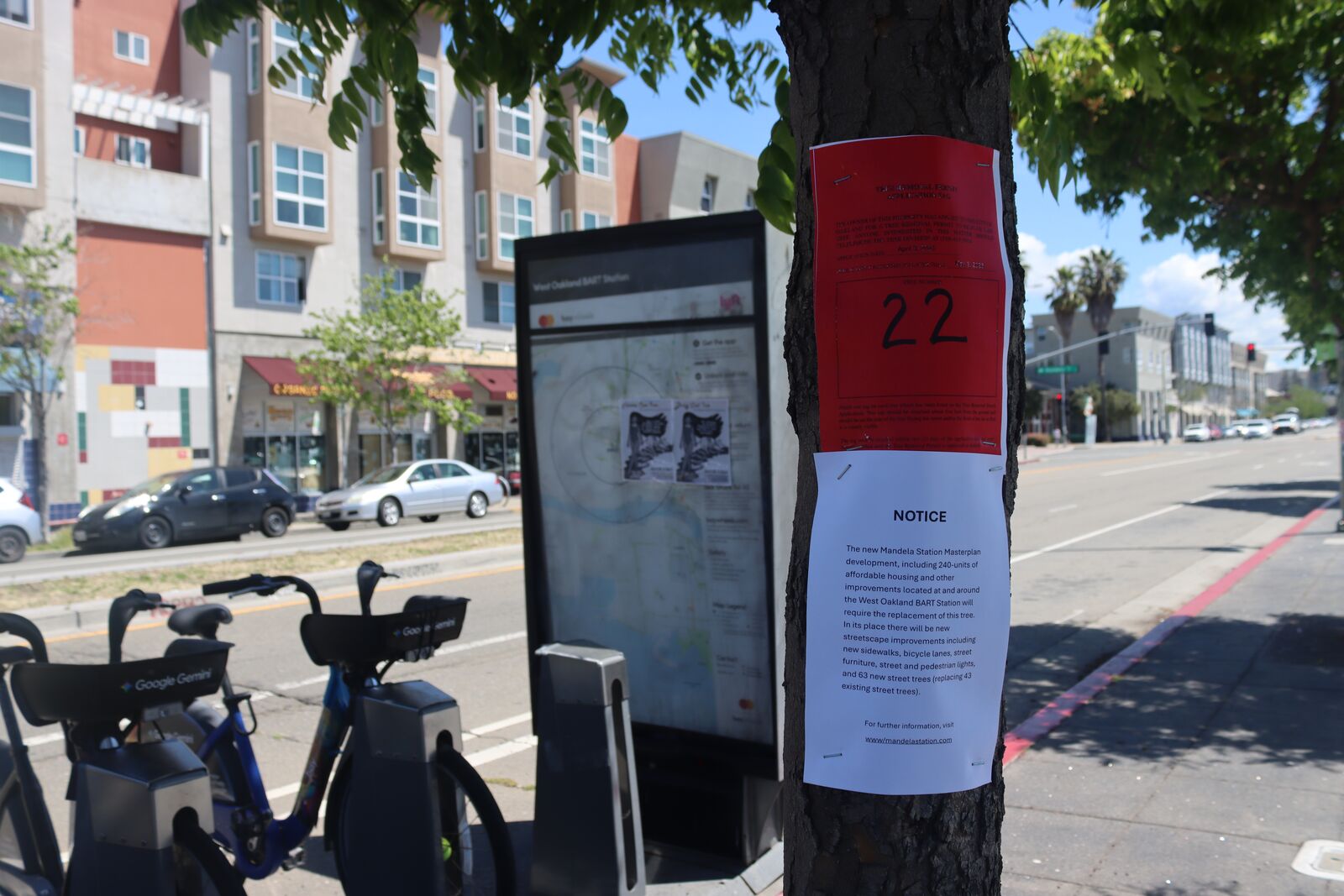 The tags include a city number to call in case of questions or concerns. Credit: Azucena Rasilla/The Oaklandside
The red tags are dated April 8, but several residents told The Oaklandside that the notices weren’t put up until last Saturday, April 18.
“I had heard of the project, but nothing about the trees, or any concrete information about it,” Moore said. “It seems like it’s going to be its own little city within West Oakland.”
Moore’s video quickly went viral, shared over 5,000 times and garnering close to 2,000 comments.
“I live here, and I have a platform and a voice, so I am going to use it,” Moore told The Oaklandside.
“72 TREES!!!!! Nooooo!!!,” read one comment by @westoaklandmuralproject, an account run by Jilchristina Vest, the owner of The Mural House, a home that serves as a museum honoring the women of the Black Panther Party that features a massive mural.
“About half of the trees are outside of the building footprint, and many of the trees are across the street nowhere near the development,” commented another neighbor, the safe streets activist Bryan Culbertson. “Can you develop a revised plan that saves the mature trees that don’t need to be killed?” he posted, tagging BART.
BART’s social media team responded to the post by saying, “As noted in the approved development plan: ‘Landscape plan is designed to enhance the pedestrian public spaces, and to create a high quality of pedestrian experience and civic prominence. The existing trees will be replaced because of conflicts with the access plan. The new tree planting complements the overall landscape strategy of the 7th and 5th Street corridors to ensure a continuous, interesting and varied visual experience.’”
“All these people see the deeper meaning,” Moore said. “It’s not about the trees, it’s about trying to resist gentrification.”
Sick and healthy trees could be removed
According to a March 8 application for development review submitted by Mandela Station Partners and BART, the trees slated for removal are covered by Oakland’s Protected Tree Ordinance.
The ordinance states that permits are required to remove all trees of a certain size, with the exception of Monterey Pines and eucalyptus, which is an invasive species, citing the ways in which trees provide health benefits and also serve as wildlife habitat.
The disruption of nesting season is one of Vest’s worries. According to the California Department of Fish and Wildlife, bird nesting season runs from Feb. 1 to Aug. 15, a time when tree removal risks disrupting tree-nesting birds and BART has said that construction is set to begin this summer.
Among the specimens listed on the removal plan are 20 Chinese pistache (Pistacia chinensis), known for their vibrant fall colors and high heat and drought tolerance, and 24 tulip trees (Liriodendron tulipifera). According to the permit application, the Chinese pistache trees are “stunned and exhibit little growth over 5 years since installation, likely due to insufficient soil volumes.” The tulip trees, it says, are “severely stressed, many dead or dying, and signs of pest or disease problems. Two large Italian stone pines that grace the pedestrian access to BART are also listed. Although not sick or diseased, the application says these two trees “conflict with development goals.”
The September 2020 project renderings include a new sewer main and undergrounding of the overhead power lines, which is why some trees outside of the building lot are slated for removal. It also includes 1.7 acres of green space. A landscape plan by the developer dated April 20, 2026, features trees such as Jelecote pines (Pinus patula), silver leak oaks (Quercus hypoleucoides), netleaf oaks (Quercus rugosa), as well as various shrubs and perennials including the Blue Flame agave, Spanish lavender (Lavandula stoechas), and creeping myoporum (Myoporum parvifolium).
 Two large Italian stone pines that grace the pedestrian access to BART are also listed although they have not been tagged. Credit: Azucena Rasilla/The Oaklandside
“There needs to be an environmental injunction,” Vest said. “You’re talking about taking down 72 natural habitats. In one of the Chinese pistache trees, I saw at least two nests. Is there somebody from the Audubon Society that is on this project that is okaying the removal of these trees and making sure that you’re not removing any trees that have an active nest or eggs in them? I need an answer to that, because you’re destroying an ecosystem of bugs, squirrels, birds, butterflies, and moths.”
The Oaklandside spoke with Alan Dones, managing partner and chief executive officer of the Mandela Station Partners, about the concerns we heard from local residents about the tree removal plan.
He said by email that the company’s landscape consultant has an arborist on staff. That team, he said, assessed the condition of the trees in advance of the permit application submitted to the city.
“While the municipal code does not require a standalone arborist report, we understand the concerns that have been raised by the community,” Dones added. “In response, our team is voluntarily taking an additional step to engage an independent, qualified arborist to conduct a more detailed assessment of the trees and provide a formal report.”
Vest, the West Oakland resident, said she wasn’t aware of the project until February and didn’t recall receiving any notification about the community engagement meetings.
“I’ve lived here for 26 years. … I know everybody in the community in my four block radius,” she said. “This is what is so egregious about what’s happening, because San Francisco Bay Area Rapid Transit already devastated West Oakland in the ‘60s, and now they’re doing it again.”
From the 1930s to the 1950s, West Oakland was a Black cultural hub. 7th Street was called the “Harlem of the West” for its booming jazz and blues music scene. That all came crashing down with the construction of the Cypress Freeway between 1955 and 1957 — which collapsed following the Loma Prieta earthquake in 1989 — and the bulldozing of homes and businesses to give way for a Post Office processing and distribution center and the West Oakland BART station.
According to Dones, the group has been doing outreach to various community groups since 2014. Dones was born in Oakland and still has family ties in West Oakland.
“Community engagement is difficult and complex,” he said. “We try to be as thorough and outreach as much as we can, but it’s not a perfect process.”
 The tree removal plan, part of the developer’s 2020 renderings, pinpoints the locations of all the trees on the developer’s list that was submitted to the city. Credit: Credit: Mandela Station Partners, LLC/Suda LLC
Dones said he feels strongly that he and the team have done the best they can to host a variety of meetings to present the plans for the complex, from in-person sessions to virtual community events.
“But that doesn’t mean we hit everybody,” he said. “And I can understand when somebody comes, they see red tags, which, by the way, red tags are important because that is, in and of itself, a notification to the community of what’s happening. We’re going to continue to be completely open to change, to adjusting and adopting to whatever we have to do.”
Culbertson was one neighbor the developers reached. He said he first learned about the project in 2016 and recalled receiving postcards in the mail. He said he attended five meetings throughout the years, with the last one being in the fall of 2024.
But Culbertson said that none of the meetings he attended addressed the tree removal plan. At the last one, he said, the developers mentioned trying to get approval to use BART’s PG&E access to build an AI data center at the site — an idea neighbors who attended that meeting were not on board with.
Dones said that the team’s work in this area is “broader than what would typically be described as either an ‘AI center’ or a traditional data center.” The focus, he said, is on “leveraging existing fiber infrastructure to help connect the community to emerging economic and technology opportunities, including efforts to help bridge the digital divide.”
He and the team want to use the fiber optic infrastructure that runs through the BART station and along BART’s 131-mile right-of-way.
“Our focus is not on a single concept, but on how to leverage that infrastructure in a way that benefits the community,” he said.
Culbertson said he learned of the tree removal plan the same day Moore’s video went viral.
 A West Oakland resident put together his own audit of the rendering and walked around to photograph all the tags. Credit: courtesy of Bryan Culbertson
“I’m glad that the city does require that the trees be red tagged,” he said. “Otherwise, the neighbors would have had no idea. We would have just woken up two weeks from now with all of the trees gone.” Still, he said, none of the notices he saw linked to a map to show the total number of trees that would be removed.
Culbertson and Vest each said they emailed various city employees in charge of the project, as well as their councilmember Carroll Fife and the developers. He said that the only response he received was from Fife.
Fife addressed her constituents in a video posted to Instagram on Wednesday. She confirmed that although this is a BART property, all of the permits were submitted by the developer. She said the decision regarding tree removal will be made by the city’s planning department. She also said that if the planned removal is approved, 62 trees will be replanted as part of the project.
A cherished tree outside a grocery store
The rendering from September 2020 shows 63 trees slated for removal; a red notice Culbertson photographed on Chester Street says 59 trees will be removed; and photos he took of white paper notices put up on Saturday along with the red tags say 43 trees are up for removal.
Culbertson went through the project renderings and created a clearer version of the tree removal plan, adding icons indicating which trees have been red tagged, which ones have not, and which are already stumps. Like Moore, he counted 72 red tags in total.
In an email to The Oaklandside, Walsh, the city spokesperson, said, “Any trees approved for removal and replacement will not be removed at one time but rather as development phases come online and construction-related permits are issued. The City will require the developer to replace the removed trees with ones that meet City of Oakland requirements.”
Culbertson insists that not all of the trees listed on the current proposed plan need to be removed.
“It would be unreasonable to expect the project to go forward and for the developer to maintain all the trees. No one is expecting that,” Culbertson said. “What is reasonable is, has there been an audit of which mature, healthy trees can remain without impacting the building footprints? Has that audit happened? I don’t know.”
The Oaklandside spoke with Archer, a worker at the Mandela Grocery worker-owned cooperative on 7th Street and provided only their first name. One of the Chinese pistache trees on the list is right outside the co-op’s door.
Archer said that members of the co-op have gotten quite fond of the tree and water it every night with ice that is used at the store during the day and is melted by day’s end.
Archer said they did not receive any notices about the project at home or at the co-op.
“Why are you starting here with this tree that has a little little library and a little art gallery right up front of the grocery store that’s trying to interrupt food apartheid in this neighborhood?” Archer said.
Walsh told The Oaklandside that in response to numerous complaints since Saturday, the permit application review and public comment period have been put on hold.
“Once the developer submits a revised Tree Permit application, holds the community meeting, and re-posts notices on the trees, as appropriate, the public comment period will recommence for a period of 20 business days,” Walsh wrote to us by email. “During the public comment period, anyone can submit comments to the Tree Division either in favor or against the removal of any of the proposed trees. The Tree Division will take these comments into consideration when making a decision regarding the approval or denial of a permit.”
That decision, she said, would then be subject to a five-day appeal period.
“Any trees approved for removal and replacement will not be removed at one time but rather as development phases come online and construction-related permits are issued,” she wrote. “The City will require the developer to replace the removed trees with ones that meet City of Oakland requirements.”
Culbertson said that even if not all of his neighbors agree with the outcome, they are in it together to make sure the developer does right by the community.
“I’m in this advocacy because I want to save the mature trees while also making sure the affordable housing project moves forward,” he said.
“*” indicates required fields