
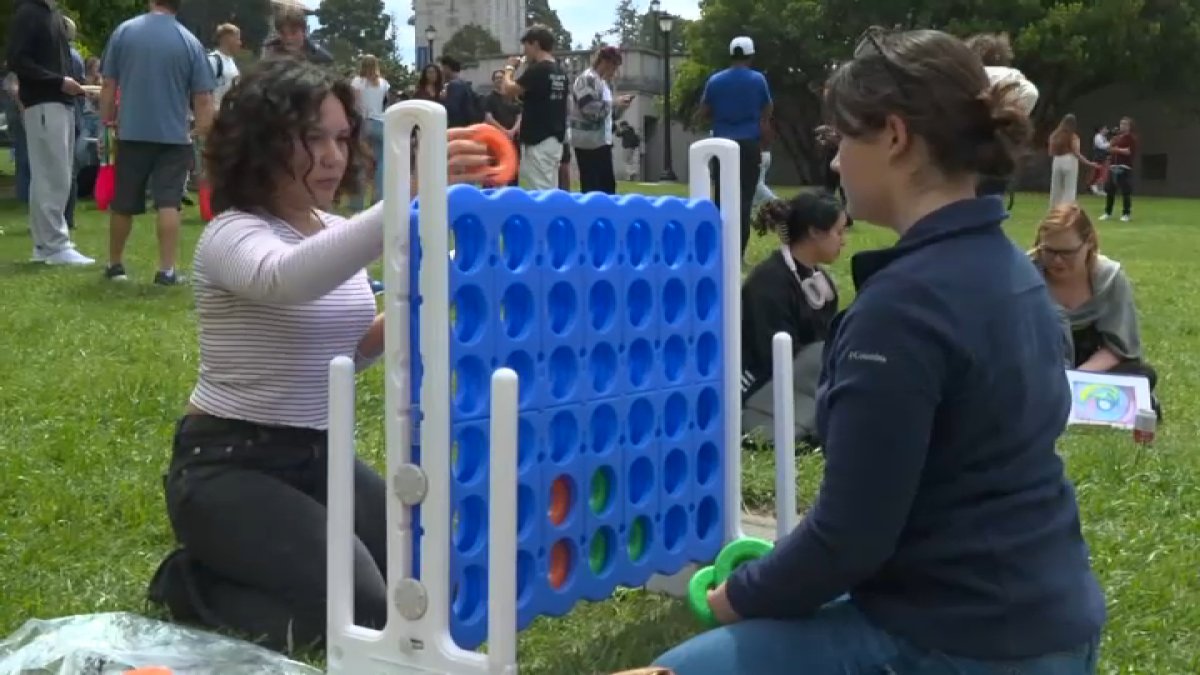
For a few hours Friday, some UC Berkeley students traded digital scrolling for real-life connection as part of a movement they hope inspires others to reduce screen time.
“We are demonstrating what our birthright should have been,” student Dawson Kelly said. “It sucks that on a regular basis I’m having to fight with my phone and I feel like I’m losing control over my life.”
Kelly, who helped organize the event, said for many in his generation, true connection and the art of talking to others in real life has been lost.
They may not be alone in wanting a reset. A new NBC News Decision Desk Poll finds nearly half — 47% — of adults ages 18 to 29 say if they could, they’d choose to live in the past.
“It is so hard to stay intentional when these apps have been designed to manipulate us,” Kelly said. “The only way we beat them is by coming together to define our generation ourselves, not let the big tech companies define us.”
Organizers are pushing for a national movement — challenging not just digital habits but how apps are designed.
Berkeley grad Dino Ambrosi runs Project Reboot, working with schools from grade school to college campuses to rethink how students interact with tech and its impacts.
Dr. Sahar Yousef, cognitive neuroscientist and UC Berkeley faculty, joined NBC Bay Area’s Raj Mathai to talk about Friday’s event, in which students traded digital scrolling for real-life connection for a few hours.
“What’s missing from the equation right now is actionable education that leads to behavior change and a shifting in cultural norms that minimizes the pressure to be online and increases access to the things that screens have been replacing for our generation,” Ambrosi said.
Dr. Sahar Yousef studies how tech and doom-scrolling shapes the brain. Her students tried a nine-week digital detox. She said the results showed less anxiety, less depression and more mindfulness. She noted current digital habits come with a cost.
“We are actually seeing brain atrophy,” she said. “We are seeing degradation of certain brain areas related to self awareness, cognitive control, which is very, very scary.”
The students at Friday’s event said they are not anti-tech. They just want safeguards and are hoping the movement spreads, keeping big tech accountable for the apps they produce and helping people connect in real life again.