
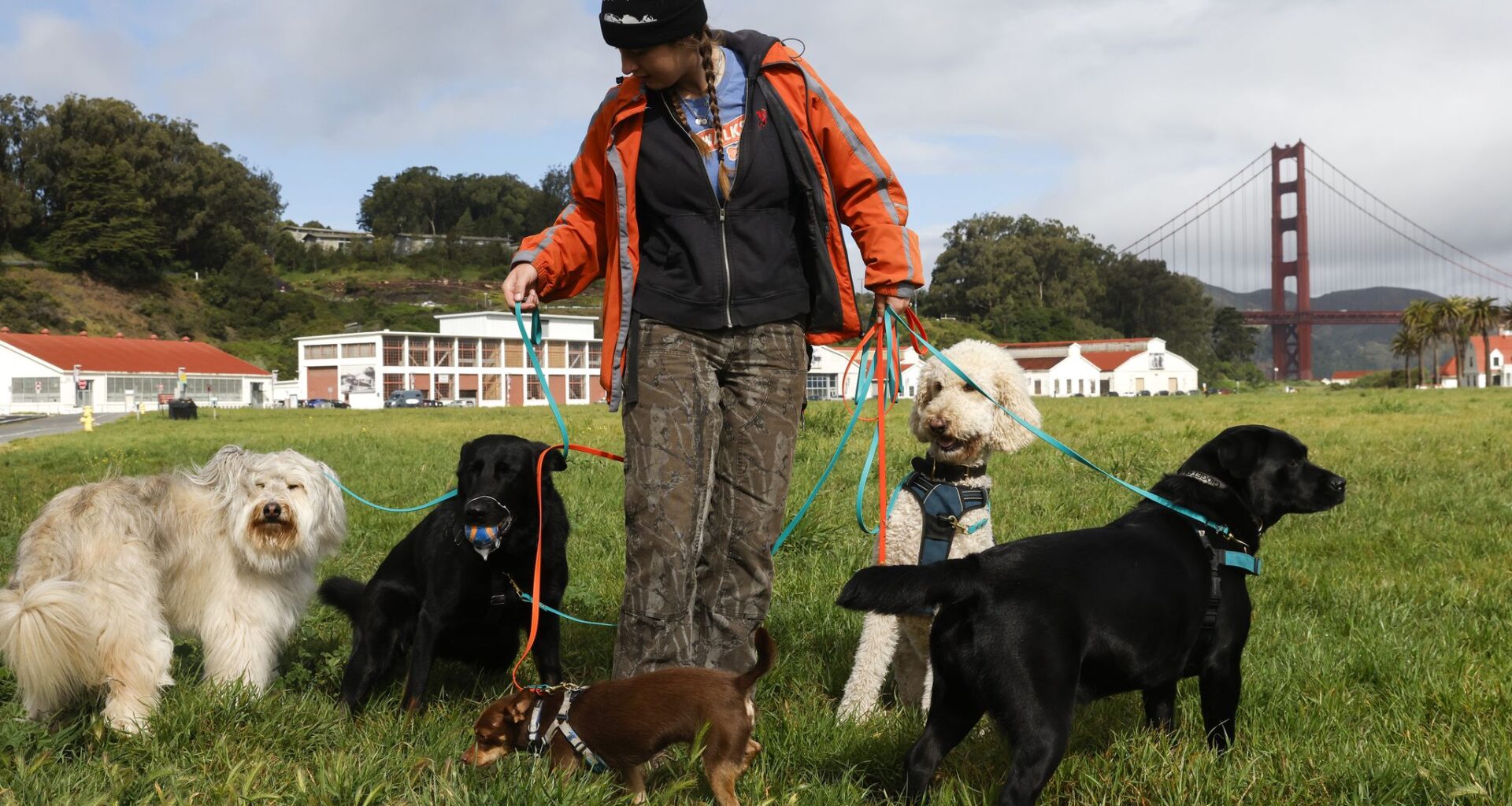
Annika Geisler walks several dogs at Crissy Field in San Francisco, where spending on luxury dog walking and day care services is booming.
Jessica Christian/S.F. Chronicle
Ricky lounges on a couch at Dogwalks’ headquarters in San Francisco.
Jessica Christian/S.F. Chronicle
Giselle Agredano watches while dogs play in the outside space at Dogwalks’ headquarters in San Francisco. For canine enthusiasts seeking to sidestep the 9-to-5 grind, a career in dog walking and day care can sometimes feel like the ultimate life hack.
Jessica Christian/S.F. Chronicle
Dog walker Dawn’s pooch howls from the front seat of her car as she arrives at Dogwalks’ headquarters in San Francisco.
Jessica Christian/S.F. Chronicle
While taking a golden Labrador named Barley for a bathroom break last week, a San Francisco dog handler noticed something Barley’s owners needed to know about — immediately. After alerting them through a mobile app, the handler sent her boss a detailed note.
The next day, seated in the lobby of Bark Avenue, his luxury dog day care in Mission Bay, Craig Cucinella chuckled as he reread part of the message: Barley’s poop is getting slightly softer.
Bark Avenue owner Craig Cucinella holds his dog, Archie, in San Francisco. According to the most recent U.S. census data, the city’s number of pet care employees more than doubled from 2013 to 2023, from around 340 to about 740.
Jessica Christian/S.F. Chronicle
“This is the thing our clients care most about,” Cucinella said, a cacophony of yips and barks emanating from the small-dog playroom down the hallway. “But, hey, that’s why I made sure our app came with ‘soft poop’ tags.”
Article continues below this ad
Such meticulous service is becoming the norm in a San Francisco dog care industry packed with high-end options. Bark Avenue is often fully booked despite rates that approach child care levels, from $799 to $1,699 a month.
In many parts of the country, paying such steep prices so a pet isn’t home alone all day might seem excessive, maybe even absurd. Not in San Francisco. This is a city where pampered pups can alleviate their anxiety with the help of an hourlong Reiki massage, chow down on a $75 tasting menu at a dog-only café, and visit a vet clinic with such perks as genetic testing and data-driven care plans.
Pricey day cares and walkers thrive as dogs fill family roles.
Jessica Christian, Wendi Jonassen
By comparison, a luxury dog day care with poop-related automated alerts isn’t merely another satire-worthy example of San Francisco’s tech-fueled opulence. It’s a sound business model in a city where cramped living, wealth and loneliness often intersect.
San Francisco Chronicle Logo
Make us a Preferred Source to get more of our news when you search.
Add Preferred Source
Dogs have long outnumbered children in San Francisco. But now, after a pandemic-spurred boom in pet ownership overlapped with some of the lowest birth rates in U.S. history, more dog owners have come to consider their canines as much a part of the family as their spouses.
Article continues below this ad
This trend has helped increase the American pet care industry’s valuation by about 65% since 2019, from roughly $96 billion to around $158 billion. Along the way, dozens of opportunistic entrepreneurs such as Cucinella, 49, went all in on San Francisco.
Longtime Bark Avenue employee Estelle Barboza walks Frankie and Devon to the Mission Creek Channel promenade in San Francisco. The dog day care service is often fully booked despite rates that approach child care levels, from $799 to $1,699 a month.
Jessica Christian/S.F. Chronicle
According to the most recent U.S. census data, the city’s number of pet care employees more than doubled from 2013 to 2023, from around 340 to about 740. That doesn’t account for the gig economy, which includes many of San Francisco’s solo dog walkers and dog sitters.
Though not all of the city’s dog care professionals charge premium rates, those who do have noticed that higher prices often boost business rather than hinder it. Data compiled by Rover, the nation’s largest online pet services marketplace, ranks San Francisco as America’s most expensive city for dog boarding.
Its average nightly rate of $75 is nearly twice the national average, with some of Rover’s San Francisco dog sitters even charging more than $250 a day.
Article continues below this ad
Sarah Fulk works with dogs at Bark Avenue Doggy Day Care in San Francisco. Factors including cramped living quarters and a pandemic boom in pets have led to high demand for dog day care.
Jessica Christian/S.F. Chronicle
“What’s happening in S.F. is an extreme example of what we’re seeing nationally,” said Kristin Sandberg, Rover’s director of corporate communications. “For many dog owners, things that used to seem like unnecessary expenses — doggy day cares, expensive dog walkers, you name it — are now just part of being a good dog parent.”
It’s not only San Francisco’s canine fervor that makes it uniquely positioned to capitalize on a surging market.
Perched at the epicenter of America’s housing crisis, it has far more apartments and condos than single-family homes, which means many of its affluent tech workers can’t simply let out their dogs to tinkle in the backyard. But these busy professionals, many of whom are Gen Z and millennial workers who adopted dogs in lieu of having kids, tend to have plenty of disposable income to spend on dog walkers or dog day care.
Sandra Luu works with small dogs at Bark Avenue in San Francisco. The day care counts 80 dogs on its current roster.
Jessica Christian/S.F. Chronicle
It’s a need places like Bark Avenue are built to meet. On a recent Wednesday morning at that boutique business on King Street, Cucinella — a soft-spoken Midwesterner with a 5 o’clock shadow, black puffy vest and gray beanie — thumbed through the day care’s most recent “doggy yearbook.” Walking past a wall covered with photos of some of Bark Avenue’s 80 current dogs, he chatted with an employee about an upcoming interview.
Article continues below this ad
It wasn’t with a prospective dog walker or trainer. It would determine whether a 1-year-old Havanese named Dill was the right fit for Bark Avenue.
Craig Cucinella greets Justin and Caitlin Suh as they drop off their miniature schnauzer, Napkin, at Bark Avenue Doggy Day Care.
Jessica Christian/S.F. Chronicle
With return-to-office mandates ramping up throughout the Bay Area, some of San Francisco’s top-rated dog day cares report long wait lists. Caitlin Suh is grateful her 6-year-old miniature schnauzer, Napkin, made the cut. When her office in San Jose stopped allowing puppies, the 31-year-old tech-marketing manager worried about leaving him home alone in their Mission Bay apartment.
Whenever she now finds herself missing Napkin, Suh scours Bark Avenue’s Instagram for the latest pictures of him or messages with handlers about how he’s doing. Those updates became especially important to her in January, after Napkin spent two days at a pet emergency room recovering from a diabetic episode.
Cucinella had been one of the first people to call Suh after the emergency to see how he was feeling.
Article continues below this ad
“Napkin really does feel like my firstborn child,” Suh said. “When I go to the office, I feel so much better knowing that he’s in good hands.”
Not every dog owner, though, wants to pay for a pet to be gone from the house the entire day. Dog walking companies provide a less intensive, more affordable option.
There are walkers who take packs on scenic hikes up mountains and across streams. Ones who use GPS collars to track dogs’ activity levels. Ones who let pooches recover from long walks at a “doggy mansion” with tons of plush dog beds and yard space. Even ones who host puppy socials at sprawling private ranches just outside the city.
For canine enthusiasts seeking to sidestep the 9-to-5 grind, a career in dog walking and dog day care can sometimes feel like the ultimate life hack.
Owner Julia Frink drinks coffee while greeting dogs at Dogwalks’ headquarters in San Francisco.
Jessica Christian/S.F. Chronicle
Though their jobs often require 12-hour workdays picking up poop and breaking up fights, these workers get to play with pups all day without fear that AI will suddenly eliminate their field. Julia Frink, owner and founder of Dogwalks, reflects on her chosen career’s relative stability whenever she sifts through dog walker applications and sees résumés from laid-off tech workers.
She quit her own tech job in 1999. After she started walking dogs to earn some cash while she plotted her next move, Frink stopped getting invited to get-togethers with her old tech friends.
“I felt completely ostracized,” she said. “No one wanted to be seen out in public with someone who walked dogs for a living.”
Dogwalks owner Julia Frink and walker Annika Geisler work with pets on the beach at Crissy Field in San Francisco. Frink, 61, oversees a 13-person staff responsible for around 80 dogs a day.
Jessica Christian/S.F. Chronicle
Twenty-seven years later, Frink, 61, oversees a 13-person staff responsible for about 80 dogs a day. Though she declined to specify how much money she makes, she conceded that it’s way more than she ever expected to earn — in any field.
Her financial adviser recently talked her into buying a house in Marin County, which she now rents out on Airbnb. Frink’s Bay Area real estate portfolio also includes that “doggy mansion” in the Inner Richmond.
“What Silicon Valley is to venture capitalists, San Francisco is to dog care workers,” said Jonathan Miller, co-owner of the dog walking business Miller’s Menagerie.
Mario Pietrygo greets dogs in the kitchen at Dogwalks’ home headquarters in San Francisco. Compared with dog day care, dog-walking companies provide a less intensive, more affordable option.
Jessica Christian/S.F. Chronicle
Cucinella recognized as much when he purchased Bark Avenue last June from its founder and longtime owner. His 10 years navigating corporate politics at ticket resale giant StubHub had made him want to run a business of his own.
Nothing energized him more than the idea of taking care of dogs for a living. He described his bond with his 12-year-old beagle-Jack Russell terrier mix, Archie, as “one of those special connections where you can just sense that this creature was built for you.”
Tens of millions of dog owners can relate. A 2023 survey of American pet owners reported that about 53% believe their pet knows them better than anyone else does, including significant others and best friends.
This finding emerged within months of the U.S. surgeon general declaring loneliness as an “epidemic.” As the rise of social media and remote work contributed to a nationwide spike in feelings of isolation and hopelessness, more people turned to pets to fill the emotional void.
“Dogs aren’t going to judge you,” said Theresa Hedgepeth, the owner of Hang Around Hound, a dog day care in a section of the Bayview known as Doggy Alley for its abundance of dog-oriented businesses. “They’re just there to provide you constant love and support.”
Gidget shakes off after swimming at the beach of Crissy Field in San Francisco.
Jessica Christian/S.F. Chronicle
This helps explain why Americans spend roughly twice as much time with pets today as they did two decades ago. And why, in the process, pet care became big business.
People now spend more than half a billion dollars per year just on their pets’ Halloween costumes. Perhaps it’s not so crazy, then, when a dog owner in need of a last-minute sitter pays $110 for a single-day drop-in at Bark Avenue.
The big unknown is how many luxury dog care businesses a city of roughly 840,000 residents can sustain. In interviews for this story, the Chronicle asked more than a dozen of San Francisco’s dog care business owners whether they were concerned about a potential saturation of the market. All agreed there was more than enough demand to accommodate an increasingly crowded sector.
James Serpell, an emeritus professor at the University of Pennsylvania who has written several books on human-animal relationships, pointed out that dog walkers and dog day care providers are in the guilt-appeasement business. “When you pay for your dog to get out of the house and have fun with his friends, you’re doing that as much for yourself as for the dog,” Serpell said. “People tend to think of dogs as people. They know they’d be sad being stuck inside all day, so they feel bad doing that to their dogs.”
Research suggests that spending motivated by guilt can be surprisingly durable. Even when people are committed to saving money, they tend to protect the splurges that reduce feelings of shame or regret.
If local dog care workers are losing sleep over the local industry’s mounting competition, they’re certainly not acting like it.
Miller has befriended dozens of other dog walkers, some of whom he meets up with regularly for beers or barbecue. When Victoria Robinson — the owner of High Tail Hotel, another dog day care in Doggy Alley — has dogs struggling to adapt to the day care environment, she refers them to Hang Around Hound, which specializes in caring for high-need pups.
“I would not call this business cutthroat, at all,” Robinson said. “Most places I talk to are doing better than OK.”
That appeared to be the case on that recent Wednesday at Bark Avenue. In a small-dog playroom with forest print wallpaper and electronic music, a French bulldog named Tuna yipped from his plush dog bed as he surveyed the scene.
Two of his pals pranced up and down a small green plastic bridge. In the far corner, a pack of six pooches fresh off a walk lapped up water from small bowls. A couple of others wagged their tails nearby as they learned a new trick from a handler.
Craig Cucinella and Archie, his 14-year-old beagle-Jack Russell terrier, outside Bark Avenue Doggy Day Care.
Jessica Christian/S.F. Chronicle
Cucinella still worries. From the lobby, he reflected on the seven dogs who’d be gone next month, including two who were having surgery and another two who were moving out of the area.
“We’re going to be making less money than we did this month,” Cucinella said. “We have to figure out a way to make that up. Our margins are pretty slim.”
That’s when he caught himself. “Actually, I’m sure we’ll be all right,” he added. “This is S.F. There are plenty of dogs to go around.”
Dan Kopf contributed to this report.