
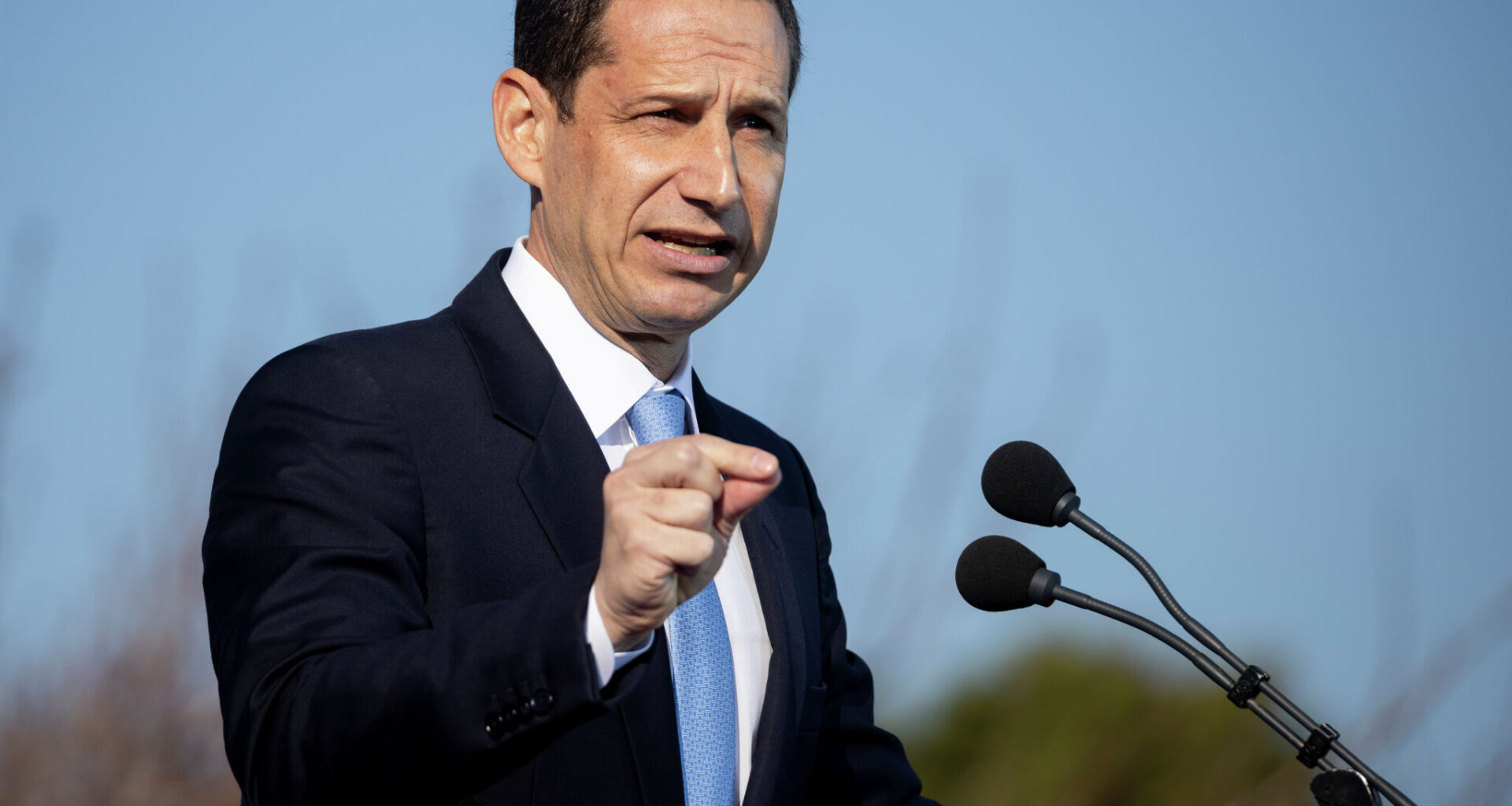
Two of San Francisco Mayor Daniel Lurie’s key allies on the Board of Supervisors will face voters for the first time in June.
Stephen Lam/S.F. Chronicle
San Francisco’s June election comes with major political stakes for Mayor Daniel Lurie.
Two of his key allies on the Board of Supervisors will face voters for the first time in districts that include the Sunset, Marina and Pacific Heights neighborhoods. The outcomes of those races could reshape the dynamics at City Hall and help — or hinder — the mayor’s agenda during the rest of his term.
District 2 Supervisor Stephen Sherrill, shown at a community meeting last December, is seeking voter approval to remain in his seat, to which he was appointed by former Mayor London Breed.
Carlos Avila Gonzalez/S.F. Chronicle
Lurie’s allies have poured huge amounts of cash into races to boost the two incumbents that the mayor has endorsed: District 2 Supervisor Stephen Sherrill and District 4 Supervisor Alan Wong. Both are mayoral appointees seeking voters’ approval to remain in their seats until their terms end in January. Their seats will be on the ballot again in November for full four-year terms.
Article continues below this ad
Both candidates face robust challenges from serious opponents who argue that the incumbents are more attentive to Lurie and his deep-pocketed allies than to their constituents.
In District 2, Sherrill is up against Lori Brooke, a Cow Hollow community organizer who has rallied opposition to Lurie’s housing plan to allow taller, denser development in the city’s western and northern neighborhoods.
Supervisor Alan Wong, a mayoral appointee, is seeking voter approval to remain in his seat.
Gabrielle Lurie/S.F. Chronicle
In District 4, Wong faces a longer list of challengers, including Albert Chow, a leader in the successful effort to recall former Supervisor Joel Engardio, and Natalie Gee, a longtime legislative aide to Supervisor Shamann Walton. Like Brooke, both Gee and Chow have criticized the incumbents for backing Lurie’s plan to authorize denser housing, and both have seized on lingering outrage among Sunset residents about the transformation of the Upper Great Highway into Sunset Dunes park — one of the biggest fights in the district.
San Francisco Chronicle Logo
Make us a Preferred Source to get more of our news when you search.
Add Preferred Source
Lurie sees the election as an opportunity to continue his own political momentum. The centrist mayor has touted his productive working relationship with the Board of Supervisors, which became more moderate in the 2024 elections. The board has consistently advanced Lurie’s legislative priorities with little resistance.
Article continues below this ad
“Supervisors Sherrill and Wong share my commitment to accountability and results, and together we’re making San Francisco safer, cleaner, and more livable for the families, workers, and small businesses of this incredible city,” Lurie said in a statement.
But his supporters fear that could begin to change if either Wong or Sherrill is ousted and replaced by a challenger less friendly to the mayor. That outcome could bring back the political dynamics seen during former Mayor London Breed’s tenure, when the board was dominated by progressives who pushed back on her policies at various points.
“If we actually expect to get anything done in San Francisco, we need to maintain the moderate majority on the Board of Supervisors,” said Nancy Tung, chair of the San Francisco Democratic Party, which is backing Wong and Sherrill. “If the city doesn’t elect them, we could expect to see some gridlock in City Hall with respect to the direction that the mayor is trying to steer the city.”
The mayor’s endorsements have come in addition to a significant chunk of change from third-party groups aligned with Lurie that are investing heavily in favor of Wong and Sherrill. In total, about $1.4 million has been spent so far by all candidates and political action committees in Districts 2 and 4, according to campaign finance disclosures. Roughly 40% of that has come from pro-Lurie groups that are backing Wong and Sherrill.
“We believe that if we lose even one seat, San Francisco will go backwards,” said Sachin Agarwal, co-founder of Grow SF, a moderate political group with ties to Lurie that raised about $573,000 to back the two supervisors.
Article continues below this ad
Agarwal and his co-founder at Grow SF, Steven Buss Bacio, pointed to several policy areas where they fear San Francisco could backslide if Wong and Sherrill lose their seats. One is housing, given that Lurie has embraced a pro-development stance shared by the board’s moderate bloc. Another is public safety, a top campaign issue for the mayor. And Agarwal said it’s also important that Lurie has allies on the board when he’s trying to eliminate San Francisco’s recurring budget shortfalls, partly by laying off city workers.
Another political action committee calling itself SF Believes has pulled in $1.1 million from 15 donors — most of whom also gave in support of Lurie’s mayoral campaign — to spend on the June supervisor races and others. The top donor to SF Believes is Jan Koum, the billionaire co-founder of WhatsApp who has been a major donor to President Donald Trump.
District 4 Board of Supervisors candidate Albert Chow raises a paddle while responding to a question during a candidate forum. He is challenging Lurie appointee Alan Wong for his seat on the Board of Supervisors.
Jana Ašenbrennerová/For the S.F. Chronicle
In the wake of all that cash, critics have ramped up efforts to paint the incumbents as overly beholden to the mayor and his wealthy donors. Wong’s four challengers — Chow and Gee, along with campus coordinator Jeremy Greco and political science lecturer David Lee — have banded together to decry the groups’ spending on the supervisor and are urging voters to leave him off their ranked-choice ballots.
But the outside groups supporting Wong and Sherrill are betting that the popular mayor’s support will boost them at the ballot box. A Grow SF-funded ad supporting Wong, for example, said “Mayor Lurie trusts Alan Wong to deliver for the Sunset.” A Grow SF-funded ad that criticized Brooke highlighted her opposition to Lurie’s “Family Zoning” plan to allow more homes on the north and west sides of the city. Both Sherrill and Wong voted for the plan.
Article continues below this ad
Wong’s campaign website prominently features a photo of him being sworn into office by Lurie. Sherrill also displays Lurie’s image first in his endorsements section. The first sentence of his message to voters refers to San Francisco as “a city on the rise” — a phrase the mayor uses in his public remarks.
“Right now, we have people embracing Lurie, and I think that probably tells us more about where voters see the city right now … and candidates are aware of it,” said Patrick Murphy, a public affairs professor at the University of San Francisco.
But the challengers in both districts have sought to turn the popular mayor’s support into a liability.
Lori Brooke, a candidate for District 2 supervisor, talks with Caroline Allen while canvassing Wednesday.
Minh Connors/For the S.F. Chronicle
“That’s a big difference between Stephen and I. … I won’t be a rubber stamp,” Brooke said. “I will be very thoughtful about the choices I make, but I am definitely responsive to my constituents.”
Article continues below this ad
Brooke said she hopes voters will be turned off by the spending to support Sherrill and see her as a “grassroots candidate” being “mowed over by corporations and billionaires.”
Sherrill has emphasized the strength of his relationship with Lurie.
“The mayor’s support is incredibly meaningful,” Sherrill said. “We want to be moving forward, and I think that’s why we have so much momentum.”
In District 4, three of the four candidates challenging Wong came together at a news conference Thursday to decry the outside spending pouring into the race. Chow and Greco wore stickers that read, “I’m not a billionaire’s b*tch,” and their supporters carried signs with slogans such as, “Give back MAGA buck$.”
Natalie Gee is challenging Lurie appointee Alan Wong for his seat on the Board of Supervisors.
Minh Connors/For the S.F. Chronicle
At the news conference, Gee criticized the billionaires she said were trying to use their influence to secure “the votes that they want at City Hall.”
“The Sunset is not for sale,” she said.
Chow has also accused Grow SF of trying to pressure him to drop out of the race. Agarwal and Bacio suggested he might be able to get an appointment on a city commission instead. Lurie is responsible for many commission appointments.
Bacio said he and Agarwal did talk to Chow about his “slim” chances of prevailing in the supervisor race but insisted that they never “pressured (Chow) to drop out.”
Gee, who is benefiting from outside spending by a union-funded committee that’s raised $300,000, hopes collaborating with the other candidates will help defeat Wong by leveraging ranked-choice voting.
In addition to embracing the mayor’s support, Wong and Sherrill emphasized the endorsements from neighborhood groups and stressed their commitment to constituent services and the meat-and-potatoes issues in their districts: irksome noise from a Tesla charging lot in the Marina, a protected left-turn lane on Sloat Boulevard.
Wong said in a recent interview that he has tried to design his campaign and City Hall office around what an “everyday normal person in the Sunset” cares most about.
“I want to take things in a very pragmatic manner,” Wong said. “Too much ideology prevents us from getting practical results.”
But Wong has had little choice but to weigh in on some politically divisive citywide issues, and his critics and opponents have taken note. During his first week in office, Wong voted for the mayor’s zoning plan, angering some residents who opposed the plan and felt their concerns were unheard.
Early in his term, Wong also failed to secure enough votes from his colleagues to put forward a new ballot measure that would have asked voters to decide on the future of Sunset Dunes for the second time in two years. At a candidate forum in February, Wong blamed the mishap on Gee, given that her boss — Supervisor Walton — could have provided the fourth vote needed to put a measure on the ballot. Gee said it was Walton’s decision to make and not hers.
Sunset resident Bob Twomey said Wong’s vote signaled a worrisome fealty to the administration that had just appointed him. Twomey, a political and labor adviser, is backing Gee, whom he sees as better equipped to represent the district.
“There’s a lot of people who do not trust him,” Twomey said of Wong.
In the months since his appointment, Wong has also managed to run afoul of some of the pro-housing groups that have endorsed him. After his office circulated a petition in support of “a comprehensive cleanup of toxic vapors” beneath a recently completed 90-unit affordable housing project in the Sunset, pro-housing group SF YIMBY penned an outraged letter to Wong.
The letter, originally reported on by Mission Local, called the petition “inflammatory” and suggested that it relied on “scientifically unfounded claims.” Still, the group has continued to support Wong despite its criticism.
Even Wong supporters have expressed concerns about his tenure. Cyn Wang, leader of the pro-housing Westside Families Democratic Club, said she has been “disappointed” by some of Wong’s actions, including those laid out in the SF YIMBY letter. Yet his vote on the zoning plan was enough to win her vote despite her misgivings.
“I don’t see his opponents as having real solutions on these issues, particularly on housing and transit, and for me he remains the only viable candidate,” Wang said.
Ultimately, what’s most important to her is preserving the moderate majority on the board.
“Alan is part of that voting bloc,” Wang said.
San Francisco Mayor Daniel Lurie’s supporters fear his working relationship with the Board of Supervisors could change if either incumbent supervisor is ousted.
Benjamin Fanjoy/For the S.F. Chronicle
For Lurie, a mixed outcome in the supervisor races — if only one of the two incumbents prevails — could leave his political prospects relatively unscathed, said Murphy, the USF professor.
If they both lose, however, it’s a different story. The double defeat could signal that the “pretty positive” vibe that has permeated San Francisco politics since Lurie’s election is weakening, Murphy said.
“That would suggest that voters think — at least in these two districts — differently,” he said.