
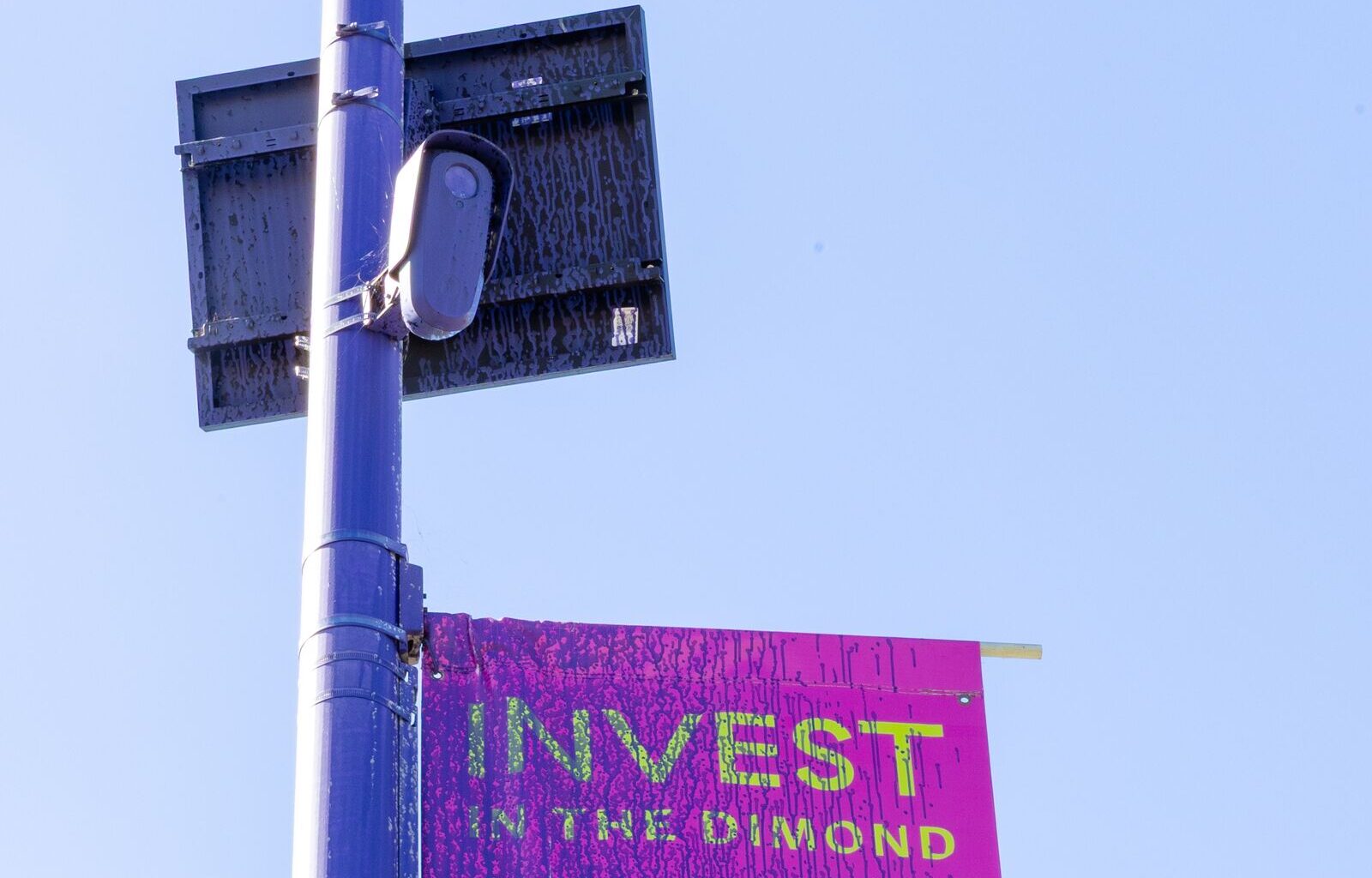
Drivers cruising along Fruitvale Avenue recently may have noticed a curious sight: a small black camera with a solar panel attached to a light post, splattered with purple paint.
This is powerful surveillance camera manufactured by Flock Safety, a Georgia-based company. In December, the City Council agreed to renew a contract with Flock to maintain a network of nearly 300 automated license plate readers installed on posts and utility poles all over Oakland. The council also approved the installation of 40 Flock Condor cameras, which can provide livestream footage to OPD.
The council made this decision over the objections of scores of residents who expressed concerns about Flock as a vendor. Many cited privacy concerns, while others pointed to how Flock’s cameras have been used to monitor protests, locate undocumented immigrants for deportation, and investigate people seeking reproductive healthcare.
It appears that an unknown vandal or vandals have started targeting Flock cameras in ways that might disable them. The Fruitvale camera, it appears, was struck with paint, including over its lens.
In addition to the camera spotted by The Oaklandside on Fruitvale Avenue, we also found a Flock camera at the intersection of W. MacArthur Boulevard and Martin Luther King Jr. Way that appears to be splattered with a similar color of paint. It’s unclear when these paint bombings happened.
Other Oaklanders have been noticing the paint bombings. Earlier this month, a resident posted a picture of a Flock camera coated in gray paint on the Temescal Nextdoor group. (It’s unclear where exactly that camera is located.)
An OPD spokesperson said in an email the department is aware of damage done to its cameras and is currently investigating.
Why are Flock cameras being painted over?
 A paint splattered Flock Safety camera on W. MacArthur Boulevard in Oakland. Credit: Darwin BondGraham/The Oaklandside
Vandalism and destruction of Flock cameras is happening in other cities, which some media outlets have referred to as a “revolt” against the company’s surveillance technology.
Residents discovered two disabled cameras left on a street median in the San Diego suburb of La Mesa in February. In the Illinois counties of Menard and Mason, sheriff deputies discovered a Flock camera had been cut down and another damaged in January. Police in Lisbon, Connecticut, recently investigated a Flock camera that had been damaged.
Flock contracts with thousands of cities, law enforcement agencies, and homeowner associations across the country. The company makes it easy for camera operators to share data with other jurisdictions or agencies, which has made it very appealing for law enforcement. Flock’s website is filled with case studies in which the company says its cameras have helped track down criminal suspects and recover missing people.
But the sprawling surveillance created by Flock has disturbed privacy advocates. In recent months, numerous cities around the country – including several in the Bay Area – have cancelled contracts with Flock or halted proposals to work with the company. In some of those cases, city officials cited concerns about federal and state law enforcement agencies accessing data collected by local police departments – an issue that prompted the backlash against Flock in Oakland. Even in jurisdictions like Alameda County that have continued to maintain Flock systems, elected leaders have expressed strong reservations about using the vendor.
In December, police arrested a 41-year-old man in Suffolk, Virginia after he allegedly “intentionally destroyed” 13 Flock Safety cameras. The suspect in that case appears to have created a GoFundMe page to pay for legal expenses, in which he wrote, “I will take the silver lining that this can be a catalyst in a bigger movement to roll-back intrusive surveillance.”
Police in Oregon reported in October that vandals had cut down three poles supporting Flock cameras in Springfield. Six cameras in Eugene had also allegedly been vandalized. A note left on one of the severed poles said “hahaha get wrecked ya surveilling fucks,” according to local press reports.
In Louisville, Kentucky, police took pains to keep the locations of their Flock cameras secret. According to a press report, once the public learned about the locations of several cameras, they were quickly destroyed.
Multiple websites have popped up on the Internet showing the locations of Flock cameras. Deflock, one of the largest, has mapped nearly 90,000 Flock cameras around the United States. Flock CEO Garrett Langley referred to the group behind this website as a “terroristic organization” in a recent interview.
It’s unclear how many of Flock’s cameras have been damaged in Oakland. An OPD spokesperson did not immediately have data available about how many cameras have been damaged.
The company doesn’t disclose how much individual cameras cost and its deals with cities are based on a subscription model in which Flock retains ownership of the hardware. Oakland’s agreement with Flock cost $2.25 million for two years.
Paris Lewbel, a Flock spokesperson, told The Oaklandside that when cameras are damaged law enforcement officials are unable to receive alerts about vehicles tied to serious crimes, which negatively impacts public safety.
“While Flock supports individuals making their voices heard in the democratic process, committing criminal acts should never be a part of that process,” Lewel said in a statement.
“*” indicates required fields