
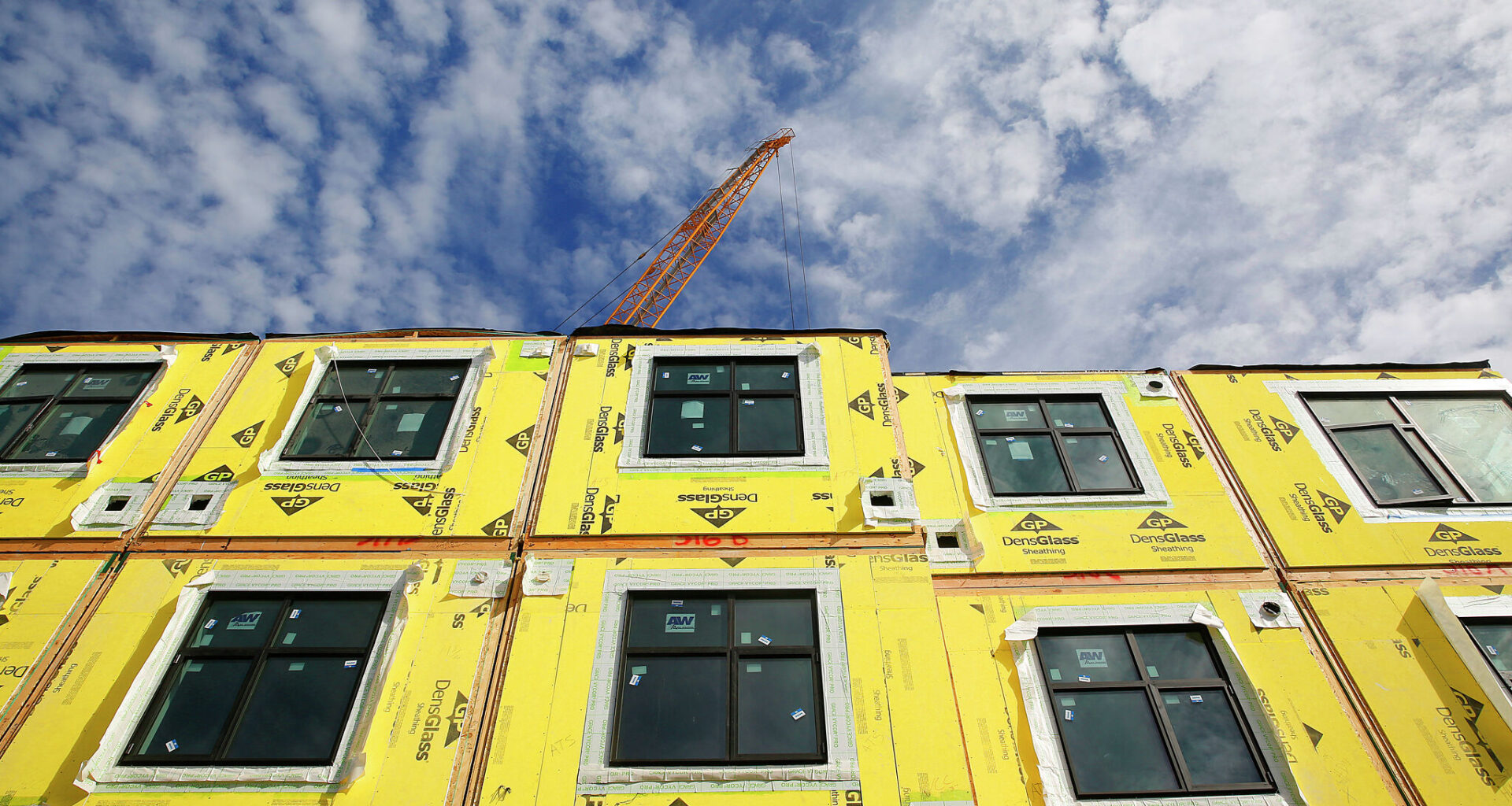
An apartment complex in San Francisco’s Bayview neighborhood is put together in 2015 with modular units. Modular and prefab housing can be faster, cheaper and more efficient than on-site construction.
Liz Hafalia/S.F. Chronicle
It’s news to no one that California has a huge housing crisis due in large part to its lack of supply. State lawmakers moved aggressively in the past few years to remove the bureaucratic obstacles surrounding zoning, environmental review and approval timelines that hamper new development. Yet production has not meaningfully increased. Skyrocketing labor and construction costs have made many housing projects financially infeasible to build.
Now, lawmakers are promising to do something about it.
On March 24, a bipartisan coalition led by Assembly Member Buffy Wicks, D-Oakland, rolled out a six-bill “housing innovation package,” aimed explicitly at bringing down building costs.
Article continues below this ad
The focus? Innovative construction methods, with a particular focus on factory-built or prefab housing, which can be faster, cheaper and more efficient than on-site building. Think of prefab housing as something akin to car manufacturing — a kit of parts put together in a factory, then transported to a site. It would be incredibly inefficient to build each car individually rather than on an assembly line. Similarly, there are efficiencies in cost, time and labor that can come with building houses in a factory.
“We’re still building homes like we did a hundred years ago, and it’s not enough to address the housing shortage we’re facing today,” Wicks said in a press release announcing the legislation. “We can build housing more quickly and more affordably for our working-class families.”
San Francisco Chronicle Logo
Make us a Preferred Source to get more of our news when you search.
Add Preferred Source
As someone with a personal history with prefab — I wrote a book on the topic back in 2002 — I’m thrilled to see California legislators finally digging into it because its promise goes far beyond affordability.
In 2003, as the editor of Dwell magazine, a publication known for its coverage of modern architecture and design, I developed an international architectural competition to design a modern, affordable home for what seemed then like an affordable price of $200,000. The winning home, designed by Resolution: 4 Architecture, felt anything but standardized, given its light-filled interiors, large open living spaces and cozy private ones. The architects beautifully integrated the home with its wooded site with what they call “modules of use,” essentially building blocks that can be reconfigured in an endless number of ways.
Article continues below this ad
The Dwell competition and the subsequent coverage of the home, built for an actual client, revealed an abundance of interest from architects drawn to the possibilities of prefab. Several of them went so far as to start home-construction companies and build new factories of their own, eager to show that the bad reputation of prefab (which is often conflated with double-wide trailers) was no longer deserved. It also became clear to me that the challenges facing a prefabricated future were less to do with design and more to do with finding financing (many lenders hesitate to fund it), zoning (many municipalities and homeowners associations forbid it outright) and labor (unions have historically been against it, believing it would result in job losses). Also, despite the beautifully designed homes we featured in Dwell, it became increasingly clear that the economies of scale really worked out with multifamily buildings — less so for single-family ones.
The housing recession of 2009 put a damper on the sort of architectural innovation that had been happening in this arena, but it wasn’t long before a few tech companies decided to try their hand at prefab. These startups insisted that 3-D printing or something described as “a vertically integrated, technology-driven, and manufacturing-based model” would transform the housing industry.
That future never came to fruition. At least not in the United States.
Many other countries use modular and prefabricated techniques: About 15% of Japan’s new housing is built this way — Sekisui Hiem has eight factories that can build 10 homes a day, for example — and close to 80% of Sweden’s homes, including some produced by IKEA. In the U.S., it’s about 3%.
Here at home, the challenges of prefab are not so much technical but are about “addressing barriers across policy, financing and project delivery,” Ben Metcalf, managing director of the Terner Center for Housing Innovation at UC Berkeley, said in the legislation’s press release.
Article continues below this ad
A Terner report, published March 2, highlighted several ways to overcome these challenges. It recommended making building codes more consistent across the state, so new construction technologies can be used more easily in different cities. It also suggested reducing financial risks by adapting state funding programs to better support factory-built housing projects and by updating existing funding sources to help ensure projects are completed. And it encouraged lowering transportation costs associated with factory housing, such as highway escorts. The report rightly stressed the importance of addressing negative perceptions of risk and of quality. As architect Jay Baldwin once put it to me: “Many prefab models are certainly CATNAP (Cheapest Available Technology Narrowly Avoiding Prosecution).”
California’s package of prefab bills was drawn from the Terner report and rightly focuses on real-world barriers. To have any chance of building prefab at scale in California, building codes need tweaking and key labor unions like the construction trades need more convincing to support the efforts.
In preparing their legislation, Assembly committee members consulted material suppliers, manufacturers, labor unions, developers, investors, government officials and advocates about the challenges that exist as well as potential solutions.
Notably, labor unions are finally getting on board. United Brotherhood of Carpenters & Joiners of America members are increasingly training to produce modular and panelized housing components in factory settings. As Pete Rodriguez, vice president of the union, stated in the legislation’s press release: “Even a well-paid carpenter can no longer afford a bottom-tier home. We can build our way out of this problem, but we need to get started now… with an all-of-the-above strategy in housing construction.”
Perhaps thanks to this union backing, the current package of bills is the most robust response to prefab challenges I’ve seen in over two decades covering this industry.
Article continues below this ad
Tyler Pullen, assistant director of building innovation at Terner and a co-author of the report, told me he felt far more optimistic about prefab’s future now than he was a year ago. “The momentum, the political will, including from the governor’s office, a willingness to get into the weeds and understand the process, makes me think this is more than just a feel-good effort.”
Guest opinions in Open Forum and Insight are produced by writers with expertise, personal experience or original insights on a subject of interest to our readers. Their views do not necessarily reflect the opinion of The Chronicle editorial board, which is committed to providing a diversity of ideas to our readership.
Read more about our transparency and ethics policies
Prefab has been around in California for over a century — kit houses were shipped by rail during the California Gold Rush of 1849; starting in 1906, Sears, Roebuck & Co. sold houses by mail in its catalog; at mid-century, the Case Study House Program aimed to introduce modernism to the masses (but only built 25 homes).
I’m hopeful that California is finally poised to succeed where past efforts failed and truly help produce the thousands of units of housing the state so desperately needs.
Allison Arieff is a columnist and editorial writer for the Opinion section.