
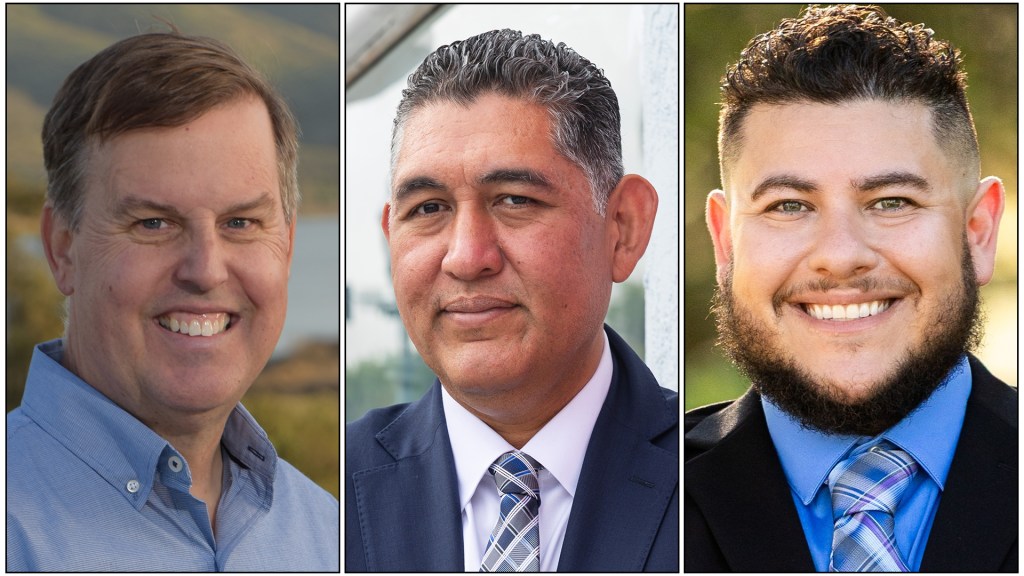
Three candidates are vying to lead Chula Vista, San Diego County’s second-largest city, in the June primary, with the winner set to serve a four-year term atop a City Council that has been marked in recent years by sharp partisan division.
Incumbent Mayor John McCann, a Republican, is the lone member of his party on a council otherwise composed of Democrats — a dynamic that has produced notable splits on several high-profile issues. His two challengers, Francisco Tamayo and Yair Gersten, come from more Democratic backgrounds, setting up a race that could reshape the ideological balance at City Hall.
McCann is a four-term City Council member and U.S. Navy Reserve commander seeking another term. Tamayo, a former school board trustee, is running on a platform of economic development and housing affordability. And Gersten, a 34-year-old county analyst and political newcomer, is making the case that fresh eyes and practical thinking are what Chula Vista needs.
Council members and the mayor are limited to two terms. Under the city’s current charter, a mayor or council member who has served two consecutive terms must wait at least one year after their second term ends before running for the same office again — a provision that was also in place under the 2000 charter, which governed when McCann first took office in 2002. That means McCann, who has held a seat on the Chula Vista City Council or in the mayor’s office for the better part of two decades, is eligible to seek another term.
The mayor’s annual salary is $161,519.80, according to the city — a benchmark that typically increases annually under the city’s charter and is tied to the salary of a Superior Court judge.
In the interest of consistency, each candidate was asked the same three questions covering the city’s development goals and its push to bring a four-year university to Chula Vista, the recently passed ordinance limiting cooperation with federal immigration enforcement, and the city’s multifaceted approach to homelessness — including the Palomar Point motel renovation and one of the county’s strictest encampment bans.
Each candidate was also given the opportunity to raise an additional issue of their choosing.
Yair Gersten
Yair Gersten, a 34-year-old administrative analyst for the County of San Diego, is making his first run for elected office in the Chula Vista mayoral race, positioning himself as a pragmatic outsider focused on delivering results on the city’s most pressing issues.
On bringing a four-year university to Chula Vista, Gersten said the city should focus on removing obstacles it controls — streamlining approvals, aligning land-use decisions and improving internal coordination. He expressed support for building on the existing San Diego State University partnership and said all major development projects, from the bayfront to the film studio, must deliver measurable community benefits.
“The path forward isn’t just finding consensus,” he wrote. “It’s making Chula Vista the easiest place for these projects to succeed, while making sure our community sees the results.”
On immigration, Gersten framed his support for protective local policies around public safety, arguing that community trust is essential to effective law enforcement. “Without it, communities are less likely to report crimes or cooperate with law enforcement, making everyone less safe,” he wrote. He said transparency and clear communication would be central to his approach as mayor.
On homelessness, Gersten supported the city’s current strategy, but raised pointed concerns about cost and scale, noting that Palomar Point’s per-unit price tag of more than $500,000 means such projects alone cannot meet the full need. He called for lower-cost, higher-capacity alternatives and stressed that encampment enforcement requires sufficient shelter availability to be fair and effective.
As an additional issue, Gersten highlighted education, arguing the city has a meaningful supporting role even though schools are primarily governed at the state and district level. He called for stronger coordination between schools and childcare providers, expanded after-school programs and a city fund to help teachers cover classroom costs — a need, he said, he witnessed firsthand at Loma Verde Elementary.
Gersten has no prior political experience and a bachelor’s degree in business and management from Excelsior College.
John McCann
John McCann, the incumbent mayor of Chula Vista who owns a real estate and property management company, is seeking another term in office, running on a record of economic development, public safety and neighborhood investment.
On the university project, McCann pointed to concrete progress made under his leadership, including a 10-year lease agreement with San Diego State University’s nursing program and a 30-acre master plan developed through the city’s University Subcommittee, which he led. He proposed a “Compact for Success” modeled after an existing partnership between SDSU and Sweetwater Union High School District, which would guarantee admission to local students who complete defined college preparatory coursework and meet a minimum GPA. He called the university “the transformational investment our residents deserve” and said it would anchor the city’s future economy, “powering workforce pipelines, fueling housing demand, and driving long-term commercial vitality.”
On immigration, McCann, who had previously recused himself from the issue citing his dual role as a federal employee through the Navy Reserve, stopped short of taking a direct position on the ordinance, saying he was serving on active military duty overseas when it passed. He said California state law already governs how local police interact with federal immigration authorities and that his department’s existing practices predate the measure.
“Our officers do not ask about immigration status, do not detain individuals on civil ICE holds, and do not share protected personal information,” McCann said. “Our department has always followed state law.”
He framed the issue in public safety terms rather than political ones. “When immigrant families feel safe calling 911, our entire community is safer,” he wrote. “That trust is not a political position; it is a public safety strategy.”
On homelessness, McCann took ownership of the city’s current strategy, citing the creation of the Homeless Outreach Team, the opening of a transitional shelter called the Chula Vista Village at Otay and the encampment ban as products of his leadership. He described his approach as “compassionate” and “results-driven,” adding that “compassion for those experiencing homelessness and safety for our residents are not competing values — they go hand in hand.” He said he would expand mental health and substance abuse treatment partnerships and track outcomes rigorously going forward.
As an additional issue, McCann highlighted infrastructure investment in older, underserved neighborhoods, pointing to park renovations, the 29-acre Sweetwater Park addition and the Citrus Park homeownership project — which he described as the largest new homeownership development on the city’s west side in more than three decades.
McCann, 57, holds master’s and bachelor’s degrees in economics and is an honor graduate of the U.S. Navy Supply Corps School. He is a commander in the U.S. Navy Reserve.
Francisco Tamayo
Francisco Tamayo, a 45-year-old technology director and former school board trustee, is running for Chula Vista mayor on a platform of execution-focused leadership, housing affordability and stronger investment in working families.
On the university project, Tamayo acknowledged recent progress — including degree programs launching at the Millenia Library this fall — but was candid about the gaps that remain. “The physical campus still has no construction funding, no groundbreaking date, and a task force that won’t report to the Legislature until July 2027,” he wrote. “The gap between ribbon-cutting and reality is where projects like this go to die.” As mayor, he said he would treat the effort as “an execution problem, not just an advocacy problem,” integrating the university, the bayfront and the film studio infrastructure into a unified economic development vision.
On immigration, Tamayo offered unequivocal support for the ordinance, grounding his position in personal experience with affected families during his 11 years as a Chula Vista Elementary School District trustee. “I have seen children come to school unable to focus, unable to learn, consumed by a fear that no child should carry: the fear that when the school day ends, their parents may not be there,” he wrote. He argued that delaying medical care out of fear of deportation made the entire community less safe, and said he would pair the ordinance with expanded language access and community liaison programs citywide.
On homelessness, Tamayo supported the city’s current strategy but argued that enforcement without adequate housing supply is “a cycle, not a solution.” He called for a dedicated city funding strategy for permanent supportive housing, a faster shelter-to-housing pipeline and direct partnerships with behavioral health and substance use treatment providers.
As an additional issue, Tamayo highlighted housing affordability, proposing the “Chula Vista Heroes Plan” — a homeownership initiative targeting teachers, nurses, first responders and other essential workers. “The people who make Chula Vista function should be able to afford to live here,” he wrote. He also called for annual housing production accountability targets and mandatory affordability requirements built into major developments, including the bayfront and the University Innovation District.
Tamayo has served as an elected trustee on the Chula Vista Elementary School District Board of Education for more than 11 years and currently serves as director of technology and security at Calbright College. He holds an MBA.