
With the backdrop of a politically-divided legislature, Michigan school superintendents are calling on lawmakers to set aside their differences and fund schools in a timely manner this year.
The general tone of an April 23 meeting was that the superintendents were dissatisfied with the budget process in 2025 and do not want to see a repeat this year. Michigan lawmakers approved their state budget Oct. 2 in 2025, which was after two missed deadlines.
Under the plan last year, K-12 schools saw an overall 2.5% increase, or a $518 million jump, in the new budget compared to the previous year.
The per-pupil foundation allowance went from $9,608 last year to $10,050. Likewise, a new $65 million grant program was established to reduce class sizes in kindergarten through third-grade classes. The class size program investment came after a months-long Detroit News investigation, published in April 2025, found 206 elementary classes — ranging from kindergarten through fifth grade — across 49 schools over the 2023-24 and 2024-25 years that had at least 30 students in them.
However, the K-12 budget eliminated a $100 million offset for retirement costs that has benefited public schools.
“This will significantly increase schools’ costs and reduce classroom spending,” said Robert McCann, executive director of the K-12 Alliance of Michigan, a public school advocacy group, in a social media post last year.
The plan also diverted about $1.3 billion from the School Aid Fund, which traditionally supports K-12 schools, to community colleges and universities. That’s a 41% increase in School Aid Fund support for higher education from $922 million in the last budget.
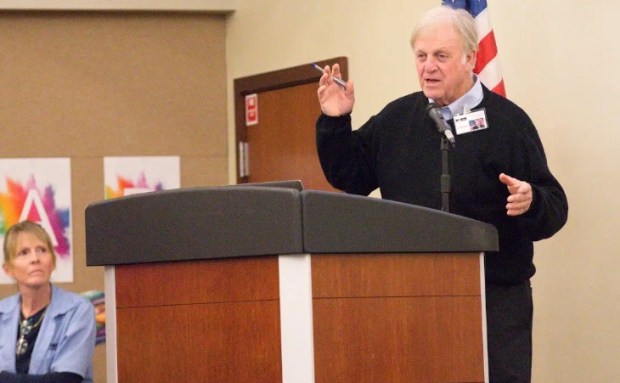 Macomb Intermediate School District Superintendent Mike DeVault speaks at an event last fall. (FILE PHOTO)
At the April 23 roundtable, Michael DeVault, the Macomb Intermediate School District (ISD) superintendent, said that people in Macomb County value public schools.
“They have a lot of issues to do, including inflation, rising health care, utilities and job security, whole host of other things but the one thing that is important to them is their school, which represents a stable and predictable part of their lives,” he said. “Parents and businesses want opportunities for their kids: technology, employment, career prep and post-secondary opportunity. Again, it’s important to them that we be predictable and represent a stable institution in their neighborhoods.”
A common topic during the roundtable was a poll from the Glengariff Group that showed state lawmakers are “out of touch” with the public when it comes to public school funding.
“What the poll tells us is that the public wants the help to go to their school with no diversion of funds to other needs,” DeVault said.
Daveda Colbert, the superintendent for the Wayne Regional Education Service Agency, shared some of the poll results.
She said that stable and consistent funding for K-12 schools ranked as voter’s number one legislative priority.
“Voters’ number one legislative priority, not just ahead of spending priorities like community colleges and public universities, but even ahead of reducing property taxes, K-12 public school funding ranked number one. So to be clear, when voters were asked to choose directly between increasing funding for K-12 public schools and cutting their property taxes, they chose schools by 22 points, 57% to 35%, independent voters chose schools by nearly 30 percentage points,” Colbert said.
She added the poll also showed that voters believed investing in public schools would do more to strengthen the local economy over the next 20 years.
“Voters understand that strong schools are the foundation of a strong community. They attract families, they support property values and they build the skilled workforce that employers need and want,” Colbert said. “Voters are telling Lansing one thing and that is to maximize the amount of money going to our local public schools, while it appears in some cases, Lansing tends to do the opposite.”
Colbert also talked about voter dissatisfaction with lawmakers missing budget deadlines.
“At times we see Lansing missing budget deadlines, something 93% of Michigan voters say should be set in stone. If July 1 is a deadline, then October 1 is unacceptable,” Colbert said. “We saw that last year that sent schools and districts spinning, that sent the public spinning that sent us into programmings being cut, that sent us into staff having to be shifted. We shouldn’t have to experience that again and we’re hopeful that this year will be different.”
She remarked it’s rare to find something in today’s political world that 93% of voters agree on.
Angie McArthur, the superintendent for the Eastern Upper Peninsula ISD, pointed out funding increases for schools have fallen below the rate of inflation.
“That means that while the number on the paper gets a little bigger, the real purchasing power or what schools can actually provide with that money goes down,” she said. “Energy costs have risen, health insurance premiums have gone up, transportation costs have gone up and supplies cost more. The funding increase doesn’t cover any of that.”
She added the consequences of not enough funding show up in visible ways like larger class sizes, fewer support staff, deferred maintenance on aging buildings and reduced or eliminated art, music, career and technical education or other extracurricular programs.
“I want lawmakers to stop hiding behind the phrase ‘record funding.’ If you compare the funding Michigan schools receive today to what they received 20 yeras ago, when adjusted for inflation, we’ve fallen behind where we need to be. Our schools are asking for funding that, at a minimum, doesn’t lose value every year, they’re asking for resources necessary to fill the bare minimum positions that our students deserve to have available to them,” McArthur said.
Kenneth Gutman, the superintendent for Oakland Schools, talked about the funds that are going to other purposes, like community college and universities, out of the School Aid Fund.
“In the current budget, more than $1.3 billion in School Aid Fund dollars are going somewhere other than K-12 schools. That is more than $900 per pupil in lost funding for every school in Michigan,” Gutman said. “Think about what that means if that money were going where voters intended it to go, every single school in this state would have $900 more per student to invest in classrooms. That could mean countless additional teachers, reading coaches, tutors, social workers and other staff in our classrooms.”