
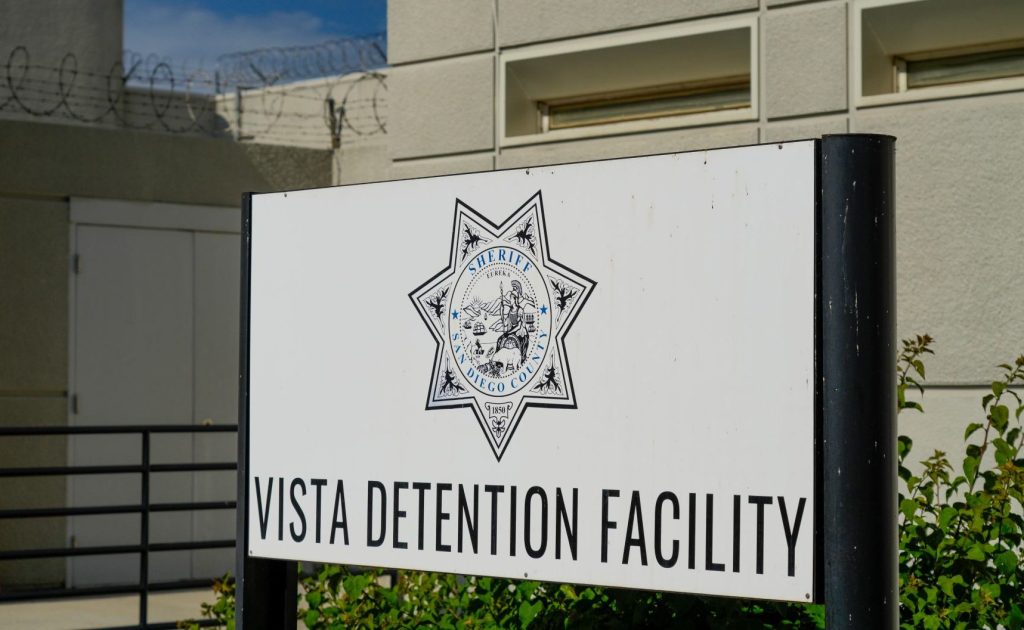
Two deputies assigned to the Vista Detention Facility were handed multi-week suspensions following the December 2024 death of Bobby Ray Patton Jr., whose desperate pleas for help in the final hours of his life were ignored by jail guards.
According to disciplinary records released last week by the San Diego County Sheriff’s Office, deputies Craig Webster and Tonee Hall-Bennetts were suspended without pay for three weeks and two weeks, respectively, after investigators found they failed to conduct required safety checks and act when Patton showed signs of medical distress.
The penalties were imposed in September after an investigation by the sheriff’s internal affairs unit. Documents show both deputies received Skelly conferences — pre-disciplinary hearings afforded to public employees who choose to rebut misconduct allegations.
The San Diego Union-Tribune requested the records under SB 519, the landmark 2023 law authored by former state Sen. Toni Atkins that significantly expanded oversight of deaths in local jails by requiring public disclosure of homicide investigations, disciplinary records tied to misconduct and other related materials.
The Sheriff’s Office initially said it would be proactive in releasing records under the law — but it was only after requests by the Union-Tribune and attorneys leading a federal class-action lawsuit over jail conditions that reports were released. So far, 16 partial reports have been posted to the department’s website.
The Patton records are the first disciplinary files released by the Sheriff’s Office under the law.
Letters signed by Sheriff Kelly Martinez to each deputy describe the misconduct in stark terms.
“You are guilty of incompetence,” the letters state. “You are guilty of acts that are incompatible with and/or inimical to the public service.”
A memo summarizing Hall-Bennetts’ Skelly conference sharply criticized her defense during the disciplinary process. Hall-Bennetts acknowledged knowing that Patton had been escorted to the medical clinic three times during the shift preceding hers, but she figured he was OK because she saw him move “and say something.”
She didn’t think it was an emergency because “inmates in East House frequently yelled.”
“Overall, the mitigating information provided by Deputy Hall-Bennetts and (her attorney) Mr. Lopez was a cold and callous attempt to avoid actual acceptance of responsibility,” Michael Binsfield, captain of detention operations, wrote in his justification for the suspension.
“As a Deputy Sheriff, you are expected to treat all persons with dignity and respect, and to demonstrate compassion in the performance of your duties,” he wrote. “In this incident, your actions did not reflect the compassion expected of a Deputy Sheriff when confronted with a person exhibiting signs of medical distress.”
He added that had Hall-Bennetts performed her duties to the expected minimum standard, “Patton’s death may have been prevented.”
Webster’s file struck a different tone. The lieutenant who handled his Skelly conference wrote that Webster accepted full responsibility for his actions and apologized.
“In closing, he added that he has taken this process very seriously and that the sustained findings in this case do not define him,” Lt. Daniel Dennis wrote.
Dennis concluded by saying he believed the disciplinary action was “appropriate and proportionate for the conduct by Deputy Webster.”
“Deputy Webster clearly violated policy, and his behavior outlined in this case has the potential to have a profound negative impact on the Sheriff’s Office,” he wrote. “More importantly, Deputy Webster showed inaction in a situation where his action could have saved the life of another.”
Neither the deputies nor their attorneys would comment on the investigation or the disciplinary records, one of the lawyers said.
Missed safety checks have been documented as an ongoing problem repeatedly by outside watchdogs, including CLERB and the state auditor and in wrongful death lawsuits.
“In our review of deaths that occurred in the department’s custody, deputies performed inadequate safety checks to ensure the well-being of those individuals,” the 2022 state auditor’s report says.
‘Please help me’
Patton was 46 when he was declared dead in his Vista jail cell on Dec. 28, 2024. He had been booked into the jail in late November on a probation violation warrant.
During intake, Patton reported a history of fentanyl use and said he was enrolled in a methadone treatment program. He was placed on detox monitoring, which was later discontinued after his condition appeared stable.
Days before his death, he was diagnosed with influenza and began treatment for pneumonia. Deputies had escorted him to the jail medical clinic the night before he died after he reported chest pain and shortness of breath.
At about 6 a.m. the next morning, Webster approached Patton’s cell during a routine safety check. Body-worn camera footage captured Patton saying “I can’t breathe” and “I’m having chest pain so bad.”
The footage shows that Webster looked into the cell, then turned away and continued toward the exit. As the deputy walked away, Patton said, “Please help me.” Webster then exited the module and turned off the camera.
Less than an hour later, Hall-Bennetts encountered Patton during a safety check.
Her body-worn camera shows she briefly looked into his cell while moaning could be heard. She then continued on without intervening.
Earlier this month, the Citizens Law Enforcement Review Board, or CLERB, found that both deputies — identified in CLERB’s investigation as Deputy 1 and Deputy 3 — engaged in criminal conduct and referred the case to the District Attorney’s Office for potential prosecution.
A spokesperson for District Attorney Summer Stephan acknowledged receiving the referral and said it was under review.
Criminal charges against jail staff are rare.
In 2019, Elisa Serna died at the Las Colinas women’s jail after a doctor and nurse left her alone after watching her collapse.
Both medical providers were later charged with involuntary manslaughter, but the nurse was acquitted and charges were dropped against the doctor after a jury could not reach a verdict.
The related civil lawsuit against the county and its medical contractor was settled for $15 million.
In May 2020, sheriff’s deputy Aaron Russell, who was assigned to the Central Jail, shot and killed 36-year-old Nicholas Bils as Bils fled, unarmed, after slipping out of handcuffs just outside the facility.
Russell was charged in state court with voluntary manslaughter and pleaded guilty, receiving a jail sentence and probation. He was also later convicted in federal court of violating Bils’ civil rights.
San Diego County separately paid $8.1 million to settle a wrongful-death lawsuit brought by Bils’ family.
As recently as last week, Martinez declined to say whether anyone had been disciplined as a result of Patton’s death, citing state law that forbids the release of peace officer personnel files.
The internal documents were released only after the Union-Tribune pressed for the records, citing language in Atkins’ law. The department turned them over the next day.
Autopsy questions remain
While the body-worn camera footage proved critical to CLERB’s review, there was no mention of it in Patton’s autopsy report, nor mention of the inadequate safety checks — meaning the deputies’ failure to respond to Patton’s pleas for help was not considered as a possible factor in his death.
Chief Deputy Medical Examiner Jonathan Lucas concluded that Patton’s death was an accident caused by acute bacterial bronchopneumonia complicated by influenza A, with substance use disorder and the effects of methadone listed as contributing factors.
The autopsy also does not address where Patton may have obtained the methadone found in his system. Records show he was supposed to be on a methadone taper.
“As a respiratory depressant, it would have reasonably contributed to the death,” Lucas wrote.
But a spokesperson for the Medical Examiner’s Office said body-worn camera footage was not reviewed as part of the investigation.
“It is not routine to request surveillance or body-worn camera footage unless it is believed to be necessary or helpful in determining the cause and manner of death,” spokesperson Chuck Westerheide said by email.
“Procedurally, if Medical Examiner’s doctors or investigators felt they needed to see the footage, they would have requested it — they wouldn’t necessarily expect it to be provided without a request,” he added.
Westerheide declined to answer follow-up questions about the Patton autopsy.