
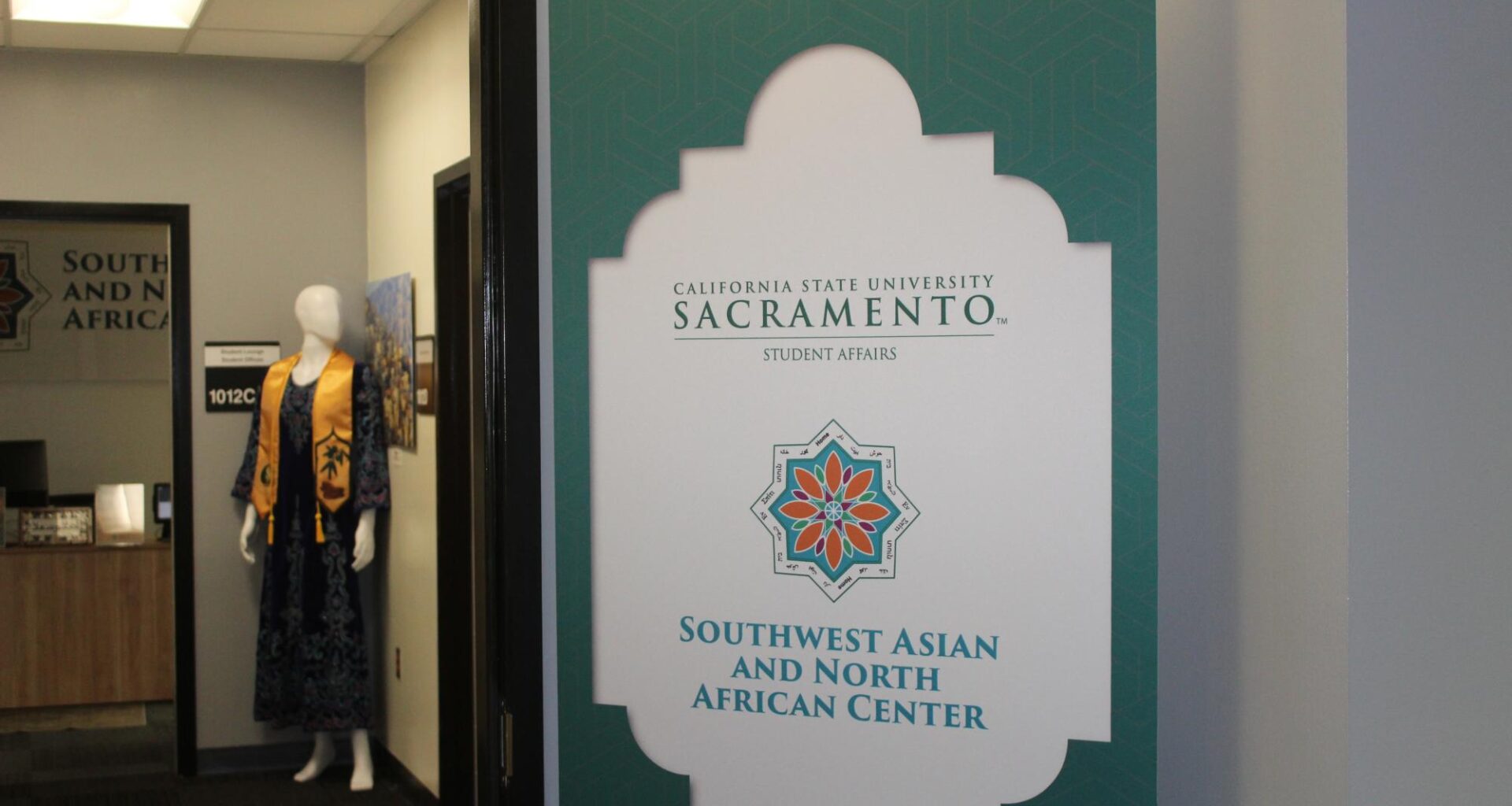
Southwest Asian and North African (SWANA) Heritage Month is recognized nationally throughout the country in April. and Sacramento State community members have discussed how to carry this recognition throughout the year.
As an Iranian-American born and raised in the United States, Sahar Razavi, an associate professor of political science, director of the Iranian and Middle Eastern Studies Center and faculty scholar advisor in the SWANA Center said people from the SWANA region are often grouped together and perceived alongside the region’s political tensions rather than as individuals with their own experiences.
“It’s very easy to find information about the region and its people that is framed in a national security framework. That’s not the kind of information that’s going to teach you about people and culture,” Razavi said. “It’s the kind of information that treats people, religions, cultures as chess pieces and not human beings.”
Marwa Al Khamees, the director of the SWANA Center, said SWANA Heritage Month is a time to celebrate the contributions and different cultures brought from the region, representing a time of hope and joy in the darkness.
“The region is literally the cradle of civilization, of writing, medicine, hospitals, education,” Al Khamees said. “It can feel a little disheartening to only see your region portrayed in a negative light in the news, and so [it’s] bringing more awareness to non-SWANA people about the region.”
Amelia Qin is an assistant professor of history and humanities of East Asia. Qin said that she hasn’t seen much public focus on SWANA, but it is important because it creates familiarity with these groups.
“It offers an important aspect to a balanced representation of all cultures and communities that we engage with in Sacramento,” Qin said.
Raising awareness to instructors teaching world history and religions could highlight SWANA contributions to the local community, Qin said.
“We would want specialists – faculty specialized in these areas to be hired on campus right, to start their teaching here and design courses that focus on these areas,” Qin said.
Micheal Vann, a professor in the history department, said that integrating the ideas of intersectionality into education can allow SWANA to be highlighted outside of one heritage month. He said many students coming into his classes don’t know about the SWANA region.
“I teach big world history classes where I talk about this part of the world and frequently, many of my students have had very Eurocentric educations in regards to history and know a lot about Europe, but don’t know about the glories of Baghdad or the Ottoman Empire,” Vann said.
Vann said he encouraged students to develop their knowledge of the world to become more informed and interesting people. He said the practice has been changed through the expansion of area 3B, the Humanities course in the general education requirements, which used to further highlight various global cultural traditions.
RELATED: First-ever SWANA festival celebrates culture with regional treats and music
“One of the things that has really been weakened is exposure to other cultures. I encourage students to take the time to take a world history class or world culture class or world religion and learn about the rest of the world,” Vann said.
The use of the term ‘SWANA’ is important because it recognizes the contributions of people who have given to humanity over the years, Al Khamees said.
“By saying it’s the Southwest region of Asia and North African region, you are naming the space, you’re naming its people and so it gives more agency to those populations,” Al Khamees said.
June Hee Kwon is an associate professor in the Asian Studies Program. Kwon said when considering the inclusivity of a term like SWANA, people need to weigh whose point of view it comes from.
“The term of inclusiveness itself is a really power-laden concept,” Kwon said. “So who is including whom? Why? So this is America, that’s why I’m going to include you others, from other world. So that’s a very American-centric term and perspective too.”
Vann said it can be difficult to categorize countries into SWANA, which can include Morocco, Algeria, Tunisia, Libya, Egypt and sometimes Afghanistan or Pakistan, among others. Like Vann, Kwon said within representation, people have different identities and history. She said that people must recognize the interconnection between them.
“This kind of random grouping, random categorization, has a lot of things to do with power,” Kwon said. “Who wants to see them that way? So that’s why representation is not just a pure or innocent viewpoint, it really reflects the power.”
Supporting SWANA people can look like simply adopting the use of the term SWANA in place of “the Middle East,” Razavi said.
“It’s colonial in the sense that it was born out of European colonialism and it’s a very Eurocentric term because both ‘middle’ and ‘east’ require your reference point to be Europe,” Razavi said.
Education is the first tool to support SWANA people,. people can continue to recognize the SWANA region and people outside of April by diversifying their news sources, Al Khamees said.
“I would want to study the history of the region, learn about the history, the contributions, the culture, so that way I am not falling victim to stereotypes of whatever people want me to understand,” Al Khamees said.
Celebrating SWANA cultural practices, practicing holidays and eating at restaurants are all ways to learn more about the culture, Razavi said. She said people should take an approach of lifelong learning, recognizing that people may not learn everything in one day.
“In this era where we have more power in our pockets than the computers that sent people to the moon for the first time, there’s no reason for us not to have a deeper education about different people, including SWANA people,” Razavi said.
Students from all backgrounds are encouraged to stop by the SWANA Center, Al Khamees said. The Center provides services throughout the year and puts on the events of SWANA Week in April alongside their typical services such as academic advising, partnering with peer wellness advocates, career advising and holistic retention advising.
RELATED: SWANA Center opening ceremony celebrates vibrant regional culture
People should seek out sources that provide information about the culture and humanity of SWANA people, Razavi said, not just war or genocide. She said that people can continue to highlight the SWANA region and people outside of April by connecting with and supporting each other across communities.
“In the last couple of years, I have become increasingly jaded about institutions, but increasingly inspired and impressed by students,” Razavi said.
Razavi said she wished students felt more comfortable reaching out to each other. She said students should take a leap of faith to engage with good intentions.
“Basically every student that I come across feels very empathetic towards just about everybody but they’re so nervous about saying the wrong thing that they have a hard time taking that step to reach out to someone that they’re thinking of and concerned about,” Razavi said.