
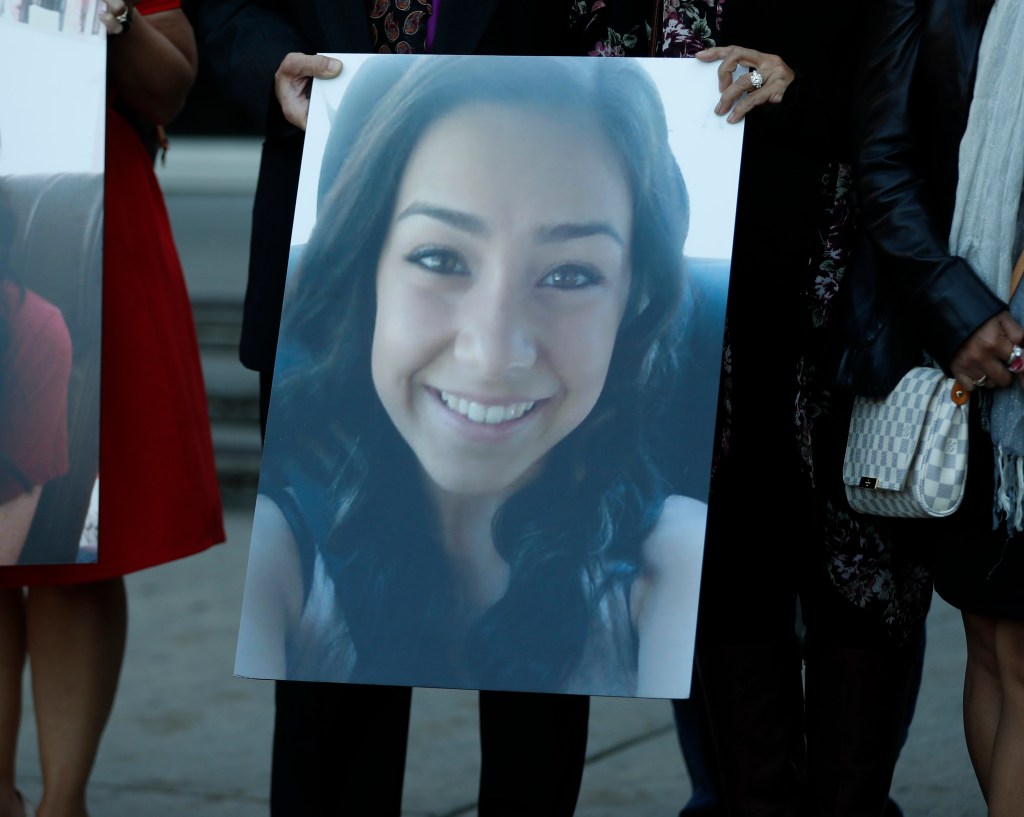
The countdown is on for the California Supreme Court to decide whether it will review the reversed murder conviction of the man imprisoned for the presumed 2012 kidnapping and murder of Sierra LaMar, whose body has never been found in one of the most gripping crimes in South Bay history.
Earlier this month, the California Attorney General’s Office petitioned the state’s highest court to evaluate the Feb. 27 ruling by the 6th District Court of Appeal that threw out murder and related charges against 35-year-old Antolin Garcia Torres in 15-year-old Sierra’s disappearance as she walked to a Morgan Hill-area bus stop for school on March 16, 2012.
The appellate court found that the Santa Clara County Superior Court erred by allowing the county District Attorney’s Office to prosecute the murder and kidnapping charges involving Sierra alongside unrelated attempted kidnapping allegations reported three years earlier in parking lots of Safeway grocery stores, at least one of which was Garcia Torres’ workplace.
Prosecutors characterized the prior allegations as a “training ground” for the crimes against Sierra to argue premeditation in the teen’s killing. In undoing the conviction, which resulted in a life-without-parole prison term for Garcia Torres, the appellate judges ordered that if prosecutors decide to re-try him, they are barred from telling a jury that Garcia Torres planned to kill Sierra, or from citing the prior attempted kidnapping claims in arguing for his guilt.
Garcia Torres will remain incarcerated — records show he is being held in Corcoran State Prison — pending the appellate process and any subsequent decision by the district attorney’s office on whether to re-file a murder charge against him. According to court rules, the state Supreme Court has 60 days after a petition is filed to decide whether to review a lower court opinion; the court can extend that decision window for up to 30 days.
Court records show that the attorney general’s petition was received April 8, which means the high court could take until the second week of July to announce whether they will review the case. If the time window passes without a decision, the petition is considered denied; local prosecutors would then be free to re-file charges.
The district attorney’s office deferred comment to the attorney general’s office, which is litigating the appellate case on their behalf and did not respond to a request for comment. Garcia Torres’ appellate attorney who secured the ruling overturning the conviction also did not respond to messages seeking comment.
However, the California District Attorneys Association, which represents most of California’s elected county prosecutors, wrote a letter to the state Supreme Court, urging justices to take on the case and undo the conviction reversal. In the 18-page missive, the association’s CEO Greg Totten — a former Ventura County district attorney — contends that the 6th District judicial panel “substituted its personal judgments of the evidence” to reach its conclusion.
The CDAA letter states that its position echoes part of the attorney general’s petition, and argues that the trial court did not act “outside the bounds of reason” when it allowed the prior kidnapping attempts to be jointly prosecuted.
The organization also asserts that the fact Sierra’s body still has not been located, despite years of weekend volunteer searches of the area following Sierra’s disappearance, “circumstantially suggests a preconceived plan to dispose of the body” and supports the notion that some premeditation and planning factored into Garcia Torres’ alleged plot.
One major tenet of the letter also argues that the state Supreme Court reverse the appellate ruling and provide undisputed, clear guidance to trial courts and prosecutors across the state.
At the 2017 trial for Garcia Torres, prosecutors relied heavily on DNA evidence they said linked Garcia Torres to Sierra, including traces found in his car, a strand of hair discovered on a piece of rope in the trunk and his DNA found on Sierra’s pants, which were recovered in a field.
His defense suggested the possibility that Sierra had run away from home, and he denied ever meeting Sierra and initially said he had been on a short fishing trip the morning she disappeared. After being confronted by sheriff’s office detectives with DNA evidence, he said he periodically masturbated in his car and discarded tissues and napkins out the window.
In the 6th District ruling, Justice Adrienne Grover wrote the three prior attempted kidnapping counts — in which Garcia Torres was accused of forcing his way into the cars of three women in Safeway parking lots in Morgan Hill over a one-week span — should have been severed from the murder case, stating that the “charged murder bore much less resemblance to the three Safeway incidents.”
She further scrutinized the original conviction by noting that “Sierra’s body was not found, raising a question as to the fact of her death, and no evidence clearly established how she died or how defendant had caused her death.” Grover ultimately concluded that “the prosecutor’s arguments at trial which encouraged the jury to consider the evidence cumulatively also contribute to our finding of prejudice,” and that “the improper cross-admission of the charges constitute prejudicial errors requiring reversal.”
In recent years, the state Supreme Court has agreed to review multiple high-profile cases from Santa Clara County where prosecutors challenged an appellate court’s reversal of an initial conviction.
Those include the 2017 murder verdicts against three county jail deputies convicted in the 2015 killing of mentally ill inmate Michael Tyree, which were overturned in 2022 citing legislative changes that nullified the “natural and probable consequences” doctrine that allowed prosecutors to argue that multiple defendants could be collectively guilty of a murder by acting in concert even if it was unclear if all members directly participated in the killing.
The Supreme Court upheld the reversals, and the three men later pleaded to voluntary manslaughter counts — resulting in them being paroled — under an agreement that required them to admit to being responsible for Tyree’s death in open court.
The high court has also opted to review the 2020 rape conviction of former San Francisco 49ers star Dana Stubblefield, who secured a conviction reversal in late 2024, also from the 6th District court, which ruled that racially tinged remarks in the prosecutor’s closing arguments constituted violations of the Racial Justice Act of 2020.
Stubblefield has been subsequently released from prison custody, and the Supreme Court review is on hold pending the outcome of two death penalty appeals from Los Angeles County that could set precedent for what relief defendants are entitled to under the relatively new law.