
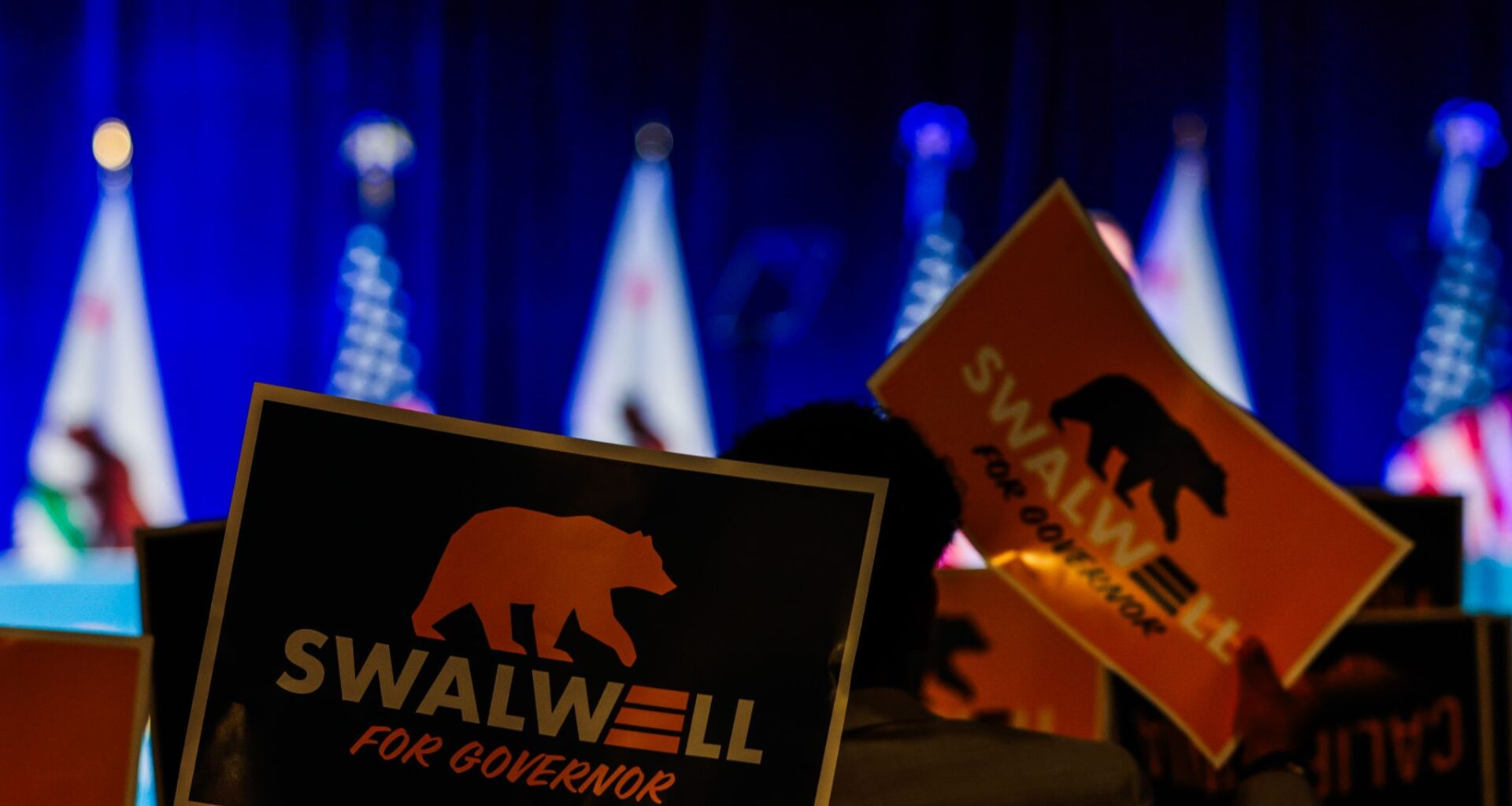
Supporters watch Eric Swalwell delivers remarks during the California Democratic Party convention at Moscone Center in San Francisco on Feb. 21, 2026.
Yalonda M. James/S.F. Chronicle
More than 200 donors are seeking more than $1.5 million in refunds from former Rep. Eric Swalwell’s gubernatorial campaign in the wake of allegations he sexually assaulted multiple women, according to an internal campaign document viewed by the Chronicle.
Swalwell’s campaign swiftly imploded earlier this month after the Chronicle published an April 10 article detailing allegations from a former staffer who said he sexually assaulted her twice when she was too drunk to consent. Since the Chronicle published its story, several more women have come forward with similar allegations. Many of his staffers resigned en masse and called for him to drop out.
Swalwell ended his bid for governor on April 12 and announced the following day he would resign from Congress.
Article continues below this ad
In the weeks that followed, some campaign staffers became inundated with refund requests. The Chronicle viewed multiple emails exchanged among people working for the Swalwell campaign referring to the hundreds of refund requests and the lack of clear guidance about what to do with them.
An El Sobrante man who donated $250 to Swalwell’s campaign in early February has been trying to get his donations back since shortly after the allegations against the former congressman broke. He said he reached out to the Democratic fundraising platform ActBlue and the Swalwell campaign. Only ActBlue responded initially, directing him to a general campaign email. The donor, Mike Hsieh, reached out again after he read a story in the Chronicle on Friday about how Swalwell had used $40,000 to pay a lawyer who has been appearing on TV on his behalf, arguing the allegations are false.
San Francisco Chronicle Logo
Make us a Preferred Source to get more of our news when you search.
Add Preferred Source
“I was very much incensed. It feels truly unjust because it has nothing to do with the campaign,” Hsieh told the Chronicle. “This seems to me to be illegal, or at least it should be.”
A former Swalwell staffer responded to Hsieh on Monday morning, according to an email reviewed by the Chronicle, and told Hsieh that he could not help.
Article continues below this ad
“We have not received an authorized procedure or clear direction on the refund process,” the former staffer wrote. “We apologize, as this is not the update we were hoping to provide. If it were up to me and my former colleagues, refunds would be the top priority.”
A lawyer advising the Swalwell campaign on campaign finance issues did not immediately respond to questions from the Chronicle about the flood of refund requests and whether the campaign had begun issuing any refunds.
Swalwell, whose financial records indicate he carries significant personal debts, appears to be relying at least in part on campaign funds to cover mounting legal expenses related to the sexual misconduct allegations.
In the most recent financial disclosure report for his gubernatorial campaign account, running through April 18, Swalwell’s campaign reported $4 million in cash on hand and about $200,000 in unpaid debts. The report also shows a $40,000 payment to high-profile defense attorney Sara Azari, who Swalwell hired in the days after the Chronicle published its investigation.
Azari would not say whether Swalwell is using campaign funds for his legal defense and how his payments to Azari so far comply with California law limiting campaign spending on attorney’s fees.
Article continues below this ad
“The scope and nature of an attorney’s representation of a client — including fees, costs, and the financial structure of the engagement — are privileged and confidential,” she wrote in an email. “I respectfully decline to answer your questions on that basis.”
Shery Yang, a spokesperson for the state campaign finance watchdog the Fair Political Practices Commission, did not comment on Swalwell but referred the Chronicle to rules that permit the use of campaign funds for litigation costs only when they are directly related to the activities of the campaign committee or the activities, duties and status of the candidate. That includes compliance with election laws, challenging ballot language and recounts, but also “action to halt defamation,” a broad category that Yang did not clarify.
Candidates are separately allowed to raise money into a legal defense committee for expenses related to sexual assault claims, but they must reimburse those funds if they are found liable. Swalwell has not opened a legal defense fund, according to state campaign finance records.
Jessica Levinson, a professor at Loyola Law School with expertise in election law, said Swalwell will likely argue that the women have only come forward with accusations because he was running for governor, justifying his use of campaign funds to pay Azari. His critics will argue that the expenses are personal, rather than campaign-related.
“The main question is would he have incurred these questions but for the campaign,” she said. “If these are private expenses, then no, he should not use donor funds to pay them.”
Article continues below this ad
Legal loopholes and lax enforcement sometimes allow politicians to redirect campaign contributions toward personal legal bills. After leaving office in 2021, President Donald Trump spent more than $100 million defending himself against congressional investigations, multiple indictments and a trial where he was convicted of falsifying business records to cover up hush-money payments to a porn star. He’d initially raised the money to fight the results of the 2020 presidential election.
Several law enforcement investigations into Swalwell are now in progress.
The woman the Chronicle interviewed confirmed she is cooperating with an investigation by the Manhattan district attorney’s office into an April 2024 incident in which she said Swalwell sexually assaulted her after a charity gala. Another former Swalwell staffer who spoke to the Chronicle on condition of anonymity said both the Manhattan district attorney’s office and the FBI reached out to them last week, though they said the subject of the latter’s investigation was unclear.
The Los Angeles County Sheriff’s Office is investigating accusations by another woman, Lonna Drewes, who reported four days after the Chronicle published its story that Swalwell drugged and raped her in 2018.