
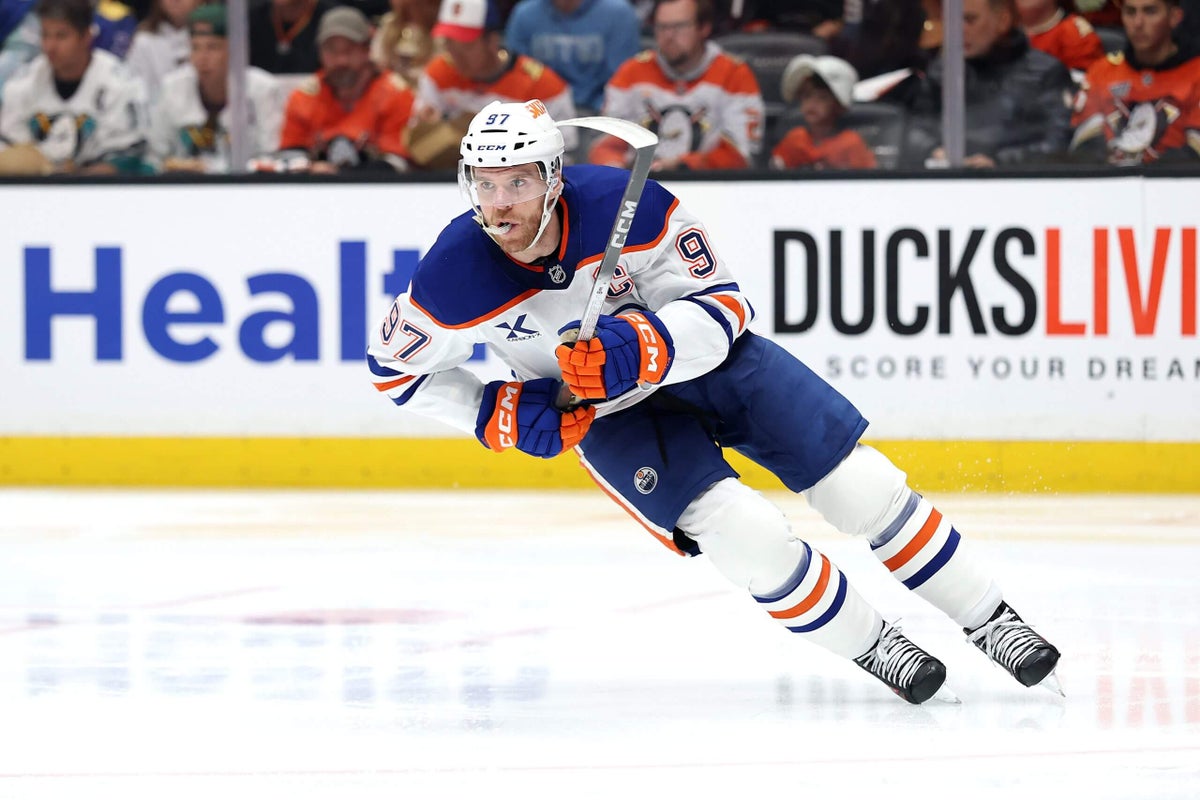
ANAHEIM, Calif. — Connor McDavid, after his shortest, most soft-spoken postgame interview of the Stanley Cup playoffs thus far, headed out from the Edmonton Oilers’ dressing room to the hallway of Honda Center and climbed on an exercise bike Sunday night.
Whatever is wrong with McDavid’s ankle, an injury he sustained in Game 2, before his Oilers dug themselves a 3-1 hole in this first-round series against the Anaheim Ducks, it hasn’t forced him to the bench. It hasn’t put him in a brace. It hasn’t stopped him from getting in some postgame cardio, as was seen after Sunday’s 4-3 overtime loss.
It has, with increasing clarity, left him often wincing on the Oilers’ bench, less capable of hitting his all-world fifth gear, struggling with his lateral movement and generally moving through the series as a diminished version of himself. He’s healthy enough to play, and on Sunday, for a second straight game, he was healthy enough to produce a pair of points. The Oilers, as a collective, were effective enough to come within a few millimeters of an opportunity to tie the series 2-2 before heading back to Rogers Place for Game 5 on Tuesday.
They didn’t close the deal, though, and they find themselves here — one loss from following two consecutive trips to the Stanley Cup Final with a first-round elimination, searching for new buttons to push and circling back to ones that, in the last few days, have gotten jammed.
“It’s not really about Connor McDavid,” McDavid said. “This is about two teams that are trying to figure each other out. And obviously, they’re playing well, and we’ve got another level as a group. But I still thought there were some good signs (on Sunday).”
The Ducks, indeed, have been a revelation, and plenty has gone wrong for Edmonton outside of McDavid’s lower body. But with every bit of respect due to Edmonton’s captain, quite a bit of this is indeed about him. Asked about the state of his health on Sunday, he responded by saying the Oilers “feel we’re all doing the best we can out there.”
Not great. He’s not himself, and neither seems to be teammate Leon Draisaitl, who, in a remarkable bit of timing, returned for Game 1 after missing a month with a knee injury. Those two bits of inconvenient reality, perhaps more than any others the Oilers face, are what take their comeback attempt from an uphill climb to a mountain summit. Superstars, as Edmonton knows better than anyone, are often cheat codes. Struggling penalty kill? Punch it in. Inconsistent goaltending? Punch it in. Brutal team defense? Punch it in.
Edmonton has dealt with all three against the younger, faster, healthier Ducks, and there’s not much of a reason to believe any of it will change over the next few days. Maybe Anaheim, one of the league’s streakiest teams in the regular season, will hit the downslope a bit early. The Ducks lost 13 of 15 earlier in the winter, then soon after won 20 of 27, and then closed the regular season by dropping eight of 10. Wild things — such as a puck sliding the minimal amount of distance over the goal line necessary to count as a goal — happen every day.
The issue for the Oilers, though, is that three games’ worth of breaks will have to go their way over the next five days. So goes life with zero margin for error.
It’s not that Edmonton is unfamiliar with the concept. In 2024, they came back from 2-1 deficits against both the Los Angeles Kings and Dallas Stars. In 2025, the Kings had them down 2-0.
Things don’t quite feel the same, though. Crucial mistakes and an ineffective penalty kill are one of the through lines, as coach Kris Knoblauch said on Monday. In consecutive games, Edmonton has gone to the box with a two-goal lead, allowed a power-play goal and then lost. In the series, they’ve allowed six short-handed goals overall.
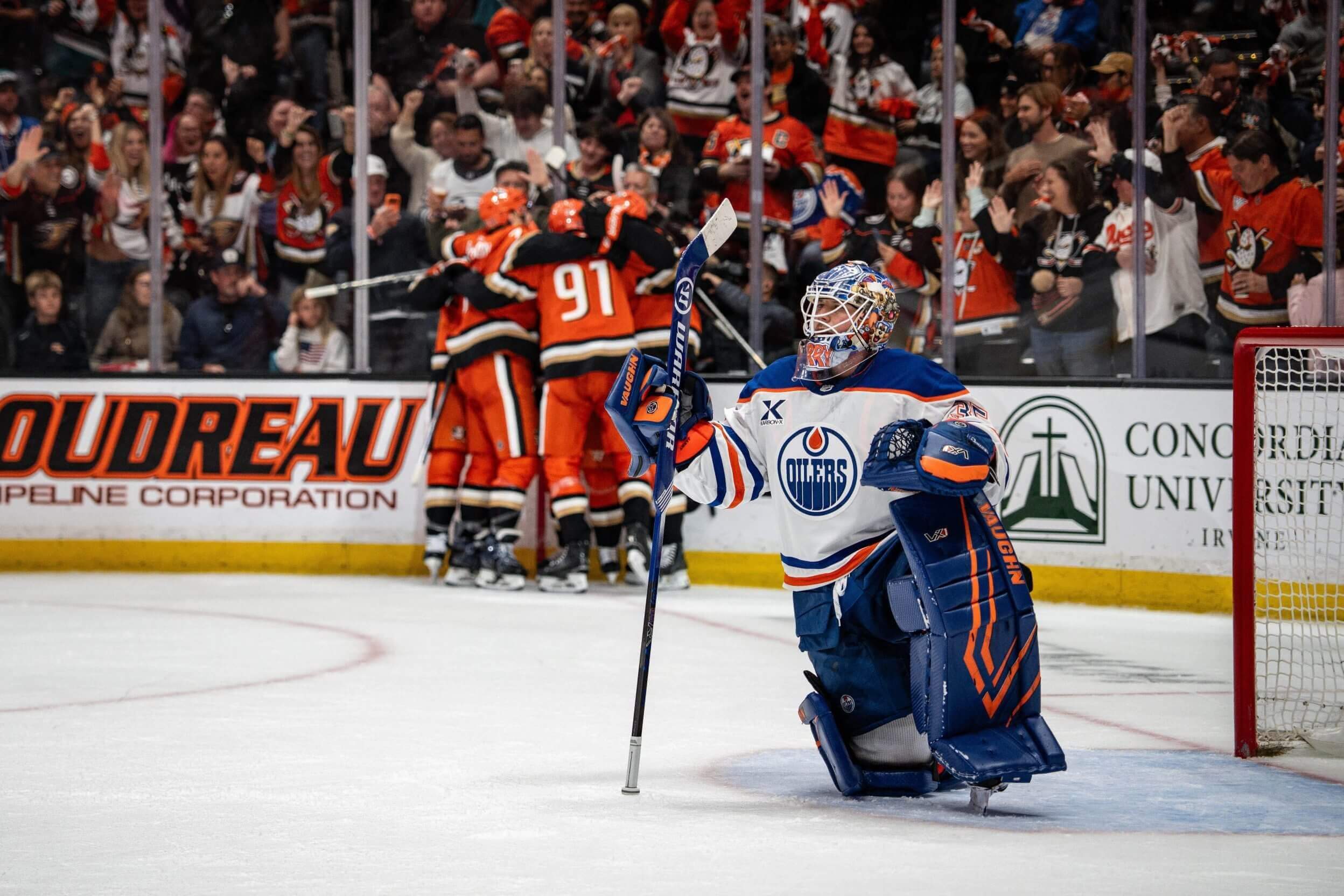
In three games for Connor Ingram and one for Tristan Jarry, above, the Oilers’ goaltenders have oscillated between vaguely competent and actively bad. (Corinne Votaw / Imagn Images)
“We haven’t been able to get the last save or another clear or a blocked shot or a loose puck or something like that,” Knoblauch said. “It’s unfortunate. Credit to Anaheim (for) playing a good game, but we’ve got to find ways to be just a little bit better.”
Team defense has been an issue, too. There, the Oilers seemed to bottom out in Game 3, allowing regular odd-man rushes, consistently making poor decisions at the net front and playing poorly enough to make one 7-4 loss feel like it should’ve counted for two. In three games for Connor Ingram and one for Tristan Jarry, the goaltenders have oscillated between vaguely competent and actively bad.
Those aren’t new problems. In a different year, at a different level of effectiveness, Edmonton’s pair of Hart Trophy winners would wallpaper over the nail holes. This April? Not quite.
It’s not that McDavid or Draisaitl are playing poorly. The former bounced back with a break-even five-on-five game on Sunday after Edmonton was out-attempted 33-17 with him on the ice and held an expected goal share of just 43 percent. The latter has centered Vasily Podkolzin and Kasperi Kaspanen on what has been Edmonton’s most effective line by a mile or two. McDavid was close enough to full strength to streak through the zone for a third-period tie-breaker attempt that was knocked off course by the toe of Ducks goalie Lukáš Dostál’s. Drasaitl is still hitting teammates in stride with backhand lasers on the regular. Whatever percentage each is operating at — 65, 85, 90 — is higher than most players’ top end. The Oilers need more, though, and time is running short.