
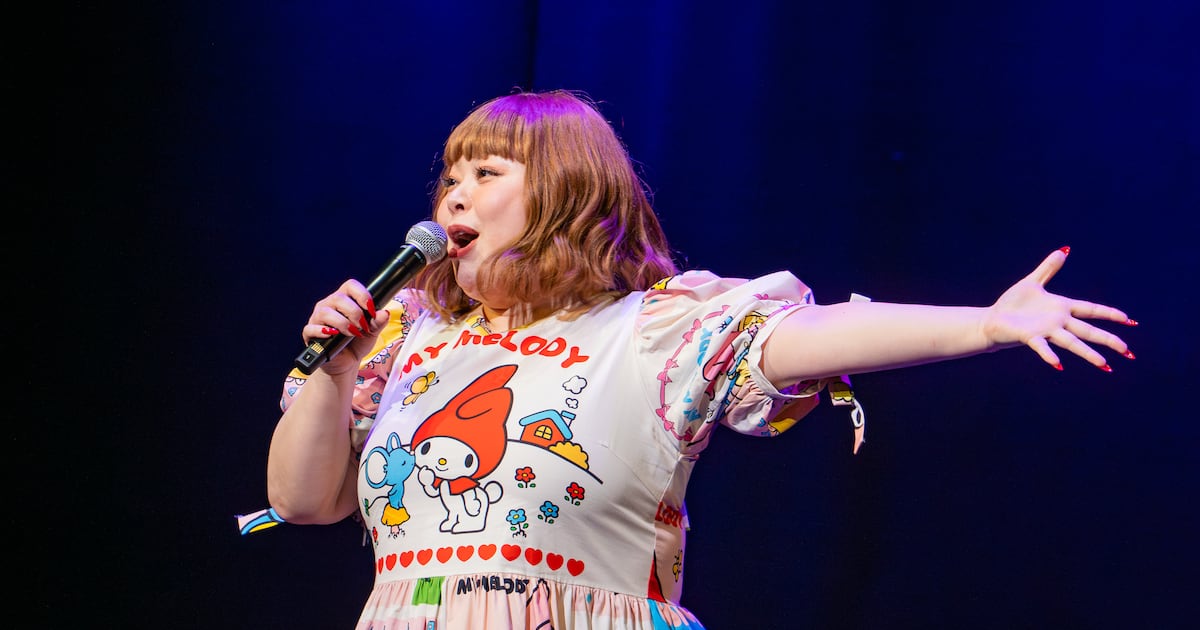
Naomi Watanabe, comedian, actor, fashion icon and one of Japan’s most recognizable entertainers, came running out April 17 to a crowd at the Wiltern, dressed in a pink patchwork gown printed with My Melody, in bold reds, blues and yellows. The dress puffed at the sleeves and fell into soft ruffles at the hem. Her short waves and baby bangs playfully reflected the bright pink stage lights.
Watanabe’s “From Tokyo” stand-up comedy tour is her most ambitious North American run to date and her first fully English show. Los Angeles marked the opening night of the spring tour spanning 18 cities across the United States and Canada. It follows a sold-out February performance at Tokyo Dome, and she reflects on her journey of her move to New York City from Japan four years ago and what she found along the way.
Two opening acts, Zavior Phillips and Sabrina Wu warmed up the crowd. Following that, Watanabe’s set unfolded like a guided tour through what she called the “mysteries of America,” the small, absurd and sometimes uncomfortable cultural differences she was genuinely baffled by from her first years living in the U.S.
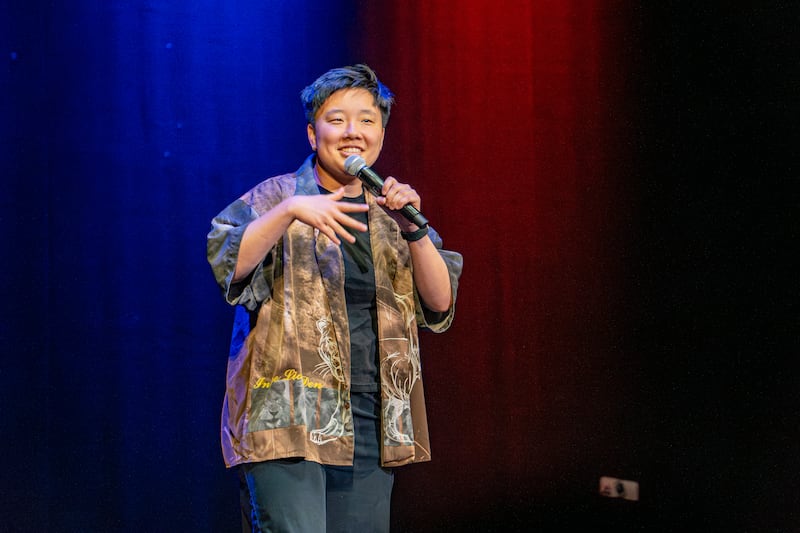 Sabrina Wu shares her experience as an Asian, non-binary person in her set. (Photo by Laury Li)
There was the toilet stall door gap — the inexplicable American design choice that leaves a large sliver of space between the door and the frame. Why, she said, was it possible to make full eye contact with a stranger while inside? There was the absence of a sound system in public bathrooms to cover up the sounds of using the bathroom, something she had taken for granted in Japan. The silence made her feel vulnerable.
Watanabe moved quickly between observations: The plastic wrap that simply refuses to cling like an irresponsible boyfriend; the shower head bolted permanently to the wall, immovable, which prompted what might have been the most memorable question of the evening: How do you wash down there? Everyday inconveniences became existential crises of deadpan disappointment of the glorious America.
She recounted a visit to Chicago, where audiences at her show had told her to order a chocolate milkshake at a bar. What arrived was not a milkshake, but a performance. Watanabe’s response: she was still thirsty, and also, she has a chest too, so this was not particularly novel. The bit landed cleanly. So did her account of a threatening encounter on a New York City street, after which her friends responded with a prideful “Welcome to New York.” She could not understand why that was considered a welcome.
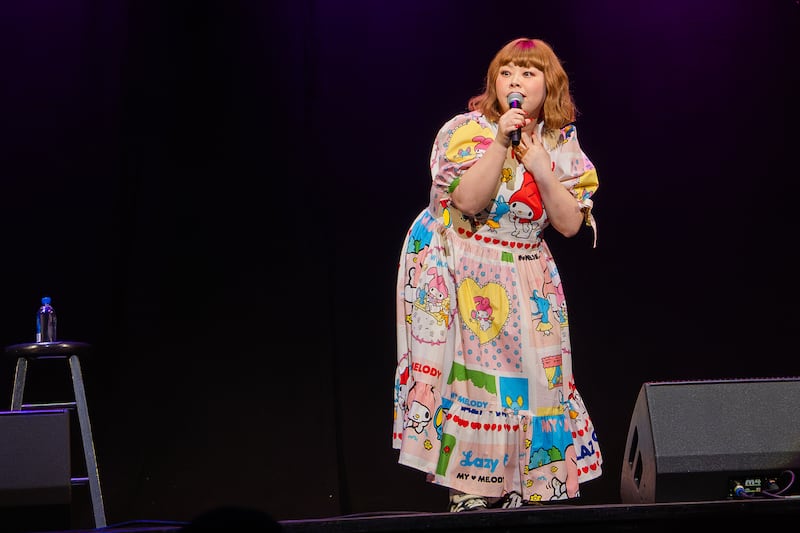 In a Sanrio-themed dress, Watanabe shares humorous observations about life in the United States. (Photo by Laury Li)
The crowd, many of whom were of Japanese origin, erupted with relatable laughter. Those who may have never thought twice about these things were pleasantly surprised by how drastically the Japanese comedy experience differs from American ones.
“You go see American comedy and someone’s making jokes about Trump, or there’s politics. Which is fine, but it gets old. This was different. I thought it was entertaining because it was new,” said Scott Sorrell, who attended the show with little prior knowledge with his wife who is a longtime Watanabe fan.
The through-line of the “mysteries of America”, however, was not complaint. Watanabe told the audience that the difference between who she was when she first arrived and who she is now is significant. In the beginning, these were genuine hardships. Now, she said, she does not care about any of it. She has embraced and adapted. Her motto is: “When in Rome, do as the Romans do.” Now, she’s happy to be a part of two different cultures, to be “American” and even joking that she does handstands when she needs that extra wash.
Meg Wright, who said she had followed Watanabe’s career for more than a decade through Japanese television, attended the show with her girlfriends for the first time as a live audience member.
“Everybody was nodding at all those mystery things she was talking about,” Wright said. “It was just making us happy.”
Watanabe grew up in the Japanese countryside until she was 15-years-old when she made her way to Tokyo despite her mother’s objections. Her 2008 impression of Beyoncé on a Japanese comedy talk show catapulted her to international recognition, becoming a viral moment that led her to meet Beyoncé herself. She has since built a career that spans television, fashion, podcasting and live performance, with global brand partnerships and her own streetwear line, Punyus. In 2024, she was named to the BBC’s 100 Women List.
Friday’s show touched on her origin story with both humor and candor. She described her Taiwanese immigrant mother’s early concern that she might join the yakuza and traced her path from the countryside to Tokyo to New York. She also spoke about her experience of being on a dating app for the first time, and navigating the “real English” she definitely had not been taught at school was the real challenge.
Nathan Phan, whose parents are immigrants, said Watanabe’s discussion of her own background having a Taiwanese mother and a Japanese father resonated in ways he had not anticipated.
“The way immigrant parents communicate can be very harsh, but it’s beautiful to see that she’s still able to talk kindly of her family. That’s what a lot of children of immigrants have to do. Navigate those meanings and find what’s between the lines,” Phan said.
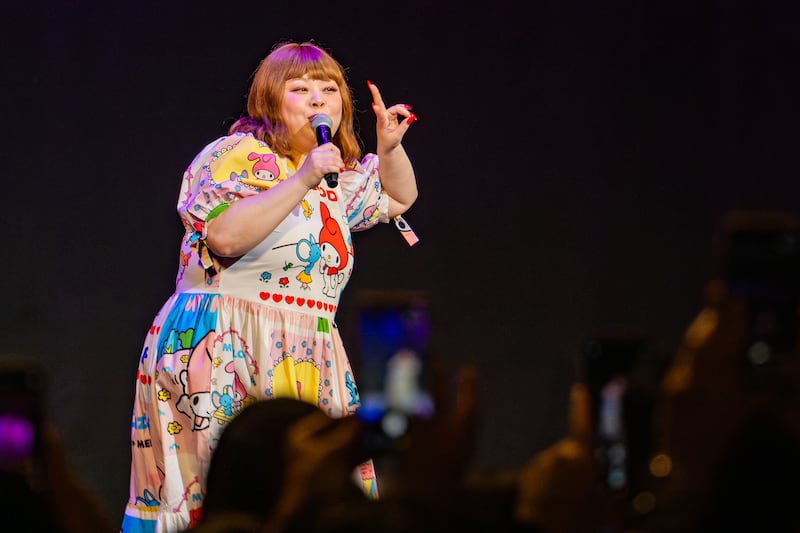 Watanabe poses for photos at the end of the show. (Photo by Laury Li)
The night closed with an open audience Q&A. When asked what she missed most about Japan, Watanabe didn’t skip a beat: plastic wrap. When asked the best thing to do in your twenties: make lots of mistakes. Then an audience member asked if Watanabe could teach her how to twerk, a move she had mentioned earlier was a part of her American cultural education. Watanabe called for music.
Karen Chu, a retired attendee who came at her cousin’s recommendation with no prior familiarity with Watanabe’s work, said she left wanting to see her again.
“She’s very quick-witted,” Chu said. “She’s very relatable.”
Watanabe’s universal humor is largely about bridging between Japanese and American cultures, between discomfort and confidence and between who you are and who you are becoming.
For Phan, the evening amounted to something more than entertainment. He mentioned that he writes and records music but has been reluctant to perform publicly. Watching Watanabe conduct a two-hour show in her second language, in front of a full crowd, in a country she moved to four years ago shifted something.
“Every time I go to shows, I get inspired and reinvigorated,” he said. “These people are living their true selves on stage. For someone like Naomi, who is very herself, it really makes me want to pursue my dreams.”