
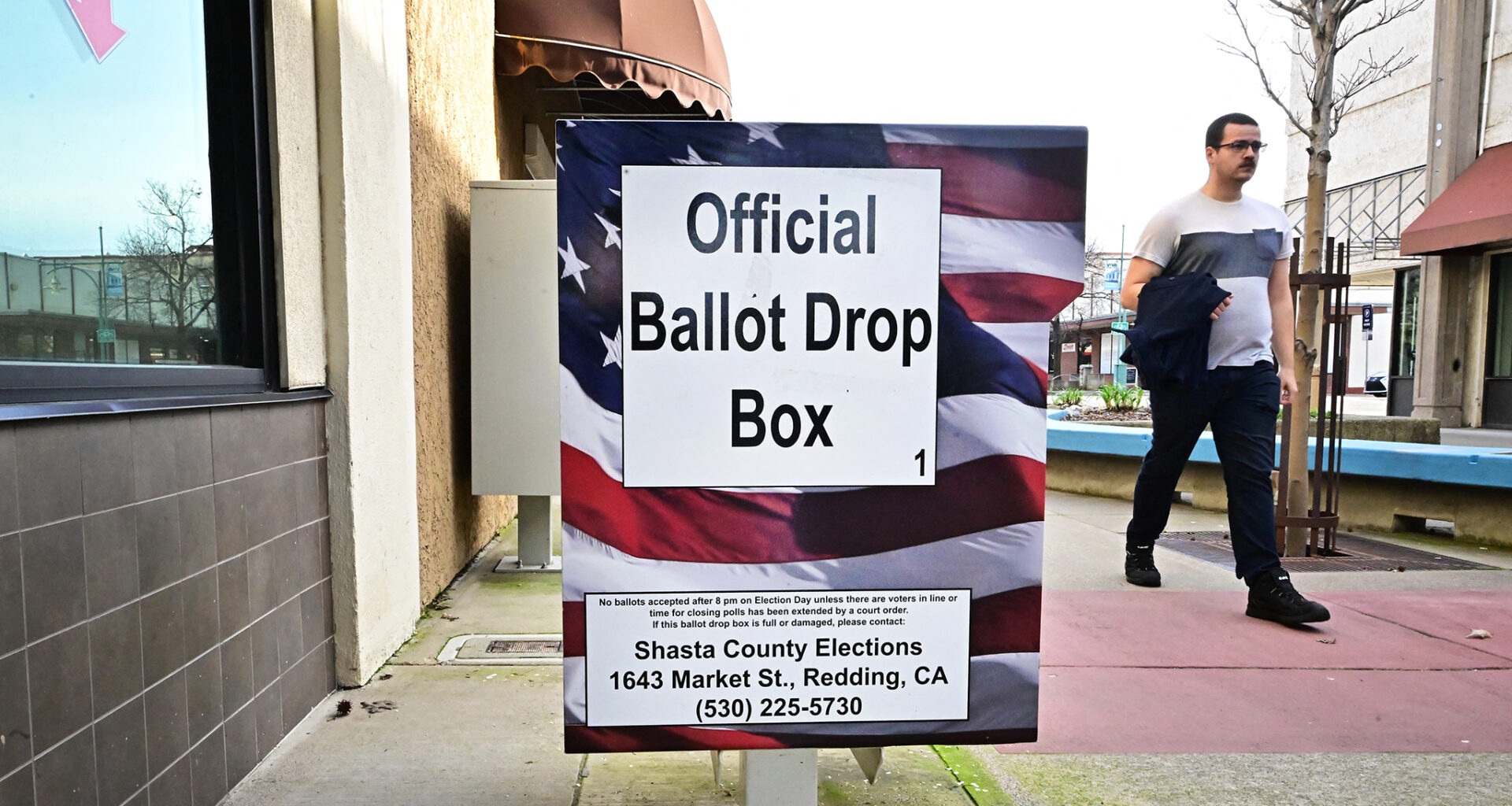
FILE: A pedestrian walks past a ballot box outside the Shasta County Clerk & Registrar of Voters offices on Feb. 23, 2024, in Redding in Northern Califonia’s Shasta County.
FREDERIC J. BROWN/Frederic J. Brown/AFP/Getty Images
Two highly contentious ballot measures are expected to come before California voters in November.

The first is the GOP-backed brainchild of a conservative California Assembly member. If passed by voters this fall, it would require voters to bring a valid government-issued ID to vote. At present, California voters are only required to give their name and address to cast their ballot.
Article continues below this ad
Assemblymember Carl DeMaio, who represents San Diego, has argued that a voter ID law would help protect against voter fraud, while Democrats push back and say the measure is part of the Trump administration’s agenda to keep people away from the polls. It cleared the threshold on Friday evening after garnering more than 962,000 valid signatures, according to the Secretary of State’s Office.
A second proposal introduced by SEIU, the state’s largest health care union, would impose a one-time wealth tax on the net worths of the state’s more than 200 billionaires and use the revenue to fill the gap in health care funding due to President Donald Trump’s 2025 budget bill. The campaign announced on Monday that it had collected 1.5 million signatures, and the coalition said it was filing those signatures to the Attorney General’s Office and county registrars by the end of the day.
Both measures needed at least 875,000 signatures to qualify for the November, according to the Secretary of State’s Office, which will now have to certify the submissions.
Make SFGATE a preferred source so your search results prioritize writing by actual people, not AI.
Add Preferred Source
Now that the measures are headed to the ballot, Californians should expect to see even more campaign outreach as advocates ramp up their efforts to make their case to voters over the next six months. The general election is Nov. 3.
Article continues below this ad
In an April survey from UC Berkeley’s Institute of Governmental Studies, a majority of voters (52%) said that DeMaio’s voter ID law is the “wrong approach” to resolving voter confidence, while 39% supported the idea. This proposal comes amid a national Republican-led effort to require people prove their identity — and, per a new Trump administration proposal, potentially citizenship — to vote in elections. Republicans argue such measures would quell fears of voter fraud, despite no evidence of widespread fraud taking place in local and national elections.
Those who are against voter ID laws argue it will make voting harder for some and could discourage people of color or low-income people from voting. Thirty-six states already have some form of a voter ID law in place, according to the National Conference of State Legislatures.
Meanwhile, 50% of voters supported the wealth tax, according to a separate March poll from UC Berkeley Citrin Center for Public Opinion and Politico, while 28% opposed it.
“Ultrawealthy billionaires have seen their fortunes skyrocket even as food, rent, gas prices increase, crushing working families who are struggling to stay afloat,” said Mayra Castenada, health care worker and member of SEIU. “So when hospitals are starting to cut services, clinics are closing and families are set to lose health care coverage, we say those who have prospered here in California can afford to invest a little more to keep California running.”
Article continues below this ad
She said they got voter support despite a “very small group of the most controversial billionaires” who “tried to stop us.” That group presumably includes billionaires like Google co-founders Larry Page and Sergey Brin, along with venture capitalists David Sacks and Peter Thiel, who made moves to relocate their businesses around the time the ballot proposal first gained steam.
In 2023, Massachusetts passed a “millionaire’s tax” on residents who earn over $1 million a year. The proponents of the California measure pointed to that policy as evidence that the billionaire’s tax in California will have similar success. “Fair taxation is just good policy, just ask Massachusetts,” Liz Perlman, another union leader, said at Monday’s press conference, adding that people continually said residents would leave that state, but that wasn’t the case.
“Being taxed like every other resident will not hurt the billionaires. It will not reduce the number of yachts they get to water ski behind,” she said.
Article continues below this ad
If voters approve the initiative, the California Franchise Tax Board will be responsible for administering the tax by valuing the wealth of each billionaire. Billionaires will also have a chance to submit their own valuation as something for the board to consider. The tax would apply to any qualifying people who lived in California as of Jan. 1, 2026.
A billionaire wealth tax was conceived on the heels of the passage of Trump’s budget bill, which SEIU says imposed a $100 billion cut to health care services over a five-year period starting in 2027.