
Ultra-wealthy Californians are pouring more money into a battle against a divisive, union-created proposal to offset federal healthcare-funding cuts by taxing billionaires’ assets. On Monday, as debate swirled over whether such a tax would weaken the state’s economy, backers of a proposed ballot measure to impose the tax said they had gathered enough signatures to put it before voters in November.
The Service Employees International Union-United Healthcare Workers West said Monday that it expected to file 1,550,000 signatures in support of the California Billionaire Tax Act to the state Attorney General and county registrars by the end of the day.
If the state’s verification process — requiring county election officials to randomly sample signatures to check if they were signed by registered voters — finds 875,000 signatures are valid, the initiative will make the ballot for the Nov. 3 general election.
Of the approximately 200 billionaires in California, about 130 live in the Bay Area, a large majority having derived their massive wealth from the Silicon Valley technology industry. The tax would impose a one-time, 5% levy on their net worth.
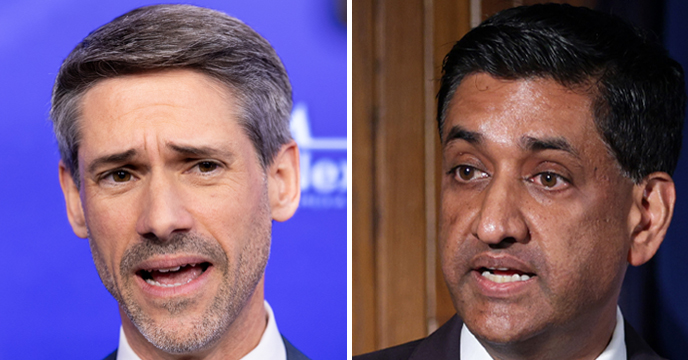
Proponents of the proposed California Billionaire Tax Act, including Silicon Valley Democratic Rep. Ro Khanna and the SEIU-UHW which created the initiative, argue that it would help California offset $100 billion in federal cuts to healthcare. Tom Steyer, the billionaire hedge fund founder turned environmentalist and philanthropist now running for governor, also supports it.
Foes, including Gov. Gavin Newsom, San Jose Mayor Matt Mahan, who’s in the race to succeed him as governor, and Ethan Agarwal, a Democratic primary challenger to Khanna, say it would drive wealthy people out of California, depriving the state of taxes and stifling innovation.
President Donald Trump’s spending bill HR 1, also known as the One Big Beautiful Bill Act, makes sweeping cuts of almost $1 trillion over the next decade to Medicaid — which provides free or low-cost healthcare coverage to low-income people — that include stricter work requirements and eligibility checks for Medicaid recipients.
California’s Medi-Cal program depends on the federal government for more than half its funding. As a result of cuts made and planned under HR 1, more than 400 California hospitals had already laid off more than 3,400 health care workers as of mid-March, the Orange County Register reported.
Of the approximately 200 billionaires in California, about 130 live in the Bay Area, a large majority having derived their massive wealth from the Silicon Valley technology industry.
Billionaires are already mounting a well-funded counteroffensive. Google co-founder Sergey Brin has led billionaires’ donations to Building a Better California, a group seeking to put measures on the ballot that would undermine or eliminate the billionaire tax should it pass.
One proposal, titled the Retirement and Personal Savings Protection Act, would prohibit new state personal property taxes. If both that measure and the billionaire tax passed, the one getting the most votes would take effect under state law, effectively canceling out the other.
The other two initiatives appear to be “spoiler propositions” meant to weaken the tax or spur legal challenges if voters approve it, UC Riverside political science professor Shaun Bowler told this news organization earlier.
One, called the Improving Transparency, Effectiveness & Efficiency in California Government Act, would require audits of programs funded by new state special taxes. Another, titled the Protect Schools and Taxpayers Act, would require new taxes to comply with existing school-funding rules.
Brin, who has reportedly moved to a $42 million mansion on the Nevada side of Lake Tahoe, upped his giving earlier this month, state data show. Worth $265.5 billion according to Forbes Real-Time Billionaires List, Brin threw another $12 million in April into Building a Better California, on top of $20 million in January and $35 million in February.
Kleiner Perkins chairman John Doerr of Woodside, worth $22.8 billion, added another $500,000 this month to bring his total to $10 million. Sequoia Capital partner Michael Moritz of San Francisco, worth $7.7 billion, also increased his donations to the group this month, adding $500,000 to his earlier $7 million. Stripe CEO Patrick Collison of San Francisco, worth $17.5 billion, has given $7 million.
Former Google CEO Eric Schmidt of Atherton, worth $39 billion, has donated $3 million. Ripple executive chairman Chris Larsen of San Francisco, worth $12.5 billion, and Beverly Hills water and pomegranate magnate Stewart Resnick, co-owner of the Wonderful Company and worth $5.4 billion, have each given $2.5 million.
DoorDash CEO Tony Xu of San Francisco, worth $1.7 billion, has donated $2 million. And Max Levchin of San Francisco, CEO of Affirm and worth $1.9 billion, has given $1 million.
California’s Medi-Cal program depends on the federal government for more than half its funding. As a result of cuts made and planned under HR 1, more than 400 California hospitals had already laid off more than 3,400 health care workers as of mid-March, the Orange County Register reported.
The tax proposal targets people worth $1 billion or more and residing in California as of Jan. 1 this year. How many California billionaires are maneuvering to dodge the tax remains unclear, but several big names in technology have reportedly bought properties outside the Golden State.
Brin’s co-founder at Google, Larry Page, has reportedly bought more than $100 million worth of property in Miami, and Brian Armstrong of San Francisco, co-founder and CEO of cryptocurrency platform Coinbase and worth $9.3 billion according to Forbes, has begun looking with his wife for a home in South Florida, the Miami Herald reported. Meta CEO Mark Zuckerberg bought a $170 million compound in Miami, the New York Times reported.