
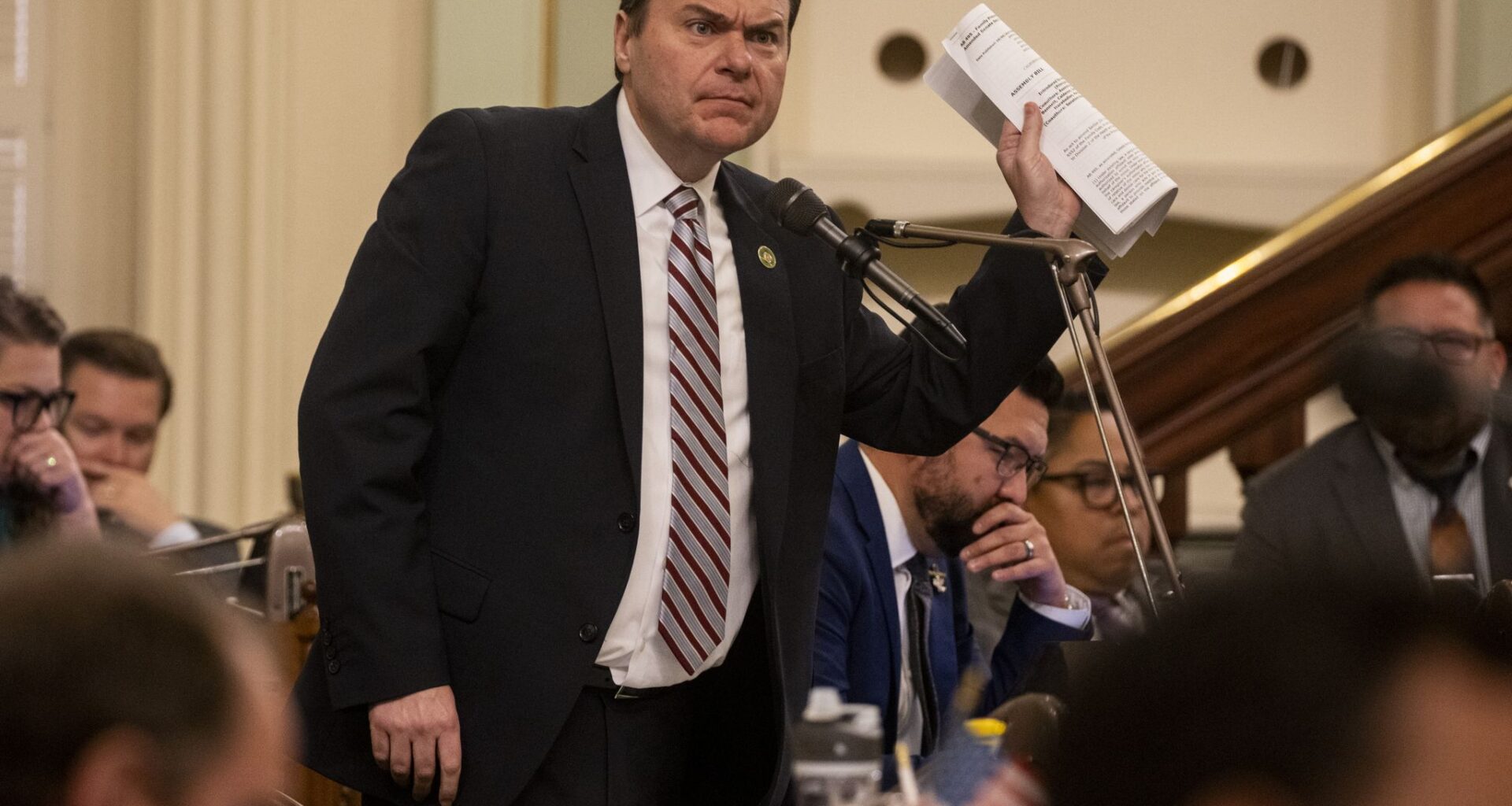
Assembly Member Carl DeMaio, R-San Diego, has attacked a bill that would extend a state program offering confidential addresses to immigrant service providers, and enlisted a controversial right-wing influencer in his campaign.
Stephen Lam/S.F. Chronicle
Assembly Member Mia Bonta, D-Oakland, was carrying a bill to insulate immigrant-serving nonprofits from Trump administration attempts to revoke their tax-exempt status when, last June, she began hearing of a surge of threats and harassment affecting the nonprofits’ workers.
“We needed to do something,” Bonta remembered thinking.
Her solution was Assembly Bill 2624, introduced in February, which piggybacks on a longstanding state program that shields the addresses of domestic violence survivors, elder abuse victims, reproductive and gender-affirming healthcare workers and their patients.
Article continues below this ad
Started in 1999, the Safe at Home program allows the eligible individuals to apply for substitute mailing addresses and to keep their voting information confidential. In 2024, during the program’s 25th anniversary, Secretary of State Shirley N. Weber released a video message crediting the program with shielding about 177,000 residents.
Bonta’s measure would expand the program to immigrant nonprofit workers.
San Francisco Chronicle Logo
Make us a Preferred Source to get more of our news when you search.
Add Preferred Source
The program was uncontroversial and so was Bonta’s bill — until recently.
Earlier this month, Assembly Member Carl DeMaio, R-San Diego, went on the attack. Summoning the attention of a right-wing YouTuber, DeMaio, his critics say, engulfed a modest bill in bad-faith messaging and stirred the very hostility that AB2624 contemplates.
Article continues below this ad
Some of that hostility has been directed toward Bonta, who said she and her staff have been inundated with death threats and “incredibly grotesque” messages of a racist and misogynistic nature.
Assembly Member Mia Bonta, D-Oakland, says her Assembly Bill 2624 is modest legislation to extend a state program to immigrant nonprofit workers.
Jessica Christian/S.F. Chronicle
“I think Mr. DeMaio owes an apology to a lot of legislators,” she told the Chronicle. “More importantly, he owes an apology to the immigrant service providers who have had to endure increased levels of hurt because of his actions.”
DeMaio did not grant an interview request or respond to emailed questions. But the freshman lawmaker and conservative radio host, whose Reform California group just qualified a voter-documentation ballot initiative that could force the state’s 23 million voters to re-register, has had plenty to say about AB2624 and its author.
On April 7, during AB2624’s first hearing before the Assembly Standing Committee on Privacy and Consumer Protection, DeMaio attempted to wed the bill to MAGA world fears of nonprofit fraud and conservative media censorship.
Article continues below this ad
Insisting, incorrectly, that California releases the addresses of law enforcement personnel, DeMaio seized on a provision of Bonta’s bill that would make it illegal to post the home address of any immigrant nonprofit worker with the specific intent of inciting violence or threatening the person’s safety.
“This is not about protecting people from violence. This is about threatening and intimidating people who are trying to shine a light on bad behavior,” DeMaio said. Referencing alt-right YouTuber Nick Shirley, whose discredited claims about childcare fraud in Minnesota and hospice fraud in California have spurred conflict between the Trump administration and blue states, he added, “But I will tell you this: The transparency is coming. … You can try to bully them, Miss Bonta, but it will not succeed.”
Assembly Member Josh Lowenthal, D-Long Beach, the committee chair, reprimanded DeMaio to “speak with decorum to our colleagues.”
Bonta, who had told DeMaio that her bill requires applicants “to show evidence of threats, harassment or violence,” said later it was her “first inkling of there being any concern with the bill.”
DeMaio posted a video of his remarks to his office’s YouTube account; his official Assembly webpage published two releases, on April 13 and 16, misnaming AB2624 the “Stop Nick Shirley Act” and characterizing it as a threat to investigative journalism.
Article continues below this ad
In the latest release, after the bill sailed through the Assembly Standing Committee on Judiciary, DeMaio claimed the bill “would make it illegal for citizen investigative journalists to post video evidence of fraud” and said he would “continue leading the fight to defeat AB 2624.”
“Instead of fixing waste, fraud, and abuse, they’re trying to punish the people exposing it,” DeMaio said in his statement. “If this bill moves forward, it sends a chilling message: expose corruption, and you could be punished.”
Bonta said the bill wouldn’t even stop questionable media operators such as Shirley, who has shown up with a camera outside the doors of Minneapolis childcare workers and Los Angeles hospice providers claiming, usually without evidence, that he’s uncovered fraud.
“This bill has nothing to do with that activity,” she said.
No news media organizations have opposed the bill.
Article continues below this ad
The California News Publishers Association, which tracks hundreds of bills each year affecting the state’s news industry, hasn’t taken a position on AB2624.
DeMaio’s one-lawmaker campaign hasn’t slowed the bill’s progress. It’s now before the Assembly Appropriations Committee.
Outside of the legislative process, there has been a flurry of activity, most of it from the 24-year-old Shirley, the callow, flat-voiced influencer who took DeMaio’s bait to decry AB2624 to his 1.8 million YouTube subscribers and 2.9 million Instagram followers.
Shirley also posted videos of himself confronting lawmakers at the state Capitol in Sacramento and reciting DeMaio’s talking points about the bill. DeMaio and a few Republican colleagues rooted Shirley on, but most lawmakers refused to engage. Sen. Scott Wiener, D-San Francisco, stopped long enough to call Shirley “a psycho scam artist” before entering a building.
In a statement, Wiener said he stood by his comment and called Shirley “a political hack” who only pretends to investigate blue states.
Bonta said the phone lines to her office blew up for days with threats to “hurt my children, hurt my family.”
“I believe the questions that Mr. DeMaio needs to ask himself are between him and his higher power, to be honest. I don’t know what questions to ask of a legislator who has had zero bills get past this Legislature or signed by this governor,” she said. She added that DeMaio appeared to be more interested in “driving clicks to his fundraising page and to his social media accounts. And if that is the kind of legislator he wants to be, that’s on him.”
According to the Bridging Divides Initiative at Princeton University, public officials have faced steadily escalating hostility since 2022, particularly women and people of color, and the Trump administration has mainstreamed the agendas of organized violent groups like the Proud Boys.
“Aggressive directives from the Trump administration, coupled with increasingly combative tactics by federal agencies, will create further flashpoints for confrontation in 2026,” the BDI said in a February report on key political violence trends for this year.
The report does not mention the role of influencers, though other studies have made the connection between online personalities, particularly in the manosphere, and the legitimization of violence in both the Americas and the United Kingdom.
Bonta said the harassment she faced amounted to “an iota of the behavior received every day by people on our front lines” and that people like DeMaio and President Donald Trump “want to create such an intense ‘social and personal cost to supporting our immigrant brothers and sisters … so we don’t introduce the bill, we don’t take the job, we don’t do this work,’ she said.
On Monday, Shirley posted a video saying he is the target of death threats by the same “radical” element that has targeted Trump with three assassination attempts, including at Saturday’s White House Correspondents’ dinner.
‘Blowing your heads off’
After the death threats and harassment, after the brick sailed through her window and the people who identified as citizen journalists followed her employees and showed up at her mother’s home, Angelica Salas knew the nonprofit world had changed.
The executive director of the Coalition for Human Immigrant Rights, which is based in Los Angeles with offices in Sacramento and Washington D.C., had been with the advocacy organization through most of its 40-year history, including when California voters approved Proposition 187 in 1994 to deny social services to unauthorized immigrants, in the aftermath of Sept. 11, 2001, and during the COVID-19 pandemic, when Muslims and Asian Americans experienced the brunt of racial animus.
While Salas said angry and even hateful feedback has long come with the territory, she never had to hire a security detail for her mom before.
“I’ve worked at CHIRLA for 30 years,” she said. “I’ve gone through so many things and never, ever have I experienced this.”
Salas said the wave of hostility began after Trump’s inauguration and spiked during immigration raids in Los Angeles and other blue cities, as a MAGA echo chamber fomented narratives about government-funded nonprofits committing fraud and promoting violence against federal immigration authorities. It’s almost become formulaic, Salas said, with Republican senators sending threatening letters to nonprofits that become public, prompting inquiries from conservative outlets like the New York Post, then exaggerated claims by online influencers, then “voicemail messages that say things like, ‘What we should be doing is just lining you all up and basically just blowing your head off.’”
At their security team’s advice, they’ve stopped listening to the voicemails. CHIRLA now has security at all 11 of its offices, staff photos have been removed from the website, the windowpanes outside Salas’ office are bulletproof and an active-shooter training is planned.
It was CHIRLA that approached Bonta’s office about expanding the Safe at Home program.
“We just thought it would be simple,” Salas said. “We never thought that then it was going to engender the same thing (toward Bonta).”