
A century ago in 1926, UC Berkeley was expanding and “nearly 100 property owners” appeared at a public meeting to protest the reclassification of the old Schmidt ranch at the city’s corner of Rose and Sacramento streets, which the University of California had purchased, for use as “an experimental chicken farm” (“college education for poultry,” the Berkeley Daily Gazette remarked).
UC representatives told the city Planning Commission that the university’s needs to experiment with poultry “transcend any neighborhood objection that could be raised.” The neighbors were worried about smells from a large-scale animal research facility and pointed out that Berkeley already prohibited the keeping of livestock in city limits.
The property would ultimately be used for research, but the poultry research program would later move to a portion of lower Strawberry Canyon. In the 1930s, the university sold the property to a private developer who built single-family homes there on the eve of the U.S. entry into World War II.
Unmentioned in the newspaper articles was the fact that Berkeley’s oldest American-style house, a wood-frame, two-story structure built nearby by the Peralta family in 1851, had been moved to the land from the region’s Peralta homestead site. The house would be demolished during subsequent periods of the property’s development.
Bank anniversary: A century ago Berkeley’s First National Bank celebrated its fourth anniversary on May 1, 1926.
“Knowing that there was need for a bank that should have Berkeley’s interests at heart and relying on the loyalty of Berkeleyans to rally to the support of such an institution, a group of Berkeley citizens founded the forerunner of these banks,” read an advertisement in the April 30, 1926, Gazette. “The little handful of depositors of 1922 has grown to nearly 16,000 in 1926, practically one depositor to every family in Berkeley.”
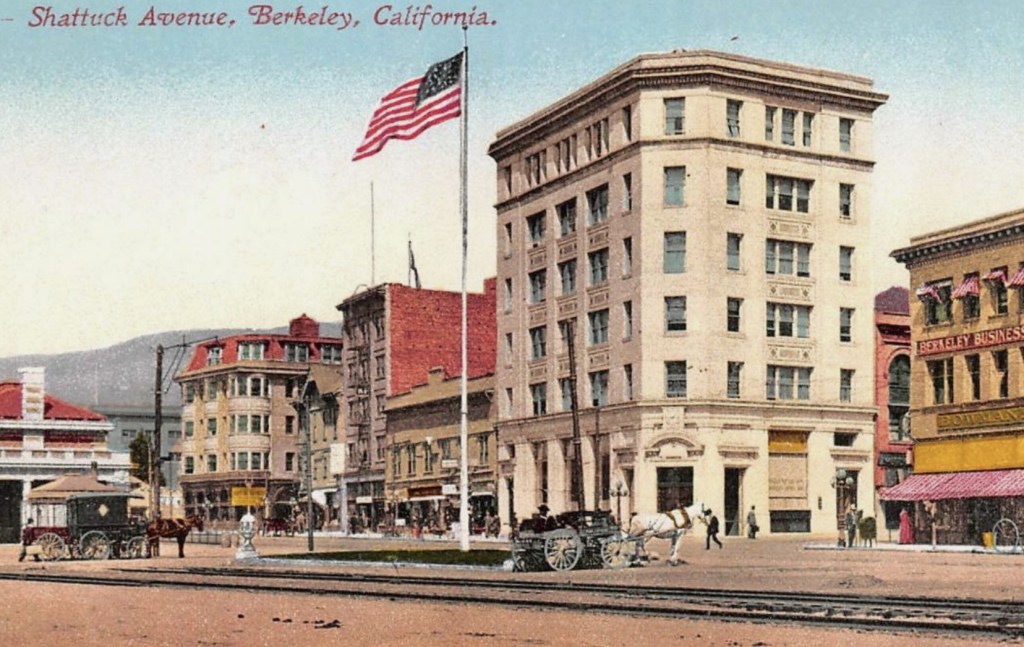
The list of the bank’s officers and directors read like a directory of local capitalists, real estate agents, civic notables and business owners. In 1926 the bank was headquartered in a handsome six-story brick office building at the corner of Shattuck Avenue and Center Street.
That corner would follow an interesting path. Decades later, the building would be demolished and a one-story Bank of America branch built there with a surface parking lot. Then some years ago that building was demolished and replaced with a nearby hotel.
Preschool health: Berkeley had a program of “preschool children’s examinations” that was expanding in 1926.
“The children are looked over thoroughly for major and minor physical disabilities, and a child specialist makes a final examination,” the Gazette reported April 30, 1926. The exams, it was hoped, would find “smaller defects (that) can be corrected before school opens in the fall. The movement is a new one in educational circles.”
The exams were conducted at public schools and targeted at children who would enter school in the next year for the first time.
Racial exclusion: An “enthusiastic audience” gathered on April 29, 1926, at the old McKinley School on Dwight Way to hear presentations on “The Covenant Plan”. A San Francisco attorney, Miss Alma Meyers, was the principal speaker and “told of the spread of Japanese in San Francisco and outlined ways and means of checking the movement.”
Voluntary neighborhood racist “covenants” were at the heart of the discussion. These committed property owners to refuse to rent or sell to non-Whites.
Landfill: On April 30, 1926, the City Council authorized purchase, for about $39,000, of 21.5 acres “of shore land at the foot of Harrison Street for use as a sanitary fill.” Garbage dumping was already taking place there.
Bay Area native and Berkeley community historian Steven Finacom holds this column’s copyright.