
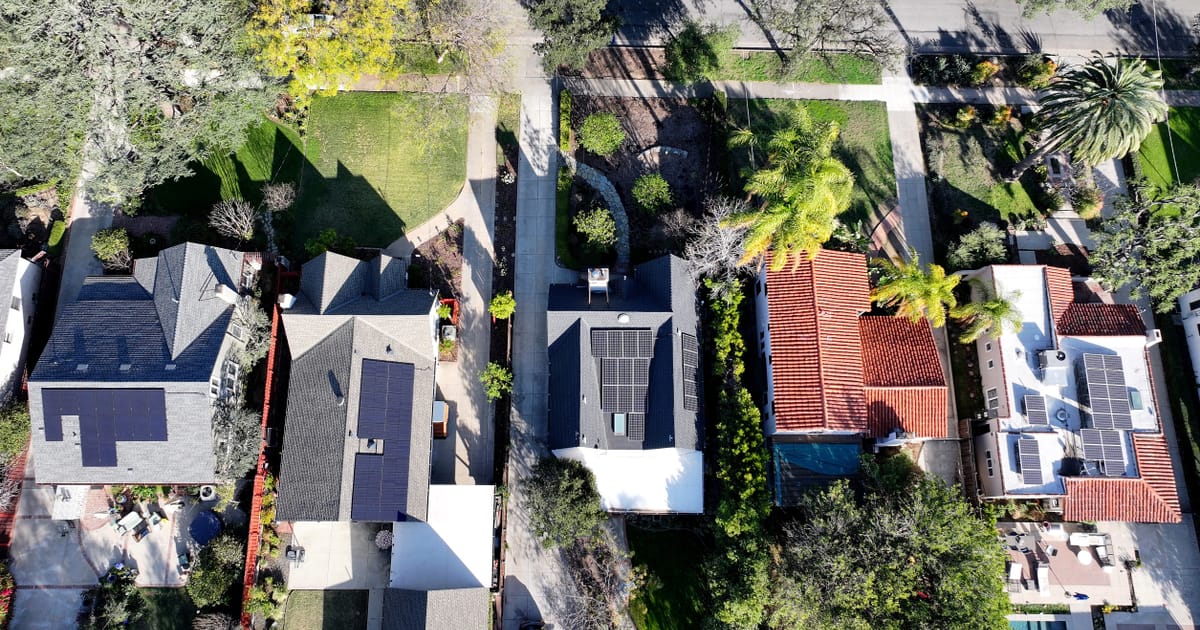
A bill advancing through California’s legislature would create pathways for virtual power plants to compete with fossil-fueled peaker plants — a move that could help the state curb its fast-rising utility rates.
Virtual power plants are aggregations of small-scale batteries, electric vehicles, smart thermostats, and other customer-owned devices that can be called upon to provide cheap capacity to the grid. VPP programs already exist in California, but the state’s utility and grid regulatory structures don’t offer a clear way for VPPs to replace peaker plants.
Senate Bill 913, introduced by state Sen. Josh Becker, a Democrat, would allow VPPs to “compete on a level playing field with traditional power sources to provide grid reliability at the lowest cost.” The bill, which lays out a slew of policy changes, passed out of the California Senate Energy, Utilities, and Communications Committee earlier this month, a first step on the way to a potential vote before the full state Senate and Assembly.
Gas-fired peaker plants are a major driver of California’s rising electricity bills. Most of the state’s aging peaker plants are used only during a handful of hours each year when electricity demand is particularly high, but utility customers are required to pay for them to be available year-round in case of emergency.
VPPs can accomplish this job at a much lower cost, their advocates say, because customers have already paid to install these devices in their homes and businesses. The potential is vast: Millions of homes across California have devices that can turn down power use, and hundreds of thousands have batteries that can inject power onto the grid — all of which can be used to reduce the need for those “peaker” power plants.
Still, SB 913 may face an uphill climb, even in California’s Democratic-controlled government.
Pacific Gas & Electric, Southern California Edison, and San Diego Gas & Electric, the state’s major utilities, haven’t openly opposed the legislation. But VPP advocates say the utilities have quietly pushed back against programs that might undermine their ability to invest in — and earn guaranteed profits on — grid infrastructure to serve peak electricity demand.
The California Public Utilities Commission, whose five members have all been appointed by Democratic Gov. Gavin Newsom, has taken a number of actions in recent years that have reduced the ability of customer-owned resources to serve grid needs. Newsom also vetoed a slate of pro-VPP legislation last year.
But Becker and SB 913’s supporters are hopeful that mounting concerns about energy affordability could push the VPP legislation over the finish line this year. The bill is backed by clean energy companies, environmental groups, and consumer advocates.
“This is part of a nationwide effort that you’re starting to see, which is all about making better use of the clean energy resources that people already have in their homes to both lower cost and to improve reliability and to reduce pollution,” Becker, who’s authored several utility cost-containment and VPP bills in the past few years, told Canary Media. “I’m hopeful that now that more and more folks are focused on these things, we can move the ball forward.”
Letting VPPs do the work of peaker plants
At its core, SB 913 is aimed at answering a fundamental question: How can VPPs reduce our reliance on gas-fired power plants that rarely ever run?
In California, the state’s aging peaker plants are paid to be available through a program called resource adequacy. In recent years, resource adequacy has become an increasingly larger part of customers’ bills, according to the community energy providers that are having to pay higher and higher prices to secure it.
Becker estimated that Californians are spending about $1 billion per year to “keep expensive peaker plants available for short-term demand,” both through resource adequacy payments and via state emergency funding to extend the lifespan of three coastal power plants, which were slated to close years ago to reduce their harmful impact on marine life.
“At the same time, we have underutilized assets like home batteries and EVs and smart thermostats,” he said.
SB 913 would order the California Public Utilities Commission to design clearer pathways for those assets to count toward resource adequacy.
That could allow VPPs to help displace gas peaker plants. Overall, VPPs could provide more than 15% of the state’s peak grid demand by 2035 and deliver $550 million in annual utility customer savings, according to a 2024 analysis conducted by the energy consultancy The Brattle Group for GridLab. About $417 million of those savings would come from deferring the need for generation capacity, the report found — a category of costs that includes resource adequacy.
Home batteries have already proved that they’re ready and able to meet these peak grid needs, Becker said. In particular, the Demand Side Grid Support program, one of California’s most successful VPP programs to date, has grown to more than a gigawatt of capacity as of last year.
DSGS has shown that its fleet of home batteries can be relied on much like a traditional power plant. In a test of the program over two consecutive hours during a late afternoon in July 2025, roughly 100,000 home batteries delivered about 476 megawatts of energy — enough power to match the output of a typical gas peaker plant.
Despite this performance, the DSGS program has been severely underfunded over the past two years and is now facing the threat of being disbanded entirely. VPP proponents are pushing legislators and the Newsom administration to keep it alive.
How to avoid past VPP pitfalls
SB 913 largely uses the DSGS program as a model for how the California Public Utilities Commission should order the state’s three major utilities to design broader VPP programs.
“DSGS has been a very successful program, and it’s the thoughtful design elements that have made it that way,” said Erik Lyon, an energy regulatory manager at Renew Home. “That’s the key thing to understand about SB 913. The latest version of the bill actually names DSGS as a model.”
Renew Home manages millions of Google Nest thermostats that control air conditioners and home heating systems to reduce energy use and relieve grid peaks across the country, including in California. But to date, California’s demand-response programs have severely limited the role of such assets in addressing resource adequacy.