
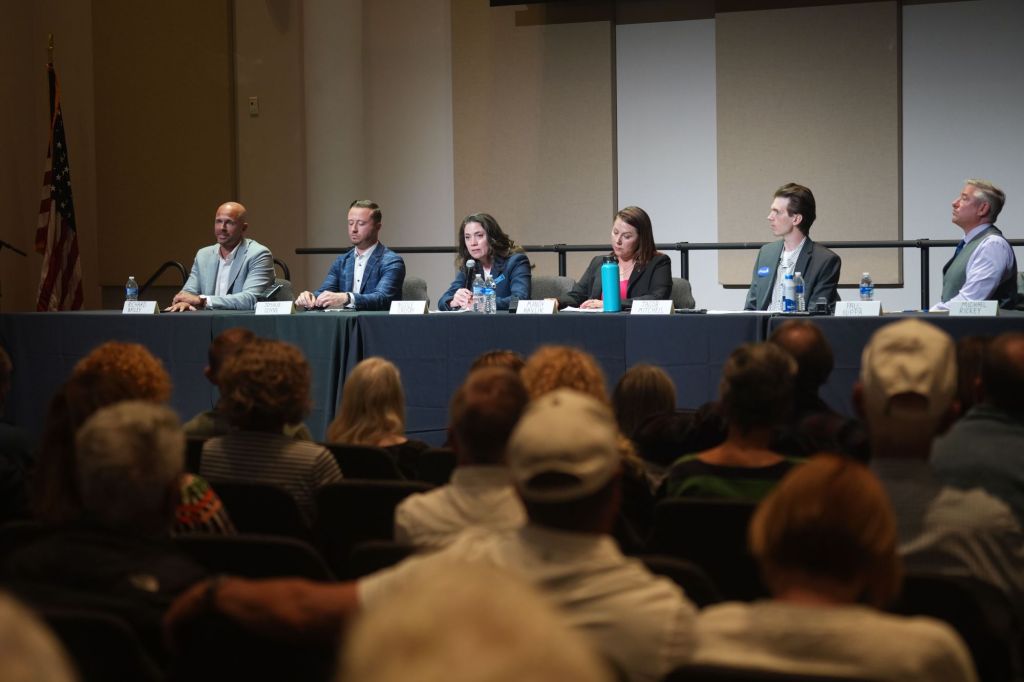
Six candidates seeking to represent Clairemont and Point Loma on the San Diego City Council clashed this week over the Midway Rising project, City Hall transparency, a proposed “empty homes” tax and Liberty Station.
Speaking to more than 200 people during a Monday night forum, the candidates for Council District 2 offered sharply different takes on the Midway Rising proposal to redevelop the city’s sports arena area.
Richard Bailey, a former mayor of Coronado who now lives in Point Loma, said the project would be too large and blamed state law for helping to increase the number of housing units beyond 4,000.
“Who does it have to be so gosh darn large?” Bailey asked.
Mandy Havlik, a Point Loma neighborhood leader, said the city hasn’t properly studied the potential impacts of the project on the nearby area.
Jacob Mitchell, a chemist from Point Loma, said he’s conflicted over Midway Rising because current plans don’t call for adequate infrastructure improvements to support the project.
Paul Suppa, an attorney living in Point Loma, agreed that the project faces significant parking and infrastructure issues.
“It should be dead on arrival,” Suppa said.
Nicole Crosby, a deputy city attorney who lives in Clairemont, praised the project and said it’s proposed in an area that is ideal for dense, high-rise housing.
“It is a very underserved, dilapidated and sad area that needs help,” Crosby said.
Josh Coyne, a former City Hall staffer who lives in Point Loma and now works for the Downtown San Diego Partnership, said he supports Midway Rising and views the project as an exciting opportunity.
On the city’s proposed empty homes tax, which will appear as Measure A on the June 2 ballot, Havlik was joined in opposition by Bailey and Suppa. Crosby, Coyne and Mitchell expressed support.
Havlik said the tax would be hard to enforce and vulnerable to legal challenges. Suppa and Bailey said they oppose new taxes.
“The city does not have a revenue problem – it has a spending and management problem,” Bailey said.
Coyne disagreed, contending the city needs new revenue like the money that would come from the empty homes tax, which would tax people who own a home but don’t live in it.
Crosby focused more on the tax’s goal of encouraging property owners to shift away from making their properties vacation rentals.
“Short-term vacation rentals and vacant homes destroy communities,” said Crosby, blaming them for shrinking school enrollments and driving senior citizens out of neighborhoods.
Mitchell said his support for the tax was tepid based on concerns that it would be difficult to enforce.
The candidates also discussed the city’s fight for control over Liberty Station with a company that leases much of the mixed-use neighborhood.
Bailey said he opposes long-term city control of the area, contending Liberty Station is an appealing area because it’s been under private control instead of city control for so many years.
“What do you think it would look like today if the city managed that property?” he said.
Coyne said he supports city control, but stressed that city officials will need to create a plan to redevelop the area in order to retain control under state law. And he expressed doubt that would happen.
Suppa and Crosby said the city must maintain control of the area. Mitchell said the only reason private operators have done so well with Liberty Station is sweetheart leases the city gave them 25 years ago.
Havlik criticized the leasing company for trying to take over.
“They want to steal our property,” she said. “The city’s not done with Liberty Station.”
On boosting public involvement in City Hall decisions and increasing transparency, Crosby and Coyne said the City Council needs to slow decision-making down to allow more thorough reviews and more public input.
Havlik said she would conduct frequent public surveys and host town halls if elected. Mitchell said he would prioritize sending someone from his staff to every meeting of every neighborhood planning group.
Bailey said it’s crucial for the city to make information more accessible, contending that most vital information about the city is typically available to the public but hard to find or utilize.
The candidates are battling to replace termed-out Councilmember Jennifer Campbell in District 2, which includes Clairemont, Point Loma, Ocean Beach, Mission Beach and some nearby areas.
The top two candidates in the June 2 primary will move on to a November runoff — even if the top finisher in June gets more than 50% of the vote.
The forum was held at the Liberty Station Conference Center, which is managed by Point Loma Nazarene University.