
A man with a vibrant blue-and-yellow macaw on his shoulder argued with a city parks official about the smell of hot artificial turf. Teens in hoodies carrying large Starbucks cups milled around in loose packs. Brewer’s blackbirds picked through the grass. Just outside a potholed parking lot, a woman dressed as the Lorax — the Dr. Seuss character who speaks for the trees — worked the bullhorn.

“This would never happen in Pacific Heights,” the Lorax said on Sunday. “They’re doing this here because they think we’re easy.”
This was the scene next to the Crocker Amazon Clubhouse on a misty April morning. Dozens of people turned out, most of them opposed to a $50 million renovation of the park’s baseball and softball fields.
Article continues below this ad
Keep Crocker Real protesters at the Crocker Amazon community input session on Sunday, April 26, in San Francisco.
Kasia Pawlowska/SFGATE
The San Francisco Recreation and Park Department and the Giants Community Fund held a community input session on April 26, setting up six pop-up tent stations along a fence to gather feedback. Two translators were on-site, relaying information to attendees through wired headsets. Opponents from the group Keep Crocker Real set up their own base directly across from the city’s, with signs in multiple languages and flyers detailing what they say are the real costs of the plan: the loss of mature trees, the introduction of acres of synthetic turf and a redesign they argue was decided long before the community was ever asked.
At the center of the tension is a question: Who are these fields actually for?
Article continues below this ad
The plan and the funding
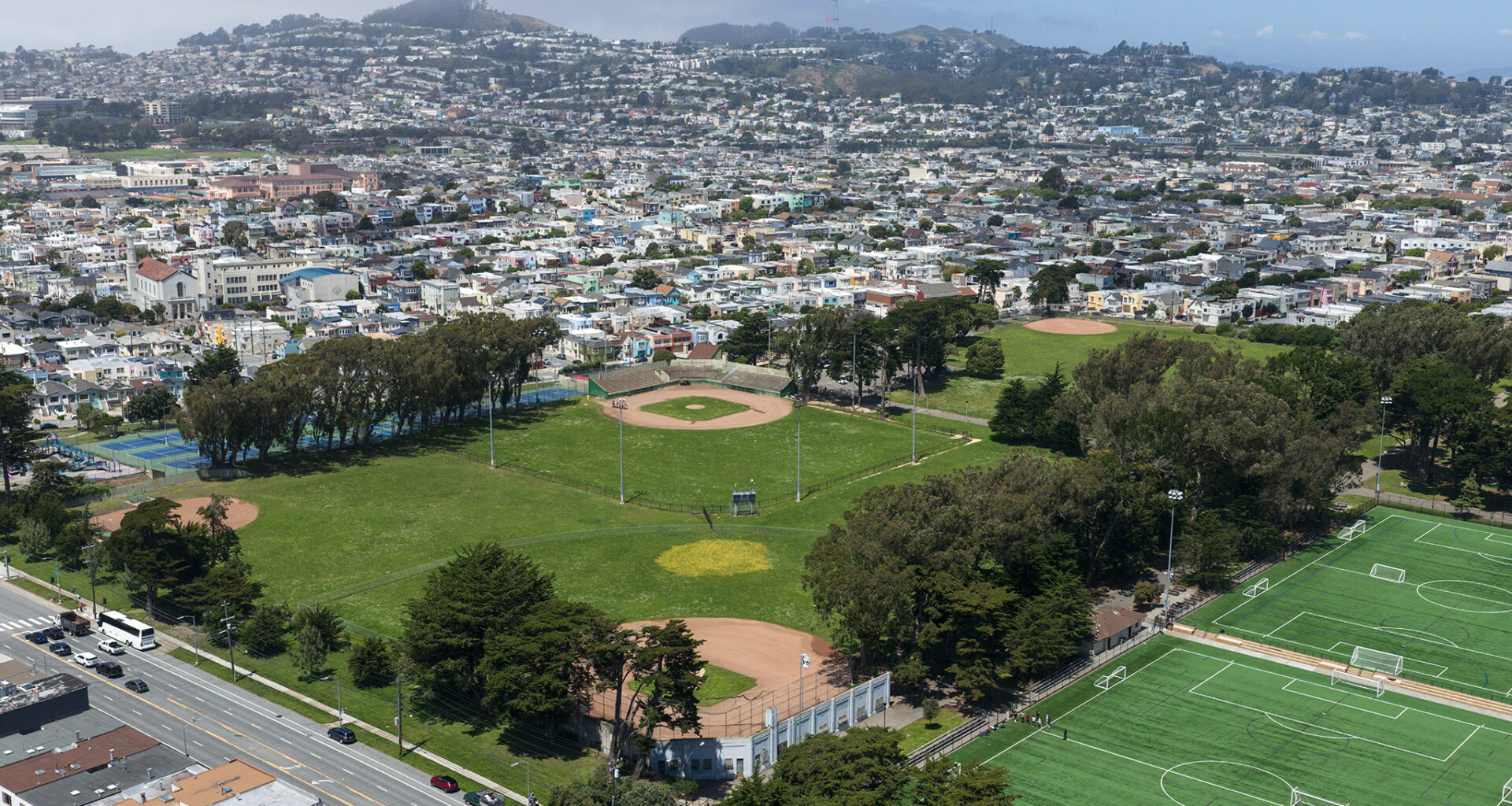
The project, developed by the Recreation and Park Department and the Giants Community Fund — the nonprofit arm of the San Francisco Giants — would renovate the western half of Crocker Amazon into a baseball and softball complex with six fields, batting cages, a plaza, expanded parking and upgraded dog play areas. The fields, aside from one, would be completely covered with synthetic turf.
A public service announcement is posted at Crocker Amazon Playground detailing the upcoming plan for the site’s baseball fields, as seen on Wednesday, April 29, 2026.
Charles Russo/SFGATE
The Giants have committed to raising $28 million for the project, and $22 million would come from the city’s 2020 Health and Recovery Bond. On April 16, the Rec and Park commission voted unanimously to recommend that the Board of Supervisors approve accepting the grant. The project will now go to the Board of Supervisors for a final vote on a date that’s yet to be determined.
Article continues below this ad
Make SFGATE a preferred source so your search results prioritize writing by actual people, not AI.
Add Preferred Source
At the commission meeting, interim general manager Sarah Madland was careful talking about the vote. “This is the grant acceptance only,” she told commissioners. “If you do recommend it, it then goes to the Board of Supervisors for their vote as to whether or not to accept these funds. … It does not permit us to or require us to accept those funds or do a particular project.” The concept design, CEQA review and final approvals would come later, she said.
Still, commissioners were clear about their intentions. “I am going to go vote ‘yes’ when it’s my turn to vote,” Commissioner Vanita Louie said. Commissioner Larry Mazzola agreed: “I will also be voting ‘yes’ to accept this grant.” Mazzola said that the Giants have been “a first-class organization for many, many, many decades” and that the park is “badly needed.”
No one opposed the motion.
Article continues below this ad
A view of one of the Crocker Amazon baseball fields in San Francisco, on Wednesday, April 29, 2026.
Charles Russo/SFGATE
The baseball complex would be renamed the Willie Mays Field of Champions at Crocker Amazon Playground if the Board of Supervisors approves. The name was requested by the Giants, to honor the late Hall of Famer whose Say Hey Foundation has contributed to the project.
Tree and turf concerns
But Supervisor Chyanne Chen, who represents District 11 where the park is located, appeared at the commission meeting pushing for a slower process. “I’m here because the giant acceptance agreement between the Giants and the city is being considered before the community has fully vetted the design for the park renovations,” Chen said. She pointed out that most of the trees that would be removed under the plan are fully grown. Chen also urged the commissioners to keep at least two-thirds of the existing mature trees, minimize fencing and maintain at least two natural grass fields before moving forward.
Article continues below this ad
At Sunday’s community meeting, Giants Chief Development Officer Jack Bair staffed the station concerning trees. Bair said the plans called for the removal of 98 trees — 75 for the project and 23 due to poor health. The trees would be replaced at a 2-1 ratio, he added.
A view of one of the Crocker Amazon baseball fields in San Francisco, on Wednesday, April 29, 2026.
Charles Russo/SFGATE
A man with a Keep Crocker Real sticker on his jacket asked Bair how long it would take for the trees to grow.
Bair acknowledged that the Monterey cypress — a dominant species at the site — can take more than 20 years to reach maturity.
Article continues below this ad
Bob Hall, the lead organizer of Keep Crocker Real, has become the central figure in the opposition group. A member of the Golden Gate Bird Alliance and board member of the California Native Plant Society, Hall estimates he spends as much as 50 hours a week fighting the project.
“They’ve been planning since 2021 — they didn’t have their first meeting on this until February of 2025 with the community,” he said during a previous phone call with SFGATE. “… You know it was already going to happen, no matter what the community said, because they spent a lot of money making it happen.”
Bob Hall, the lead organizer of Keep Crocker Real, is pictured in the stands of one of the Crocker Amazon baseball fields in San Francisco, on Tuesday, April 28, 2026.
Charles Russo/SFGATE
Hall questions the independence of the project’s testing and design vendors, saying Rec and Park has used the same artificial turf suppliers and field-testing contractors for years.
Article continues below this ad
In an email to SFGATE, Rec and Park spokesperson Tamara Barak Aparton said that the city uses the most modern turf with natural cork-and-sand infill as opposed to rubber. “These infill materials are non-toxic, PFAS-free, and biodegradable, providing a comfortable, safe surface for players,” Aparton wrote.
Hall argues there is no available artificial turf that is truly free of perfluoroalkyl and polyfluoroalkyl substances, also known as forever chemicals. “There’s no such thing as a PFAS-free artificial turf yet,” he said. “They only test for 40 legacy PFAS. … There’s about 14,000 PFAS.”
Protest signs at the Crocker Amazon community input session on Sunday, April 26, in San Francisco.
Kasia Pawlowska/SFGATE
At Sunday’s event, Dan Mauer, Rec and Park’s project manager, staffed the turf station and stated that synthetic turf is more environmentally friendly than irrigated natural grass over its life cycle.
Article continues below this ad
A truncated season
Not everyone at the Crocker Amazon input session was there to oppose the renovation. Pro-project people were present, despite being outnumbered.
James Nash, a board member and coach trainer at San Francisco Little League who has been involved in youth baseball for 15 years, wasn’t in attendance on Sunday but shared his views ahead of the meetup.
He said the case for the project comes down to a basic reality of field maintenance and safety. “These turf fields really end up being much better playable over long periods of time,” he said during a phone call with SFGATE. “… We regularly see injuries on the Crocker fields — sprained ankles from gopher holes, bad hops in the infield.” Holes dug up by the burrowing rodents are often cited by those in favor of the project as a reason to shift to turf fields. He noted that while grass fields are cheaper to build upfront, “the yearly cost of maintaining a baseball field outweighs it over time.”
Article continues below this ad
A view of one of the Crocker Amazon baseball fields in San Francisco, on Wednesday, April 29, 2026.
Charles Russo/SFGATE
Nash described the fields as having deteriorated significantly from years of deferred maintenance and heavy use. In the spring of 2023, weather-related closures shut the fields down for 37 days, or 31% of the playing season, according to a November 2025 Rec and Park presentation. In the spring of 2024, closures reached 57 days, nearly half the season. The project team estimates that synthetic turf would add roughly 2,000 hours of playtime during the baseball and softball season, since it doesn’t need to dry out after rains like grass fields do.
On the Giants, Nash pointed to the free Junior Giants program as evidence of commitment to the community. “If this program didn’t exist for this kid, then I don’t believe that this kid would have ended up getting to play baseball,” he said.
According to the 2025 Rec and Park presentation, 29 different baseball and softball organizations use Crocker Amazon — including Junior Giants, San Francisco Unified School District teams, San Francisco Little League and the Bay Sox Girls Baseball Program. The park hosted over 330 games in 2025, per the presentation.
Article continues below this ad
Weathered murals decorate the baseball diamond facility near the Crocker Amazon parking lot along Moscow Street in San Francisco.
Charles Russo/SFGATE
Some parents and sports organizers supported the fields at the commission meeting. “We’ve had kids stung by wasps nests, kids twist ankles in the gopher holes that people before me have mentioned,” Cecelia Wolf said. “… I believe these kids deserve the better conditions that the renovation would provide.”
Wolf spoke on behalf of the Orlando Cepeda Academy, a Giants Community Fund program that, along with San Francisco Recreation and Park, provides free, competitive baseball and softball for kids in under-served communities.
The commission’s president reiterated that the Crocker Amazon project was specifically listed in the 2020 bond, which passed with 71% of the vote citywide.
Article continues below this ad
A park at a crossroads
A handful of factors make the project so charged.
Hall put it directly. Crocker Amazon “is a really hard-working working-class community of immigrants who are all looking over their shoulders right now,” he said during a phone call.
Protest signs at the Crocker Amazon community input session on Sunday, April 26, in San Francisco.
Kasia Pawlowska/SFGATE
It’s not a place where residents are necessarily ready to square off against a well-funded project.
Article continues below this ad
Keep Crocker Real has gathered over 1,700 signatures on a petition calling for a citywide moratorium on new artificial turf. Let’s Play Crocker, a pro-renovation group affiliated with the Giants, has gathered over 2,200 signatures, according to its site.
As the project moves to the Board of Supervisors, Supervisor Chyanne Chen’s opposition will test how much weight neighborhood resistance can carry against $50 million and the reality that for many of the city’s kids, baseball season keeps getting rained out.