
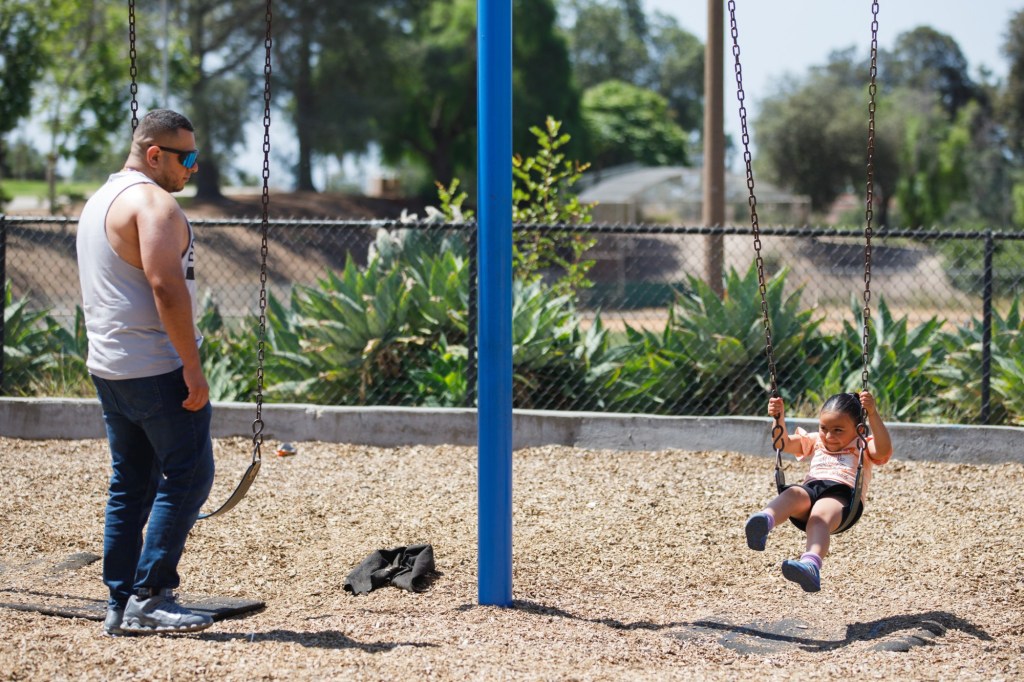
Nearly four years after San Diegans voted for a ballot measure to help address the city’s shortage of available child care, the dream is still far from being realized.
Ongoing legal and feasibility assessments have slowed progress in implementing Measure H, a ballot measure passed in 2022 that would allow child care to be hosted at public parks and recreation centers.
The measure passed overwhelmingly by San Diego voters with more than 68% support, but in the years since the approval, the city has lagged in bringing the measure to life. Funding to build and set up the child care facilities has been unclear from the start, since the measure passed without any earmarked dollars.
Now, as Mayor Todd Gloria has proposed cutting services for youth as part of his plan to address a projected $146 million deficit — including eliminating the Office of Child and Youth Success and cutting funding for the Department of Parks and Recreation in next year’s fiscal budget — any city funding for the measure seems out of reach.
The city’s actions leave child-care advocates worried that Measure H and supporting children more broadly isn’t a priority.
“It’s been largely at a standstill, and now with the cut to OCYS completely, it really puts the city in jeopardy to not follow through with Measure H,” said Courtney Baltiyskyy, vice president of policy and advocacy at the YMCA of San Diego County.
Advocates say that Measure H presents an opportunity to expand much needed child care in the region. According to data from the YMCA of San Diego, nearly half of San Diego County is a child care desert — without a sufficient amount of providers for the number of children — for children under 5 years old.
Finding affordable child care is especially difficult for low-income families. Baltiyskyy said that more than 4,000 children were on the waitlist for state-subsidized child care in recent months.
Following the voter approval in 2022, Measure H did see some momentum.
The city’s Office of Child and Youth Success worked with Parks and Recreation to review the more than 70 city-owned properties to determine which would be viable for hosting child care, ultimately settling on five rec centers as its priorities, the majority in south San Diego.
It also studied licensing requirements, identified what programs and operations to target and searched for funding sources.
Staff worked with Parks and Rec to determine potential space at each facility that could be used, including in existing buildings and park space that could accommodate modular, prefabricated buildings built specifically for child care.
But for more than a year, the measure has been delayed over the potential use of the modular, prefabricated buildings, according to city spokesperson Nicole Darling.
The city aims to develop a request for statement of qualifications to help solicit information about how the buildings could be used in practice, and the City Attorney’s office is evaluating to ensure lawful implementation of the measure.
Darling said community engagement would be necessary to ensure any proposed child care would not disrupt current park use.
Since Measure H didn’t come with secured funding, there has also been uncertainty over how building and preparing the facilities for child care would be funded — whether through city money or with child-care providers. The actual care services would be paid by parents or guardians.
After the measure passed, child-care advocates wanted to identify funding opportunities, such as through philanthropy or grants, and the city said it would try to find funding for the facilities.
The city received $2 million in federal funding, secured by Representative Sara Jacobs in February, to support the purchase and installation of modular units for child care at Parks and Rec spaces.
But even with that funding, Darling said feasibility and legal assessments would still need to be completed for potential sites and costs. And while the analysis conducted roughly three years ago determined five priority rec centers, comprehensive feasibility assessments still need to be made for each location to move forward.
Darling says that such assessments won’t be impacted by the mayor’s budget proposal to cut the Office of Child and Youth Success. But the office has been the city’s main department working on Measure H implementation.
The Office of Child and Youth Success launched in 2022, but it has already lost support from the city in recent years. Last year, its three-person staff was consolidated under the Library Department, which left it without direct access to city leadership, and its executive director position was cut. Now, under Gloria’s proposal, it would be eliminated entirely, saving the city roughly $758,000.
“Does that really help the budget all that much?” said Angie Giovannini, founder of the nature-based educational program Empathy in Nature. “Now we have… less voices advocating for kids in San Diego.”
Giovannini explored using Measure H several years ago with the Office of Child and Youth Success for her vision of an outdoor preschool, but the effort was deemed too expensive and never got off the ground.
Erin Hogeboom, director of San Diego for Every Child, says that cutting the Office of Child and Youth Success and its staff would be detrimental to Measure H since it would remove the people who understand the intricacies of the requirements for child care.
“Having that kind of expertise is critically important if you’re ever going to do anything in this space,” she said.
Some child care-care advocates say they understand that implementing an initiative like Measure H may take time. But Susan Seiguer, founder of the All Friends Nature School, says it’s frustrating to see the slow progress on something that could benefit San Diego’s children and care providers.
“I feel like there’s another agenda, and child care is not at the top,” she said.
All Friends Nature School provides outdoor education to children ages 3 to 8 years old, combining play-based learning with education about the natural world.
Seiguer was involved in early conversations with the Office of Child and Youth Success about Measure H’s implementation, including helping provide training to child-care providers who would host their services outdoors.
That kind of support from community partners was always the intention of Measure H, said Hogeboom, who helped advocate for the measure.
“The intent was never to have the city run child care, per se, but to always work with partners to really tap into the expertise in the community of people who are already doing that kind of work,” Hogeboom said.
She says that until the city is ready for implementation to begin in earnest, those partners are standing at the ready.
“I think that community is ready and willing, and just kind of waiting to see what happens,” she said.