
If there is one leaf shape everyone knows, it’s the maple leaf.
Botanically, it’s known as palmately lobed. Just the other day, I was ogling some Japanese maples at a nursery while lamenting how difficult it is to grow these trees in Southern California. From personal observation and investigation, if you wish to see their leaves without brown tips, allow Japanese maples to receive direct summer sun until 10 a.m., then keep them in the shade for the rest of the day. I’m not saying they won’t survive with more sun than that, and I have seen 50-year-old specimens that are 30 feet tall and get half-day sun, but direct sun after 10 a.m. will burn the margins of their leaves, if not more than that, to a crisp.
It occurred to me while contemplating Japanese maples that our own California sycamores — whose leaves are also palmately lobed — are riparian trees, meaning that they grow naturally on the banks of streams or rivers or in proximity to these water sources. It happens that trees with maple-leaf foliage are native to forests or to locales adjacent to flowing water. In other words, in their native state, they need protection from the consequences of heat exposure, offered by shade or constant moisture in their root zone. Once established, however, the picture changes as California sycamores are drought-tolerant, not long after being planted in the garden. Japanese maples, too, will not be so water-needy after they have grown for several years in your shady backyard.
Further investigation revealed that when it comes to trees native to the San Fernando Valley, the dominant species fall into the riparian category. Although some of them may be found in an upland woodland habitat as well, namely: California sycamore (Platanus racemosa), Valley or white oak (Quercus lobata), coast live oak (Quercus agrifolia), Western redbud (Cercis Occidental’s), and California black walnut (Juglans californica). After all, a valley is a place where water settles, and it’s not surprising that trees native to valleys would appreciate a ready supply of water. In any case, all of these trees would thrive in a well-watered garden as long as the soil drainage was good.
Getting back to maples, it should be noted that not only are they palmately lobed, but they have acuminate apices — a fancy way of saying that their leaves come to a point. Pointed leaf tips are actually an advantage in shady environments where excess water on leaves could lead to fungus problems. A pointed leaf, however, makes it easy for excess water to run off, keeping the leaf dry. It’s noteworthy that when tomato plants of the same variety are grown in both sun and shade, the plants grown in the shade have pointier lobes than those grown in the sun. The large size and papery nature of maple leaves also attest to their need for moisture since they lose water more readily than thicker, waxier, or more leathery leaves.
Upon examination of all California native maples, we see the same riparian pattern. The most magnificent of our indigenous maples is bigleaf maple (Acer macrophyllum), which can grow to 100 feet or more where cultural conditions are optimal. It’s found growing naturally beside streams, in canyons, and in valley bottoms where soil stays moist throughout the year. Although it can grow where water is more scarce, it looks its best where water is readily available. The most glorious specimen of this tree I have seen may be found at the California Botanic Garden in Claremont.
The native Rocky Mountain maple (Acer glabrum) is also known as a dwarf maple since it stays at a manageable height of 30 feet. It can definitely grow in Southern California, but it must be given some shade and regular water. Vine maple (Acer circinatum) is a small native tree or large shrub growing up to 20 feet that demands shade and moisture. It doesn’t grow as a vine, but its shoots sprawl along the ground and take root as vine shoots sometimes do.
It should be noted that maples or any other plants that require regular moisture and protection from summer sun are most suitable for container growing. When it comes to Japanese maples, those most tolerant of heat have green leaves, and I have seen some of these with the lushest foliage imaginable when grown in containers on a shady patio. I have also seen one of the crimson-leaf, finely lobed varieties in a container that was thriving where it got a modicum of filtered sun only, and was otherwise in complete shade throughout the day. You might also want to consider planting a coral bark Japanese maple. Its bark is red, and its foliage is pale green with pink margins. Leaves turn brilliant yellow, orange, and red before dropping in the fall.
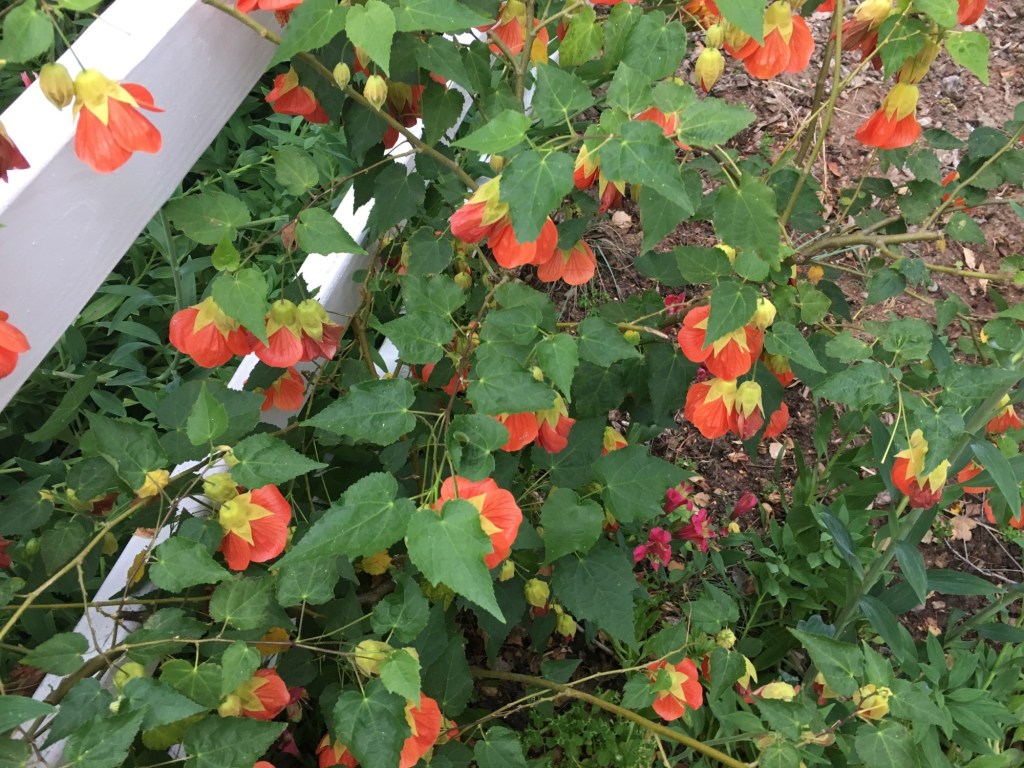
Ironically enough, one of the most floriferous plants for growing in the shade is abutilon, especially the hybrids, known as flowering maple on account of its palmate, pointed foliage. I once saw a Tiger Eye abutilon several decades old that had vined 20 feet up into a 30-foot all Japanese maple, which was growing in the shade of a larger tree itself. Tiger Eye has yellow flowers with a bloodshot look that’s highlighted with deep red venation. This plant flowers year-round and, like all abutilon cultivars, is not water needy. There are hundreds of abutilon cultivars, yet only a few are commonly available in the nursery trade. Victor Reiter is a noteworthy selection whose soft orange lanterns expand to three inches in diameter, while Moonchimes has two-inch lemon yellow blooms, and Fruit Salad has strong orange flowers that erupt prolifically on and off throughout the year. Abutilon shoots are long and may touch the ground. These shoots should be pruned since ants will carry scale insects onto the plants via ground-rubbing leaves. Abutilon trunks can be protected from scale-toting ants by application of vaseline on a cardboard collar around their base.
California native of the week: Western azalea (Rhododendron occidentale) grows throughout California but is curiously absent from our gardens. It grows 10 feet tall with two-inch flowers that are white or pink with a yellow blotch on one of the petals. Flower buds are red. Western azalea is native to forest habitats, but it will need some sun to bloom. Flowers have a powerfully perfumed fragrance, especially towards dusk. This azalea is deciduous and blooms during April and May. Leaves are a lustrous green and turn yellow, orange, or crimson in the fall. You can find seedlings at Etsy.com.
Do you have a thriving Japanese maple? If so, tell me about your triumph via joshua@perfectplants.com. Your questions and comments, as well as gardening conundrums and successes, are always welcome.