
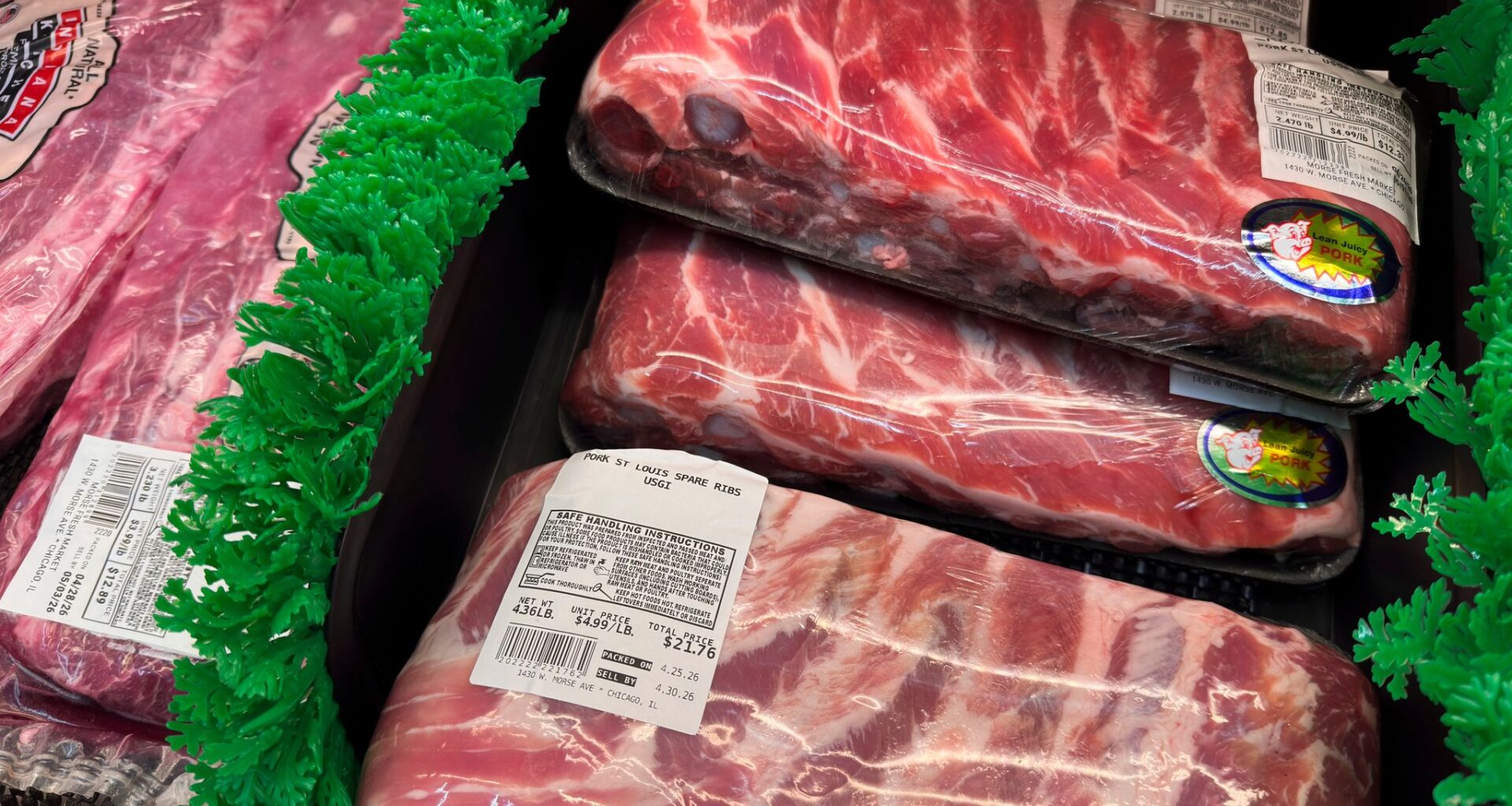
California voters overwhelmingly adopted Prop 12 in 2018, mandating that pork, veal and eggs sold in the state come from animals raised in more humane conditions.
Erin Hooley/Associated Press
WASHINGTON — Opponents of a California law mandating more space for breeding pigs scored a significant win on Thursday when the House of Representatives narrowly passed legislation that would nullify the state’s pork production standards.
It’s a consequential step toward the federal government invalidating a state law approved by millions of California voters because of intense lobbying by a powerful industry.
But Proposition 12 — which has survived previous congressional threats and a legal challenge that went all the way to U.S. Supreme Court — is not dead yet. The long-running battle between animal welfare advocates and the nation’s largest pork producers now moves to the Senate, where there is a higher threshold for approving bills and unified Democrats could block action.
Article continues below this ad
“Sometimes you work for hundreds of hours on an issue and then in one moment it’s over,” said Rep. Lateefah Simon, an Oakland Democrat who helped organize a bipartisan defense of Prop 12 in the House. “It’s not over for us. It’s not over. We’re going to keep fighting.”
Language prohibiting states from setting regulations for livestock production that could affect farmers beyond their borders was tucked into the federal farm bill, the food and agriculture policy omnibus that dictates everything from grower subsidies to funding for nutrition assistance.
San Francisco Chronicle Logo
Make us a Preferred Source to get more of our news when you search.
Add Preferred Source
That GOP-drafted proposal, which would update a law that expired three years ago, advanced off the floor Thursday by a vote of 224-200, with mostly Republican support. Reps. Jim Costa of Fresno and Adam Gray of Turlock (Stanislaus County), who both represent heavily agricultural districts, were among 14 Democrats to vote for it.
Rep. Glenn “GT” Thompson, a Pennsylvania Republican who leads the House Agriculture Committee, said the provision overriding Prop 12 was necessary to stop any individual state from dictating policy for the rest of the country.
Article continues below this ad
“That’s what California is doing. It’s imposing its will on the rights of every other state,” he said following the vote. “And that’s just wrong.”
California voters overwhelmingly adopted Prop 12 in 2018, mandating that pork, veal and eggs sold in the state come from animals raised in more humane conditions. For pork production, it means breeding pigs must be kept in cages no smaller than 24 square feet, giving them enough room to turn around.
That has always been the most contentious provision, because most pork is produced outside of California, in places such as Iowa, where industrial farms commonly house sows in 2-foot-by-7-foot “gestation crates,” barely larger than their bodies, for months at a time while they are pregnant. Prop 12 banned the sale of meat from hogs born in those conditions, sparking a fight over whether the law unconstitutionally interfered with interstate commerce by essentially forcing regulations on businesses outside California.
Fearful of losing access to the largest consumer market in the U.S., major pig farming operations sued to stop law, but it was narrowly upheld by the Supreme Court in 2023.
So the industry has turned its attention to Congress, seeking to supersede Prop 12 — as well as a similar law in Massachusetts — in a move that it argues would restore certainty to the pork market. Though the U.S. Department of Agriculture estimated last year that more than a quarter of American hog farmers had already made investments to comply with California’s regulations, major pork producers contend it is financially unsustainable to have conflicting standards across the country and the costs will crush small farmers, leading to consolidation and higher prices.
Article continues below this ad
Most congressional Democrats and some Republicans have nevertheless continued to back the law, because of concerns over animal welfare, states’ rights and Chinese ownership of the country’s largest pork producer, Smithfield Foods.
“Everything coming out of that other side is about cruelty,” Simon said. She pushed this week for a bipartisan amendment that would have stripped the Prop 12 provision from the House farm bill, but it was overshadowed by a fight about liability for pesticides makers and blocked by Republicans in a tense committee hearing where the ranking Democrat accused a GOP colleague of calling people who support more space for breeding pigs “stupid and uninformed.”
The Senate will soon begin its own process to pass the farm bill. Sen. John Boozman, an Arkansas Republican who leads the Senate Agriculture Committee, said Thursday he personally supports nullifying Prop 12 but he is uncertain that language will make it into the Senate version because “I don’t know if a single Democrat in the Senate is interested in voting for it.”
“We’re not going to be held hostage and not have the farm bill over things like that,” Boozman said. Unlike the House, where a simple majority suffices, most legislation in the 100-member Senate needs at least 60 votes to overcome the filibuster.
Article continues below this ad
Formal negotiations would likely follow to settle the differences between the House and Senate farm bills. Thompson said he would fight for the Prop 12 language if it is not retained by the Senate.
“But I understand that Sen. Boozman, who is a dear friend, has got to do whatever he can to get 60 votes in the Senate, and I respect that,” he said.