
The chardonnays were gorgeous, textured, distinctive and stony; the pinot noirs, savory and spicy, complex and structured.
It’s not unusual on the West Sonoma Coast to find a vigneron who excels with both these varieties. But in this case, those were just the beginning of the fascinating array of wines.
Matt Taylor also makes stunning cabernet sauvignons and merlots from the Napa Valley. He makes rich, deep sauvignon blancs that taste like no others from California, and he’s making superb wines with chenin blanc and gamay, grapes that have often made good wines in California, but seldom great, and pineau d’Aunis, a grape that is virtually unknown there.
In an earlier era, big California producers routinely grew many different varieties, often blending them together or marketing the wines under proprietary names. But in today’s far more specialized world, where growers tend to concentrate their efforts on small sets of grapes that are matched to specific vineyard conditions, excelling with such a variety of grapes in such different terroirs is exceedingly rare.
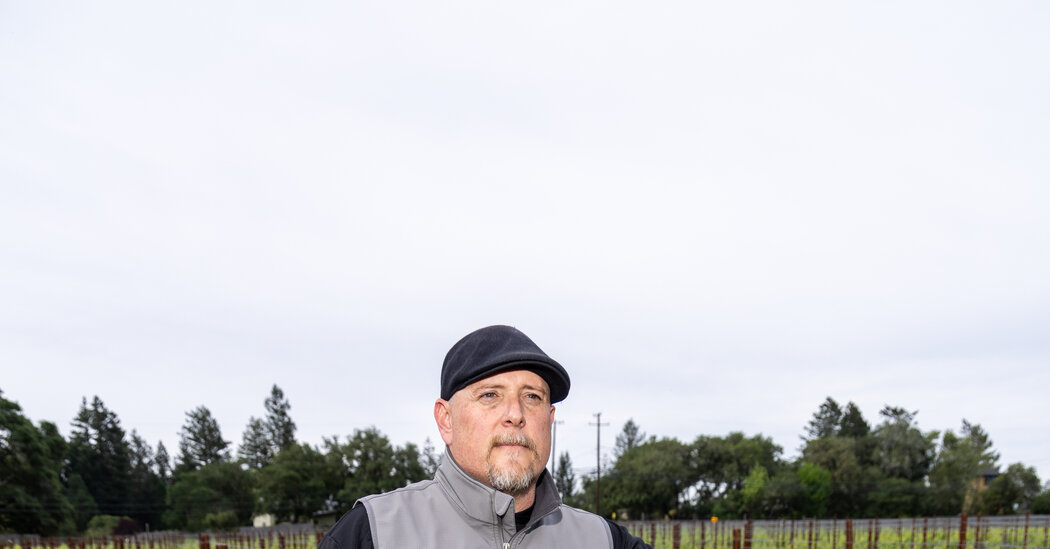
Mr. Taylor has worked for other people, overseeing farming and making wine. But a decade ago, he started to make small amounts of wine released under his own label, Matt Taylor Wines. They were so exquisite that people began to pay attention.
I know I did. The more I learned, and the more of his wines I drank, the more impressed I was with their sincerity and distinctiveness. This was especially true with his pinot noirs and chardonnays.
Then I learned that he’s no longer making either wine. Mr. Taylor had lost access to the source of his grapes, the Komorebi Vineyard near Occidental on the West Sonoma Coast, a plot that he had planned, planted and farmed. The lease agreement he had signed had become a financial challenge. With a wife and three children, he decided to let it go.
Carlton McCoy Jr., a master sommelier and chief executive of Lawrence Wine Estates, which owns several historic Napa Valley properties, loved the Komorebi wines. The fact that Mr. Taylor wasn’t making them anymore, he said, was “a tragedy.”
Back in 2019, Mr. McCoy tasted the 2016 Komorebi pinot noir, Mr. Taylor’s first vintage, and said he found it “uniquely compelling.” Not long afterward, he hired Mr. Taylor to make the wines at one of the Lawrence properties, Ink Grade on Howell Mountain, and eventually at a second, Haynes Vineyard in Coombsville.
“I really wanted to put on a pedestal the classical cabernet style of Napa and see it revered as much as the bigger styles,” Mr. McCoy said. He learned that Mr. Taylor had worked early on at Domaine Dujac, a superb estate in Morey-St.-Denis in Burgundy, and at Araujo in Napa Valley, a leading producer of big, polished cabernets.
“You don’t really see people with that range of experience, they’re usually in one camp or the other,” Mr. McCoy said. “His taste and DNA were in classic wines. He was exactly what I was looking for.”
I first heard about Mr. Taylor a few years ago, but not until 2024 was I able to track down a bottle of his wine, a 2017 Komorebi chardonnay with an unusual, hand-painted label.
The wine was striking, so different from the prevailing style of lean, precise chardonnays that had emerged from Burgundy and captured chardonnay producers worldwide. This was more generous, richly textured and complex, precise and saline, yet not at all heavy or buttery. It was utterly distinctive, a wine that spoke of its coastal California origin and of its producer.
Jeremy Seysses, whose family owns Dujac, has known Mr. Taylor since he interned there in 2004, and has worked with him at Trailside Vineyards, a Lawrence project that pairs the two as winemakers. He called the Komorebi chardonnays “umami driven and textural.”
The more I found out about Mr. Taylor, the more fascinated I became. He farmed biodynamically and regeneratively, and without irrigation. He made his chardonnays without sulfur dioxide, the stabilizer and antioxidant that is almost universally used except in the more extreme natural wines. He worked oxidatively, exposing the wines to oxygen when young rather than protecting them, as many winemakers do, and he ages the wines for prolonged periods before releasing them to the market.
His farming is instinctive and based on observation and discernment rather than recipes and prescriptions.
“Matt feels a sense of awe when walking in a vineyard, which I believe is a prerequisite for doing great wine work,” said Steve Matthiasson of Matthiasson Wines, who worked with Mr. Taylor at Araujo nearly 20 years ago.
Mr. Taylor counts Richard Leroy, whose brilliant natural chenin blancs from the Loire Valley have a cult following, among his mentors. It was Mr. Leroy, Mr. Taylor said, who convinced him that his chardonnays were stable enough not to require sulfur.
When I went to see him in California, Mr. Taylor suggested we meet at Ink Grade. At the time, I was puzzled as I didn’t yet know that, like many independent vignerons in California, Mr. Taylor needed a day job.
There I tasted all his Komorebi chardonnays and pinot noirs, including a 2020 chardonnay that was super savory with umami and mineral flavors, wonderful yet not at all showy.
“For me, this wine sings of the property and what I want to do with it,” he said.
He made two cuvées of pinot noir, both from Komorebi but one from a single section (called Cuvée Kaela after his wife) that makes slightly less structured wines. Like the chardonnays, the pinot noirs are savory, with complex floral, rootsy flavors that are unusual to find in California.
Partly, this was a stylistic choice. He made his pinot noirs with whole clusters of grapes rather than destemming, which would yield a fruitier wine. The 2022 pinots won’t hit the market until 2027.
“One of my pet peeves with California pinot noir are sweet fruit-forward flavors,” he said. “Whole cluster dampens the sweetness and spreads out the structure and adds a touch of bitterness.”
As wonderful as these wines turned out, Mr. Taylor said he was not wed to whole cluster. Rather, it was a choice he made each year only after tasting the grapes and deciding that whole cluster was appropriate for the grapes.
“My property spoke,” he said. “Every year I wondered if this would be the year I don’t do 100 percent, but I chewed on the stems, and every year it was 100 percent.”
Mr. Taylor has an affinity to the region. He grew up near Bodega Bay, spearfishing and abalone-diving in the Pacific. His family ran the Tides Wharf, where “The Birds,” the Alfred Hitchcock classic was filmed.
“In my imagination,” he said, “these are wines that I wanted to hit that briny seaweed place, coming out of the ocean with free diving, spearfishing and boats coming in.”
Mr. Taylor often speaks as if he were still farming Komorebi, but 2022 was the last year he made wines from the grapes. The owner, Mel Pearl, a Toronto developer, now sells the grapes to Napa Valley Reserve, Mr. Taylor said, a club in St. Helena that gives its members opportunities to make and bottle their own wines.
We nonetheless walked through the densely planted vineyard earlier this year, where he invoked the Japanese idea of shuhari, which suggests that after learning and absorbing the rules of any endeavor, you must then feel free to break the rules and learn to innovate and act creatively without constraint.
“I still have high hopes that I’m going to make wine from there again,” he said
Mr. Taylor is now working with the Mammoth Rock Vineyard not too far from Komorebi, where he is growing Loire varieties, including pinot fin, an ancestral form of pinot noir that he is slowly propagating from cuttings he received from a Sancerre Rouge producer.
The Mammoth Rock wines are outstanding, including a gorgeous 2023 sauvignon blanc of depth and precision, a textured, deep 2023 chenin blanc and a spicy, lovely 2024 pineau d’Aunis.
“The Loires will tell the story for now,” he said.
Mr. Taylor got interested in Loire varieties in 2015, when he first tasted a chenin blanc from Littorai on the Sonoma Coast. Soon after, he persuaded Pascaline Lepeltier, the sommelier and partner in Chambers in New York, to offer a personal seminar on the wines on the Loire and to travel with him to the Loire Valley.
“His patience, will, care, desire to profoundly understand was remarkable,” Ms. Lepeltier said.
The Ink Grade wines are honest expressions of their Howell Mountain terroir, structured yet with fine tannins, more floral and herbal than fruity, complex and compelling. Like top Napa wines they are not cheap — roughly $200 a bottle, except for the sauvignon blanc and the Andesol, a red field blend, which sell for around $75.
The Matt Taylor wines are made in small quantities and are mainly sold through a mailing list, though they occasionally turn up in restaurants and in retail. They are not as expensive as the Ink Grade wines, but the pinots and chardonnays were more than $100 a bottle. The Loire varieties will go on sale in May.
Few of us will have the chance to drink these wines regularly. But if you do have an opportunity, seize it. They are riveting expressions of California.