
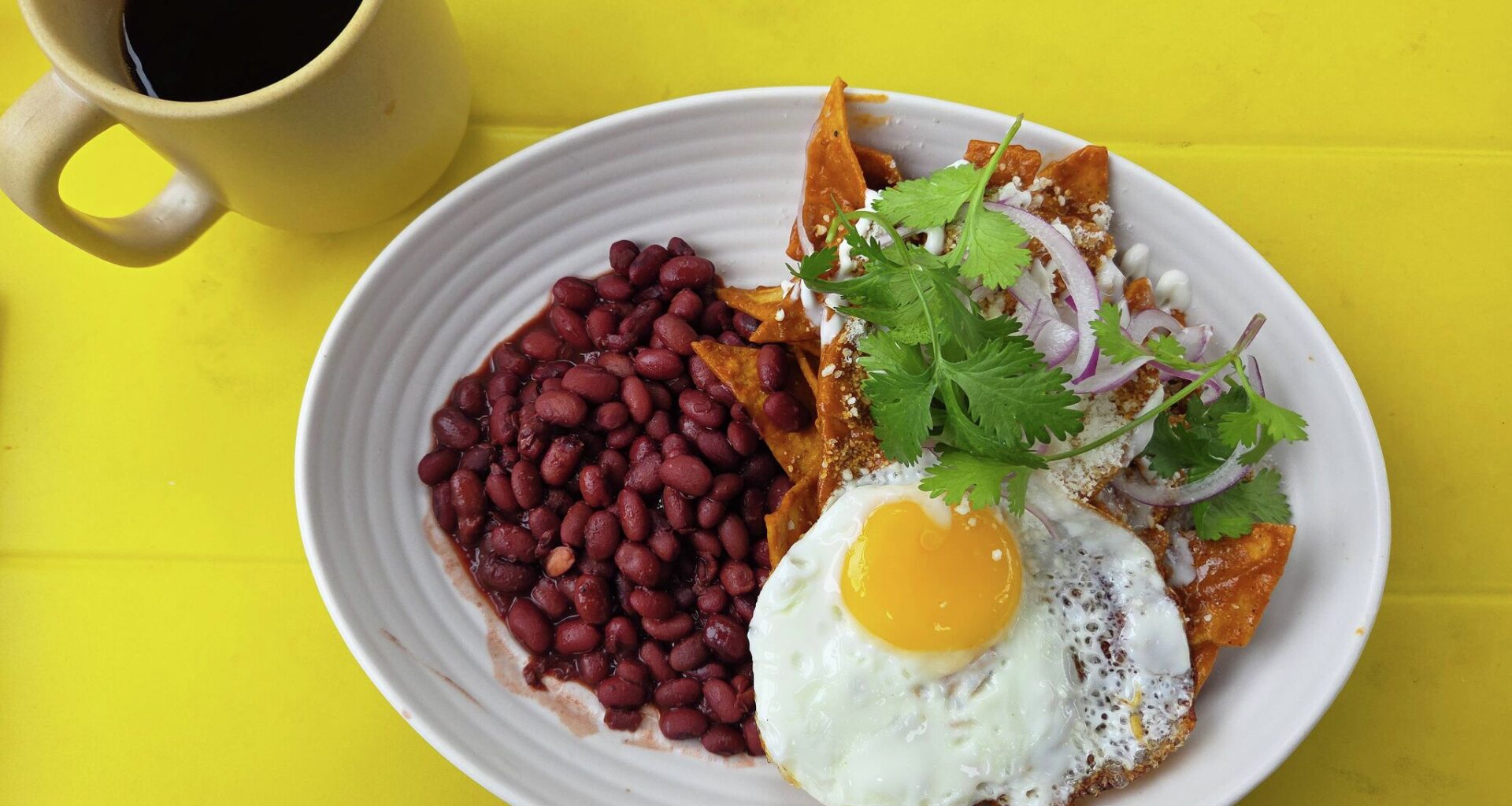
Chilaquiles with beans, a weekend only special at Café Bolita in Berkeley.
Cesar Hernandez/S.F. Chronicle
The beef barbacoa quesadilla from Café Bolita in Berkeley.
Cesar Hernandez/S.F. Chronicle
The blue corn tortilla, which accompanies a mole verde chicken plate, from Café Bolita in Berkeley.
Cesar Hernandez/S.F. Chronicle
A tamal, whose masa is flavored and tinted with carrots, is an anchor of the menu at Café Bolita in Berkeley.
Cesar Hernandez/S.F. Chronicle
In 2015, a trip to Oaxaca exposed Emmanuel Galvan to the potential of masa, the ground corn dough that forms the bedrock of Mexican cooking. There, he learned its myriad geometries — almond-shaped tlacoyos, triangular tetelas and thumb-printed dumplings called chochhoyotes — and the prismatic shades of tortillas. He was especially entranced by one with an ashy pink hue, made from a varietal of corn called bolita. “This is insane,” Galvan said.
He was officially masa obsessed.
He researched freshly milled masa produced from maiz criollo — landrace or heirloom varieties of corn that might have gone extinct, were it not for places like Oaxaca, the state with one of the strongest indigenous cooking traditions in Mexico — a far cry from the powdered supermarket stuff made with genetically engineered corn. By 2018, he was making his own.
Article continues below this ad
Back then, the Bay Area had few restaurants — El Molino Central in Sonoma, for instance — that made masa from scratch using the ancient process of nixtamalization, where corn is bathed in cal (calcium hydroxide), to make the kernels edible, nutritious and malleable.
In 2020, Galvan started a contemporary molino (mill) out of his Oakland home, called Bolita. He nixtamalized corn from Mexico, then ground it into a dough, which he sold on a pay-what-you-want basis. The goal was to make heirloom masa “quotidian,” Galvan said. “That was a very idealistic version of the business.”
San Francisco Chronicle Logo
Make us a Preferred Source to get more of our news when you search.
Add Preferred Source
Eventually, Bolita sold packaged goods — balls of masa, tortillas, salsas — at farmers markets, then expanded to catering and popups. Some restaurants, such as La Vaca Birria, started using his masa; two Michelin-starred restaurant Californios did too, for a period.
Now, Galvan has opened a restaurant, Café Bolita, which is dedicated to the exaltation of masa, offering it in many configurations and colors: a yellow that tastes of popcorn, a grassy-flavored blue and an earthy purple.
Article continues below this ad
The pork chile verde quesadilla from Café Bolita in Berkeley.
Cesar Hernandez/S.F. Chronicle
Located in Berkeley, Café Bolita debuted in February, taking over the former Standard Fare space, which closed late last year after 11 years in operation. Today, the patio is reanimated by cyclists digging into machete-length corn tortilla quesadillas, couples with matching puffer vests sipping cortados and dads carrying newborns trying to sneak bites of chilaquiles. You’ll have to be punctual, as it closes promptly at 1:30 p.m. One would-be patron arrived minutes after, and, in a defeated tone, said, “Let’s go back to Berkeley Bowl.”
Café Bolita is proof of the growing appreciation for the complexities of Mexican food among diners in the Bay Area — and nationally — and it arrives during a banner season for the region’s Mexican cuisine. Already, this year has welcomed Cenaduria Elvira, known for its Jalisco-style homecooking, and Maria Isabel, a coastal-inspired, fine dining Mexican restaurant by the couple behind acclaimed restaurant Dalida. Pretension-wise, Bolita lands somewhere in the middle. It operates on a counter-service model and offers a tight, vegetable-forward menu with a masa throughline: seasonal tamales (currently carrot), quesadillas with rotating fillings and seasonal specials, which could be asparagus tostadas one week, then mole verde with freshly pressed corn tortillas the following.
The sunny patio at Café Bolita in Berkeley.
Cesar Hernandez/S.F. Chronicle
Café Bolita has cultivated an audience who appreciates specialty masa — that is to say, on some level, masa with a story, one about craftsmanship and provenance — paired with seasonal produce. That grants its menu a level of liberation from the expectations of typical taqueria fare. It’s a perfect fit for Berkeley, in other words, where produce is next to divinity.
Article continues below this ad
A seasoned restaurant worker with a resume that includes Tacos Oscar in Oakland, as well as Delfina and Bar Tartine (now closed) in the city, Galvan esteems local produce, but he holds the often overlooked labor powering farms (and restaurants) in equal regard, especially when it comes to Mexican food. The hardest challenge, so far at the restaurant, he said, is finding staff that’s experienced with masa. “This is such hard work,” he said.
Galvan learned to appreciate the labor behind food and wine at home in Napa, where he was raised by Mexican immigrants from Jalisco. His mother was a caretaker, while his father has worked in vineyards (and still does). After a long day in the vines, Galvan’s father would arrive home exhausted and smelling of sulfur. “So much of brown work is just anonymous,” he said.
Despite its Berkeley locale and Standard Fare lineage, Café Bolita’s approach to seasonal cooking is less Chez Panisse and more rustic Mexican. That means it makes as much room for tetelas — filled triangular masa pockets common in Oaxaca’s Mixteca region — as it does for Southwest-style burritos (an ode to Galvan’s partner).
The masa at Café Bolita continues to be the highest caliber in the region, with a supple mouthfeel, hints of minerality and toasted corn aromas. And yet, the restaurant’s greatest achievement is that it makes experiencing the breadth of masa more approachable. Dishes are usually under $25 — cheaper than a visit to Bombera and Californios, two spots that also make their own masa. You’re likely to spend more here than at, say, Taqueria El Farolito, but the prices reflect the cost of labor — masa requires a learned hand — and the cost of goods, as the corn is sustainably sourced from Tamoa, a Mexican company that works directly with farmers.
Mole verde over chicken served with beans, greens and a side of denim blue tortillas at Café Bolita in Berkeley.
Cesar Hernandez/S.F. Chronicle
Stick to the masa items, such as the excellent seasonal tamal plate ($16), which is accompanied by a salad and toothy black beans. A March visit saw a carrot tamal, where the vegetable was worked into the dough, its sweetness balanced with the heat of an emulsified serrano salsa poured atop the bundle.
Article continues below this ad
Quesadillas consist of handpressed corn tortillas — the color might be blue, yellow or purple, depending on what Galvan is using that week — filled with salty Oaxacan cheese. Of the ones I sampled, the chile verde pork ($18) filling was the standout for its piquancy, which was complemented by the earthiness of the denim blue corn tortilla, to say nothing of its softness and petrichor fragrance
Great masa alone does not make a dish work: The beef barbacoa quesadilla ($22), which had sweet undertones from a yellow corn tortilla, suffered from the relatively muffled spice of the braised meat and accompanying raw tomatillo salsa. If you want more heat — and you probably do — order a side of the chile onza salsa ($1), a vinegar-based sauce with a decent burn. (I wish the café offered sides of Galvan’s salsa macha, which I revere as the Bay Area’s best. Currently, it’s only available for retail.)
Weekly specials are more improvisational, sometimes showcasing homey dishes, sometimes highlighting seasonal produce. One week, I encountered a chicken thigh drenched in a mole verde thickened with pumpkin seeds, deeply reminiscent of home cooking. The delicate tostada ($19), on the other hand, used in-season asparagus, pairing spears with broccolini, and citrus-infused whipped ricotta. It was topped in a salsa tijera, an extra savory salsa centered around fried ancho chiles. The ancho chiles reappeared recently, along with sesame seeds and dates, as the base for the salsa of the chilaquiles rojos ($22). The chips retained their sturdy crunch despite being coated in the sauce, which, combined with the sturdy corn flavor, gave them the taste of Fritos. The chilaquiles are available on weekends, though the salsa may shift from red to green, or somewhere in between.
Currently, Bolita is only open during the daytime, but Galvan hopes to roll out dinner soon — first as a series of popups, then as regular evening service. I look forward to all the colors and permutations of masa yet to come.
Article continues below this ad
2701 Eighth St., #118, Berkeley. cafebolita.com