
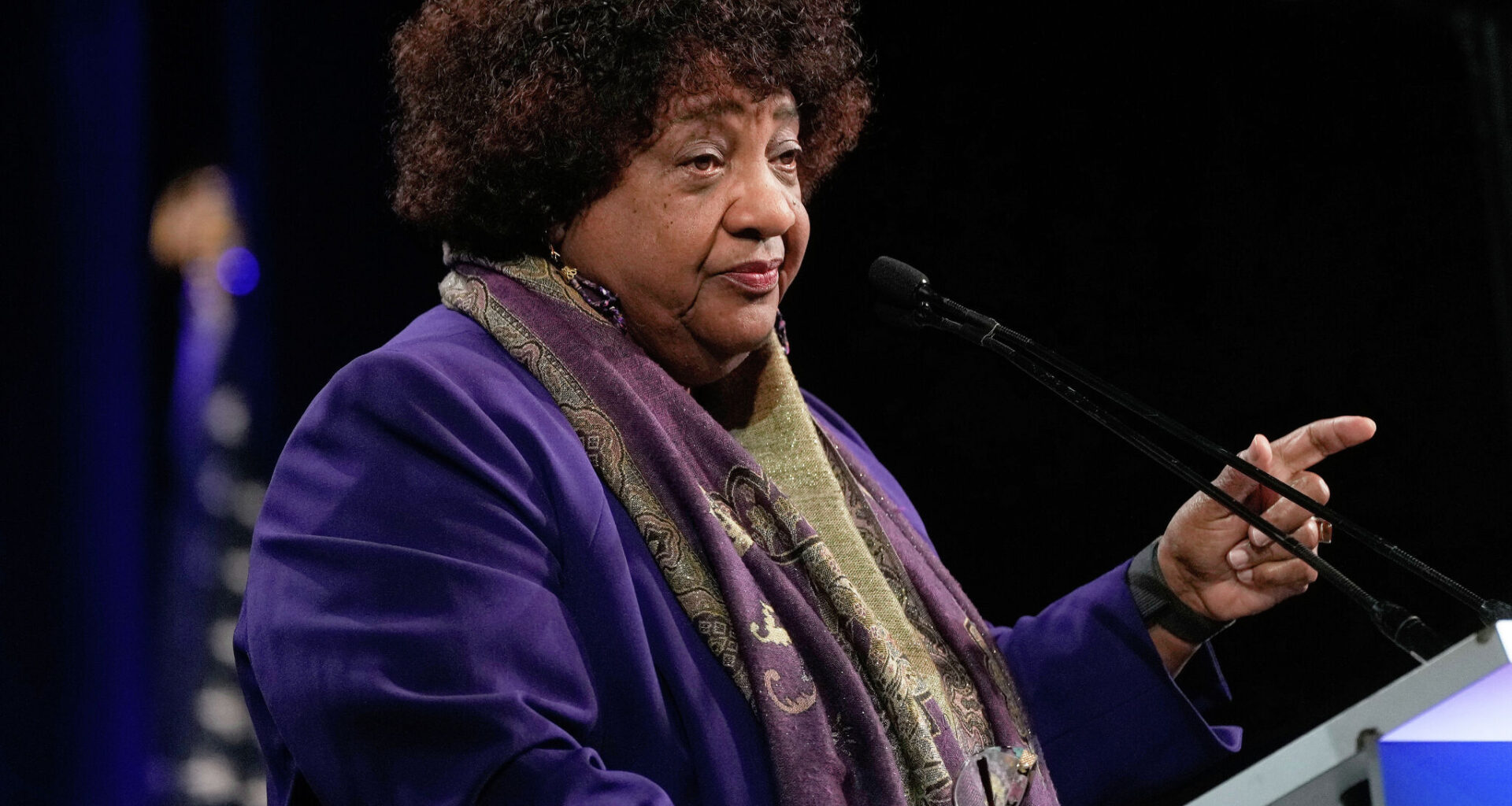
Secretary of State Shirley Weber speaks on Feb. 21 at the state Democratic Party convention in San Francisco. Weber’s commitment to voting rights makes her the best candidate for the office, the editorial board says.
Jeff Chiu/AP
There’s arguably never been a more difficult time to serve as California’s secretary of state.
As chief elections officer, the role has come to demand navigating a stream of baseless allegations of voter fraud from President Donald Trump. Last year, Trump sued to force California to hand over sensitive data on millions of voters, including Social Security numbers, driver’s license information and political party registration. A federal judge rejected Trump’s lawsuit. Now, Trump is seeking to ban voting by mail nationwide.
Meanwhile, California is no ocean of calm when it comes to elections.
Article continues below this ad
In November, state voters will determine the fate of a ballot measure to require voters to show identification at the polls. There has been growing internal polarization over how county registrars of voters should do their job. And Riverside County Sheriff Chad Bianco — a Republican candidate for governor — seized 650,000 ballots cast in the 2025 special election on Proposition 50 after a conservative election denial group alleged “inconsistent ballot counting.”
Amid this chaos, the need for steady and trustworthy leadership from the secretary of state cannot be understated.
The Chronicle editorial board has begun rolling out its endorsements for California’s June primary election. In the weeks to come, we will publish our assessments of all the state races, including the governor’s race, plus local races and ballot measures. To read more about how the editorial board makes its election endorsements, go here.
Plus: Look out for the Chronicle’s Voter Guide to publish in early May as ballots get mailed out across the Bay Area.
Incumbent Shirley Weber, a Democrat first appointed to the office by Gov. Gavin Newsom in 2021 and elected to a four-year term in 2022, is running for reelection against three challengers.
San Francisco Chronicle Logo
Make us a Preferred Source to get more of our news when you search.
Add Preferred Source
They include Green Party candidates Michael Feinstein, a former Santa Monica mayor, and Gary Blenner, a Sacramento high school teacher who also ran in 2022. Both Feinstein and Blenner are thoughtful in interviews with the editorial board, but seemed less interested in performing the secretary of state’s duties than using the office as a platform for enacting proportional representation and replacing California’s top-two primary system with ranked-choice voting.
Article continues below this ad
Also running is Republican Orange County Supervisor Don Wagner, a former mayor of Irvine and state Assembly member. Wagner told us that voters “don’t have confidence” in the state’s election process — apparently ignoring a 2025 survey in which 68% of voters said they did. He pledged to create a “more robust and secure election system” in part by pushing the state Legislature to overturn a 2021 law requiring a mail-in ballot to be sent to every voter.
“Even if there is no fraud, folks feel like it’s possible, and there is a lack of confidence in the system, which is debilitating for democracy,” Wagner said.
Yet his goal seemed to be to stoke, not soothe, those fears.
By contrast, Weber, a former Assembly member and university professor, has repeatedly demonstrated her commitment to following the letter of the law and holding fair elections. In 2021, Weber refused to let Newsom — who’d appointed her — bypass a legal deadline to correct a filing mistake that led to the omission of his party affiliation on the ballot for the election to recall him. Newsom sued, but Weber didn’t back down — and won the case.
Weber told us that although she doesn’t think the voter ID ballot measure is necessary, given the lack of evidence of widespread fraud, “We’re going to make it work to the betterment of California” if voters approve it.
Article continues below this ad
Weber has also done what too few politicians are willing to do: admit their mistakes. In last year’s special election, the official state voter guide inaccurately numbered one of the congressional districts that would be redrawn under Prop 50. Instead of sweeping the mistake under the rug, Weber ordered that postcards be sent to voters acknowledging and correcting the error: “I made the decision that we’re going to have to redo this. We have to do it right.”
The editorial positions of The Chronicle, including election recommendations, represent the consensus of the editorial board, consisting of the publisher, the editorial page editor and staff members of the opinion pages. Its judgments are made independent of the news operation, which covers the news without consideration of our editorial positions.
In what Weber describes as the “hardest decision I ever had to make,” she pulled the plug on a project started by her predecessor, now-U.S. Sen. Alex Padilla, to overhaul California’s outdated campaign finance web portal after an independent assessment found it was “flawed” at practically every level. Weber opted to restart it under a different vendor, even though it would cost the state more money. The revamped portal is now scheduled to launch in November, a month earlier than expected.
Weber’s breadth of experience, willingness to do the right thing and fierce advocacy for voting rights — informed by her parents fleeing a lynch mob in the Jim Crow South — make her the strongest candidate in the race. She deserves to be reelected.
Reach the editorial board with a letter to the editor: www.sfchronicle.com/submit-your-opinion