
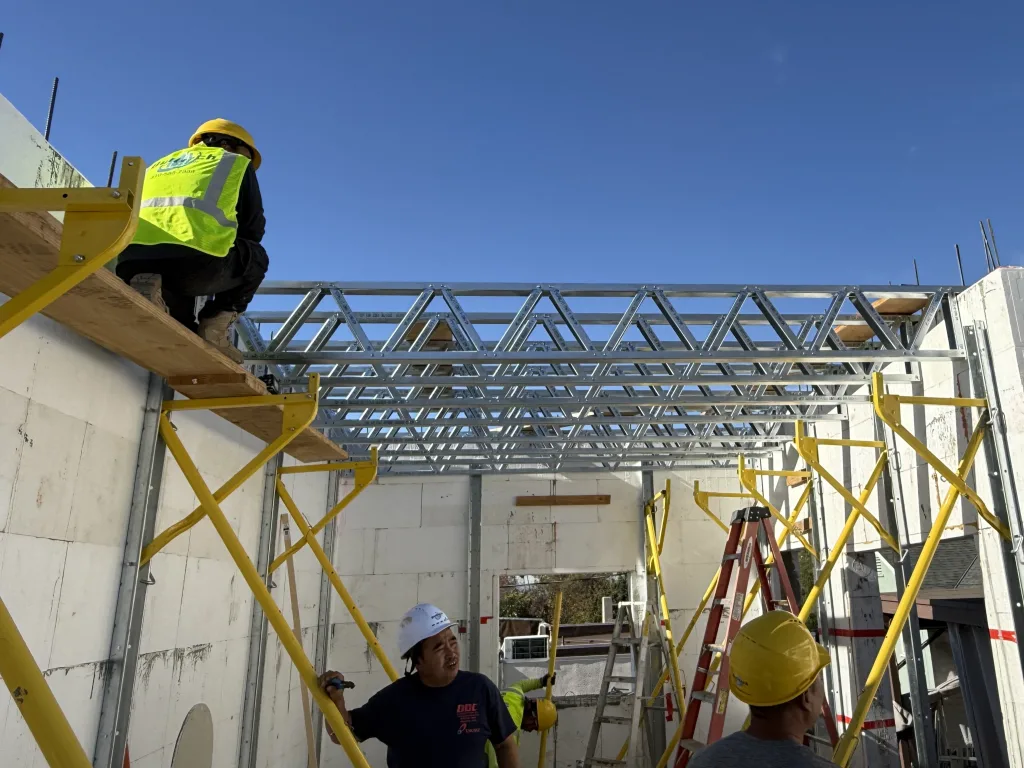
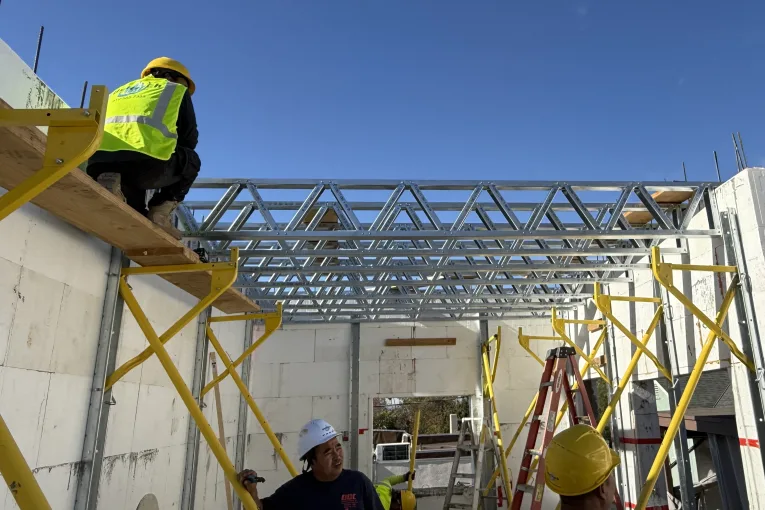
SAN JOSE, Calif. — A newly launched accessory dwelling unit project in San Jose is underscoring a broader shift in how builders and policymakers are approaching fire safety in California, as rising housing density and changing environmental conditions increase risks well beyond traditional wildfire zones.
Builtech Construction recently broke ground on an 850-square-foot ADU using insulated concrete form construction, marking one of the first projects in the region built to Type IA fire-resistance standards, the highest classification under state and international building codes. The project reflects a growing emphasis on noncombustible construction as fire threats evolve across the state.
Aaron Liu, a general contractor and Certified Wildfire Mitigation Specialist, said his company has been moving in this direction for several years, expanding beyond traditional wood construction into fire-resistant building systems. “From 2020, I lead my team not only focus the wood construction, we also do the non-combustible fire resistant houses,” Liu said.
That shift has included experimental and first-of-its-kind projects, including a 3D-printed ADU completed in Walnut in 2024. “That is the first one. We get the full permit and full inspection. It’s very tough to get the permit, but we did it,” Liu said, noting the structure avoided wood entirely, including in the roof system.
The San Jose project is part of a broader pipeline that includes similar developments in both Northern and Southern California. “Right now, we have two projects… one is in Los Angeles… another project is same insulate concrete form block in city of San Jose,” Liu said.
The increased focus on fire-resistant construction comes amid what builders describe as a fundamental change in fire behavior and exposure patterns. Liu pointed to shifting climate conditions and recent fire events as key drivers. “The fire season actually is more frequently than [before],” he said, referencing recent fires that occurred outside the traditional seasonal window.
He emphasized that environmental factors are only part of the equation, noting the growing role of human activity. “Usually the fire happened, 80% is human. It’s not only the weather,” Liu said.
Population movement patterns are also contributing to increased risk. “Right now, more people move to [wildland-urban interface] area… so that will be a lot of risk to make the fire,” Liu said, estimating significant increases in population exposure in high-risk areas.
Yinnan Shen, who also worked on the project, said the expansion of ADU development across California has compounded those risks by increasing housing density in both urban and suburban settings. “California, since I think seven years ago, started to really promote the build of ADU… so the housing density has increased dramatically in the past few years,” Shen said.
That density, Shen noted, is changing how fires spread, even in areas historically considered lower risk. “Even for those homes not in the WUI areas, they are also facing increasingly high fire risks,” Shen said.
As a result, builders are increasingly looking beyond traditional fire mitigation strategies and toward more comprehensive structural solutions. Liu said the goal is not only to build new fire-resistant homes but also to improve existing ones. “Right now, I think it’s very important to do the fire resistant houses… also relatively improve the fire resistant of the existing house,” he said.
Despite assumptions that such systems are prohibitively expensive, Liu said cost can be managed through a range of approaches tailored to homeowner budgets. “We have four solutions how to solve the issue… to match the owner’s budget also,” he said.
Those options range from retrofitting existing homes to full noncombustible construction. “Some houses… not really need to tear down to rebuild. So we can do retrofit,” Liu said.
For new construction or rebuilds, hybrid approaches can also reduce costs while improving safety. “If the budget not enough to do 100% non-combustible, we can do wood construction with fire resistant coating to improve the wood fire resist[ance],” Liu said.
He emphasized that fire-resistant construction provides multiple benefits beyond fire protection. “The most important is fire proof… sound proof, thermal control, no termite,” Liu said, adding that concrete components can also be recycled.
Seismic resilience is another advantage. “For sure, the earthquake resistant, no problem either, because all the structural design will be based on the safety code,” Liu said.
In terms of cost, Liu said the price range varies depending on the method used. “If some people really need a number, I think from 10% to 40%. That’s based on different construction methods,” he said.
Shen added that some fire-resistant construction methods, particularly insulated concrete form systems, can be comparable in cost to traditional wood construction. “The cheapest one would be the ICF one… typically going to cost from about the same price with wood construction to about maybe 10% more,” Shen said.
More advanced methods, such as 3D printing, remain more expensive due to equipment and material costs. “Because the technology right now hasn’t been massively adapted… the cost is primarily in renting the equipment,” Shen said.
Liu added that specialized materials further drive those costs. “The 3D printing materials is very expensive so far… it’s totally different with the standard concrete mix,” he said.
Despite the technical differences in construction, both Liu and Shen said most homeowners would not notice a significant difference in appearance for certain systems. “I think it can look exactly like the wood construction if you use the ICF one,” Shen said.
More experimental methods, such as 3D printing, may produce different aesthetics depending on design choices. “You can even do a house in a sphere shape… so that might look differently from the traditional kind of house,” Shen said.
Liu said that flexibility is part of the appeal. “3D is more useful… for the unique shape,” he said, noting that unconventional designs can offer both cost and structural advantages in certain contexts.
As California continues to confront both a housing shortage and escalating wildfire risks, projects like the San Jose ADU illustrate a potential convergence of policy priorities: increasing housing supply while reducing vulnerability to disasters.
For Liu, the trajectory is clear. “That will be more and more important,” he said of fire-resistant construction, as density rises and fire conditions become less predictable.
Follow the Vanguard on Social Media – X, Instagram and Facebook. Subscribe the Vanguard News letters. To make a tax-deductible donation, please visit davisvanguard.org/donate or give directly through ActBlue. Your support will ensure that the vital work of the Vanguard continues.
Categories: Breaking News Housing State of California Tags: ADUs california housing construction innovation fire safety San Jose wildfire risk