
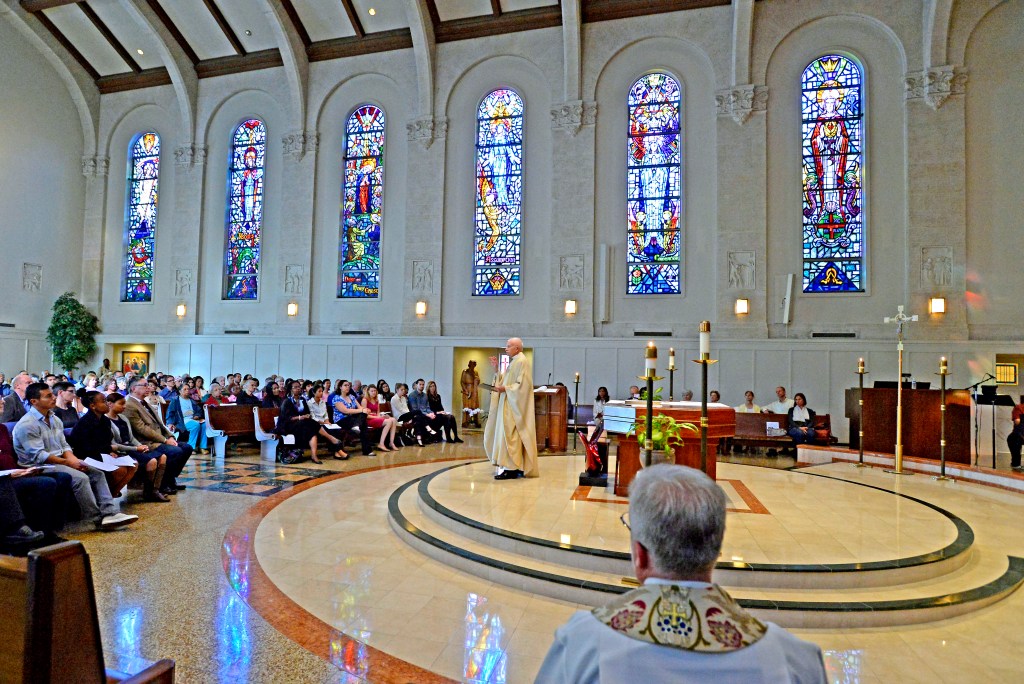
The Roman Catholic Diocese of Oakland plans to close 13 of its locations across the East Bay in what it claims is a yearslong reorganization effort to address flagging attendance — a move that comes as the church faces a dire financial outlook due to hundreds of sexual abuse claims.
The decision by Bishop Michael Barber affects 12 parishes and one pastoral center across Oakland, Fremont, Alameda, Castro Valley and Crockett, according to a missive posted online Tuesday. No timeline was announced for the closures, with the bishop saying only that it will be “unique for each site.”
The announcement comes at a difficult time for the diocese, which has been seeking Chapter 11 bankruptcy protection since spring 2023 amid a torment of lawsuits alleging decades of sexual abuse by its priests. That legal peril began when state lawmakers passed legislation opening a new three-year window for people to file lawsuits claiming sexual abuse; it closed on Dec. 31, 2022.
Just last week, an Alameda County jury awarded $16 million to one such abuse victim, in a key case aimed at spurring long-plodding settlement talks between other abuse victims and the diocese. A group of some 350 other abuse victims have demanded $314.1 million over the course of three-and-a-half years, some $90 million to $134 million more than the diocese’s most recent offer.
Barber made no mention of the pending sexual abuse lawsuits in his letter to the diocese, and he made only a glancing reference to the bankruptcy proceedings — telling parishioners that “regardless of that outcome, we must face the realities described above and proceed with these closures.”
In his letter, Barber stressed that the moves were due to “the diocesan-wide trends in declining Mass attendance, participation in the sacraments and Catholic school enrollment (that) began in the early 2010s.” He also cited an “all-time low” number of priests available to the diocese, along with the fact that parishes and schools in some parts of the East Bay are “struggling with financial sustainability.”
“While many of our parishes were built to serve the Catholic Church of 1965, we now have far fewer priests and parishioners,” Barber’s letter said. “Not all parishes can afford to pay for a support staff to fully serve the parish and our missionary aspirations. Others are surviving on rental of parish parking lots or empty school facilities.”
“The status quo is not sustainable, nor is it serving God’s people,” Barber added.
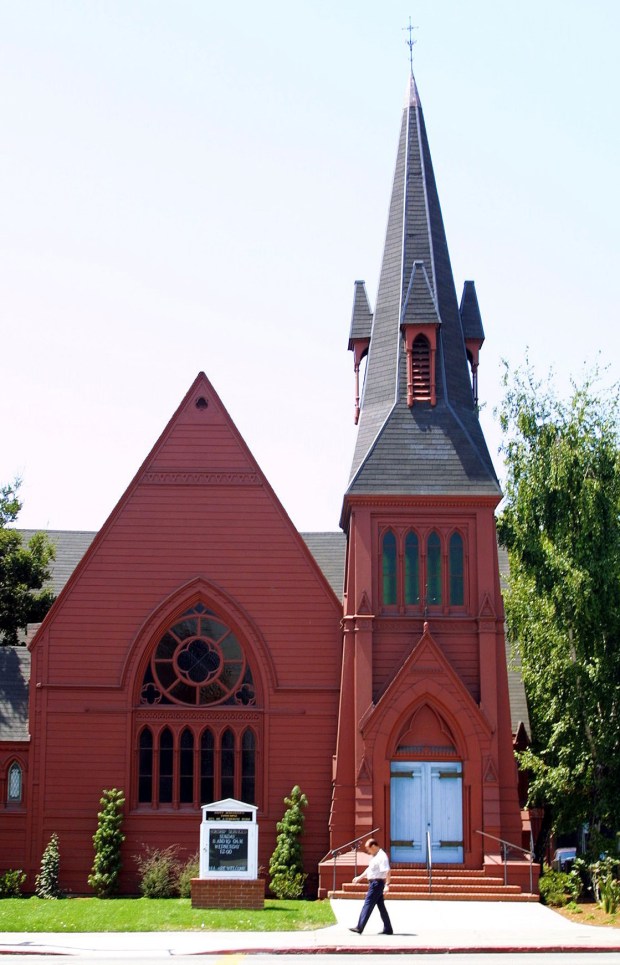 St. Augustine’s Church on Telegraph Avenue in Oakland on Friday, August 9, 2002. The church is one of 13 locations across the East Bay that the Roman Catholic Diocese of Oakland plans to close, citing a years-long reorganization to address flagging attendance. (Nick Lammers/Bay Area News Group archive)
The closures include seven locations in Oakland: Mary Help of Christians, Our Lady of Lourdes, Sacred Heart, St. Augustine, St. Paschal Baylon and St. Patrick and the St. Andrew Kim Korean Pastoral Center. Also closing are two locations in Alameda — St. Albert the Great and St. Barnabas — along with Our Lady of Guadalupe in Fremont, St. Rose of Lima in Crockett, St. Stephen in Walnut Creek and Transfiguration in Castro Valley.
On Thursday afternoon, at least two of the parishes marked for closure stood silent and seemingly devoid of activity. Knocks on the doors of those locations – Mary Help of Christians in East Oakland and Our Lady of Lourdes across from Lake Merritt – went unanswered when visited by a reporter.
The decision has left myriad questions for parish leaders and their congregations. In a letter issued to his congregation, Jayson Landeza, pastor of the soon-to-be-shuttered St. Paschal Baylon in East Oakland acknowledged the uncertainty surrounding artifacts at the site, as well as the future of Vietnamese Mass and a lease agreement the parish had with the Northern Light School at its building.
Landeza wrote that the congregation would have time “in the weeks and months ahead” to remember and mourn the site.
“I know that this news brings sadness, disappointment, anger, and confusion,” he said in his letter, which was obtained by this news outlet. “Those feelings are real, and they deserve to be acknowledged. This is a loss, and it is right to grieve.”
The diocese’s moves come on the heels of its decision in 2024 to close two elementary schools amid declining enrollment and operating deficits that forced officials to tap into reserve funds. Affected by the closures were St. Anthony School, which opened in the late 19th century and provided private K-8 education to a largely Spanish-speaking community in Oakland, as well as Our Lady of Guadalupe in Fremont, another private K-8 Catholic school that was founded in the 1960s.
This week’s announcement represented an opening step to bringing more cash to the diocese amid its settlement talks with abuse victims, said Dan McNevin, a state treasurer with the Survivors Network of those Abused by Priests.
He acknowledged that the closures are “sad for the parishioners of the active parishes that they’re going to lose their community.” Still, he questioned why the church’s decision wasn’t accompanied by any apparent plans to sell numerous high-value properties that are sitting vacant in Livermore, Pleasanton, Fremont and elsewhere. Those moves, he argued, would have had less of an impact on parishioners, and potentially net more money for the church and abuse victims.
“It’s a start,” said McNevin, of the pending closures. “But there isn’t enough money in these 13 properties to really meet the needs of the creditors, to really property compensate survivors.”