
Advocates for La Jolla’s independence from the city of San Diego are bracing for more challenges as the process moves forward.
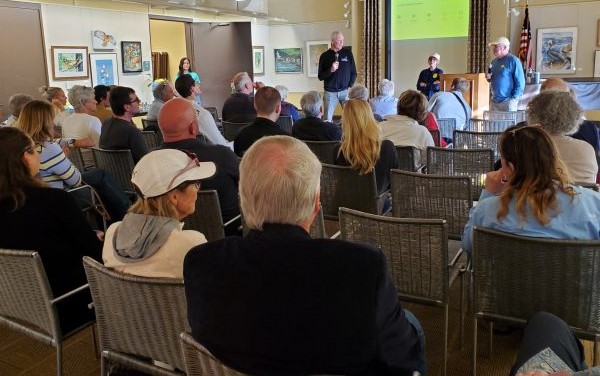
At a community meeting April 28 at the La Jolla/Riford Library, the Association for the City of La Jolla provided an update on its efforts, discussed anticipated issues and outlined next steps. It was the first such meeting since the association brought on La Jolla resident and former San Diego city manager Jack McGrory as its chief negotiator and strategic adviser.
McGrory said there likely will be more legal battles as well as public perception challenges to address.
Story gallery: “Leaving San Diego?” A series about potential La Jolla cityhood
Legal issues
San Diego filed a lawsuit last June calling on the Local Agency Formation Commission — which provides guidance to communities seeking to become cities — to rescind a ruling allowing La Jolla’s cityhood effort to move forward. LAFCO had issued a “certificate of sufficiency” indicating ACLJ had gathered the required number of petition signatures to keep the movement alive.
ACLJ responded with a court motion arguing that the city’s case was a strategic lawsuit against public participation, or SLAPP, calling it a “meritless attempt to obstruct democratic participation and silence a public interest effort through costly litigation.”
In October, Superior Court Judge Judy Bae granted ACLJ’s motion, dismissing the city’s lawsuit and allowing LAFCO to move to the next steps in the process, which include a comprehensive review of the proposal’s feasibility.
However, McGrory said he expects more legal problems and other conflicts with the city.
“There is going to be a lot of litigation, and the city is going to be all over us,” he said.
San Diego decided not to appeal the judge’s ruling, though the city attorney’s office did not comment further.
The city had argued in its lawsuit that LAFCO overstepped in the process of verifying the petition signatures and that the La Jolla cityhood review process would impose “substantial irreparable harm” on San Diego due to the costs associated with staff time required for the next steps.
Another challenge for ACLJ is that, if LAFCO approves the cityhood application, a majority of voters both in La Jolla and the rest of San Diego would have to approve the detachment.
“We know La Jolla needs to vote to make sure the people here are willing to form a new city, but there is an open question about what the other votes [will] look like,” McGrory said.
Some residents of other San Diego communities “think we are this rich community, and we are probably [contributing] a lot of money to the city treasury that is being used by the neighborhoods,” he said. “But we have to be revenue-neutral so they won’t be harmed by us leaving.”
A preliminary fiscal analysis completed last year by Richard Berkson of urban economics company Berkson Associates estimated San Diego would lose $8.5 million in annual revenue as a result of La Jolla’s departure.
That raised the possibility that La Jolla would need to make annual mitigation payments, or “alimony,” to San Diego, since “state law prohibits LAFCO from approving and incorporating [La Jolla] if it causes adverse financial impacts on another public agency, in this case the city of San Diego, and unless there is an agreement in place between La Jolla and San Diego,” the report stated.
The analysis did not estimate the amount of any such payments, saying it would “be negotiated between the two cities during the LAFCO process.”
To tackle the issue of public perception, ACLJ member Ed Witt said “We believe, and what we are working on, is a positive approach where we will prove that this is not only good for La Jolla, but it is really better for the city of San Diego so they can spend their money on the underserved areas … they want to help anyway.”
Should the matter go to a citywide vote, “we are going to have to run a [major] campaign,” McGrory said. “It will be a political campaign.”
ACLJ leaders have said they hope to have the proposal on the ballot in 2028.
However, McGrory added that the association is “exploring other paths” to determine whether a vote of citywide residents actually would be needed. He did not elaborate.
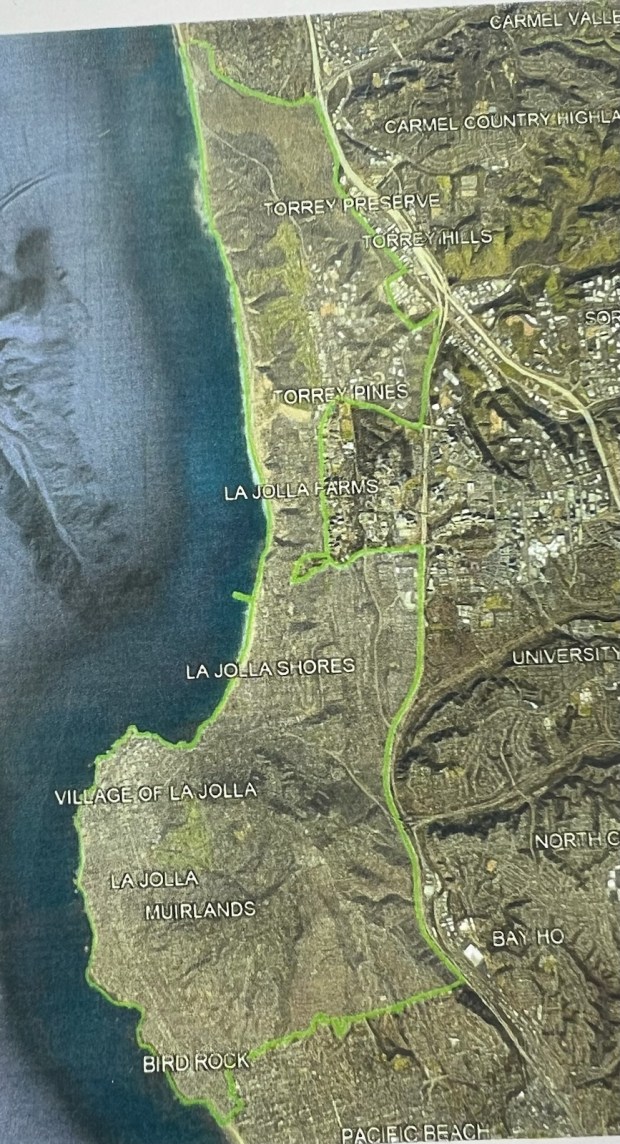 The map of a potential city of La Jolla largely aligns with the 92037 ZIP code, stretching north-south from Del Mar to Pacific Beach and east-west from Interstate 5 to the ocean, excluding UC San Diego. (Association for the City of La Jolla)
Funding questions
Additional hurdles may be the costs associated with completing the LAFCO process, along with funding to repair La Jolla infrastructure should it become its own city.
The association has $82,000 in the bank with an additional $200,000 in commitments, McGrory said. However, to keep the process moving forward, the organization will need “a million dollars by the end of the year” to cover costs associated with LAFCO staff time, McGrory said.
Thus, he said, volunteers and financial donations are needed.
Also, with La Jolla being one of San Diego’s older communities, it has a laundry list of infrastructure needs that a new city government would have to address.
“When you look at our water meter boxes from the 1920s and 1930s, we have a lot of deferred maintenance,” McGrory said. “We [would] take responsibility for all deferred maintenance as a new city. The condition of the streets, the condition of the pipes underground, that all becomes our responsibility.”
He said a “viable revenue source” needs to be found to help fund those repairs.
“We are going to have to figure out how we are going to deal with all this stuff,” McGrory said. “We get all the assets but we get all the deferred maintenance. So it will be a challenge.”
Comprehensive fiscal analysis
ACLJ members said progress is being made to complete the necessary comprehensive fiscal analysis of the likely impact of La Jolla’s secession.
Though Berkson’s preliminary analysis painted a fairly optimistic picture — projecting a first-year city budget for La Jolla of $74.8 million and a surplus of $8 million — the final report will dive deeper into the facts and figures.
In January, ACLJ released a request for proposals to select a contractor to complete the comprehensive analysis.
Two consultants sent in proposals and were interviewed in late April, ACLJ President Diane Kane said.
“We should be finding out shortly who won the proposal and moving forward from there,” she said.
As part of the process to select a contractor, the board added representatives of the San Diego Regional Chamber of Commerce and city unions because they carry “perspectives we thought would be useful going forward,” Kane said.
LAFCO needs to give final approval to whomever ACLJ chooses as a consultant.
McGrory said he expects the comprehensive fiscal analysis to take until the end of 2026 to complete.
“It’s a tough study,” he said. “[They] will have to go into the city budget, extract all the information for La Jolla … across all the city departments.”
Among that information, he said, are the costs associated with public services such as fire and police.
He added that should the city of San Diego not contract its services to La Jolla, ACLJ would contract with San Diego County.
To learn more about ACLJ and the cityhood effort, visit cityoflajolla.org. ♦