
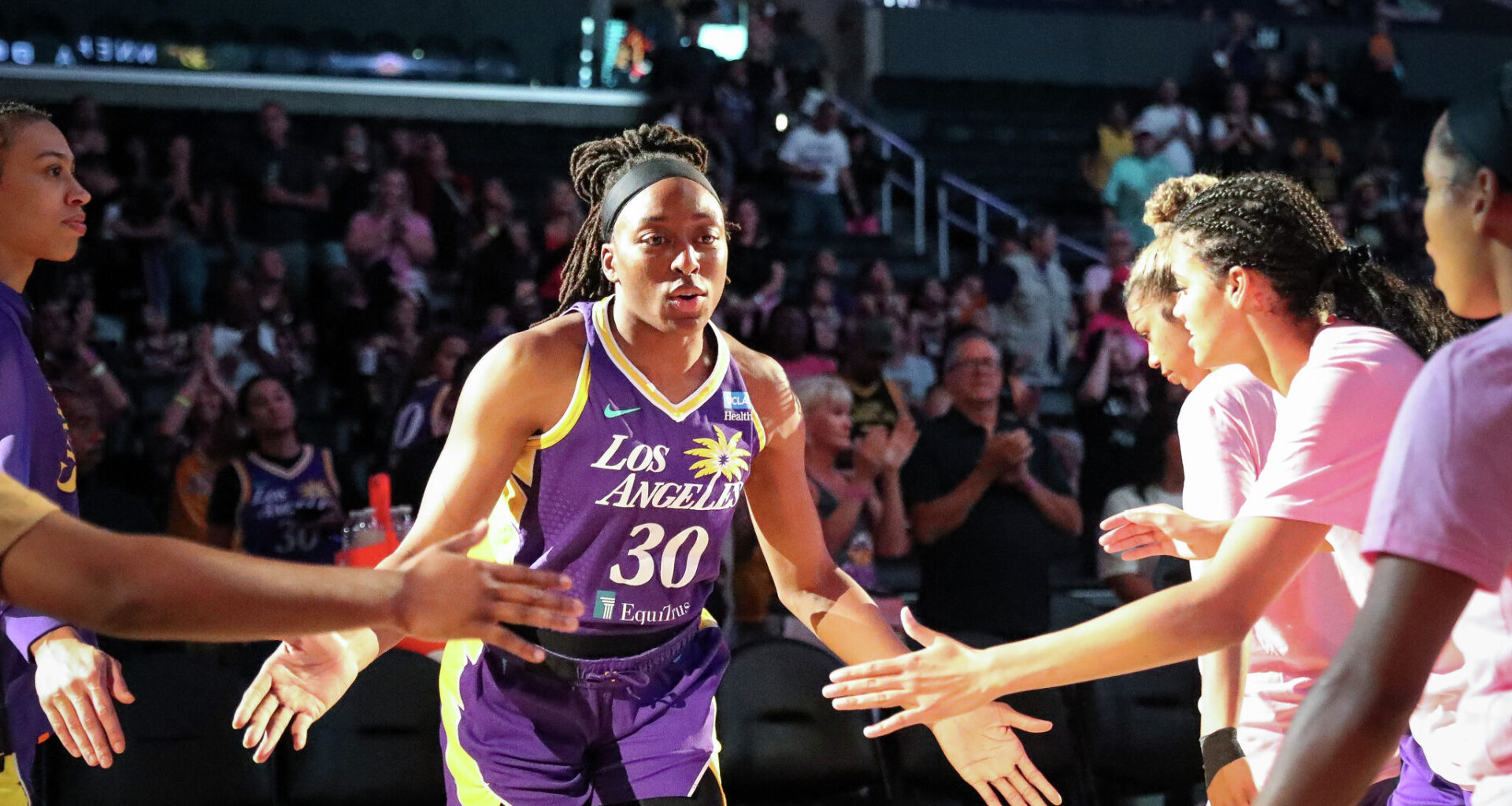
Forward Nneka Ogwumike, seen in her first go-round with the Los Angeles Sparks in 2023, returned to the team after spending two All-Star seasons with the Seattle Storm.
Meg Oliphant/Getty Images
Los Angeles Sparks forward Nneka Ogwumike takes a shot during a 2014 game, early in her WNBA career. She became the president of the players union in 2016.
Christian Petersen/Getty Images
Stanford’s Rosalyn Gold-Onwude, Nneka Ogwumike, Jayne Appel, JJ Hones and Kayla Pedersen celebrate late in a victory over Georgia in the regional semifinals of the 2010 NCAA Tournament at Arco Arena in Sacramento.
Michael Macor/S.F. Chronicle file photo
Tara VanDerveer was at an event recently and saw someone wearing a T-shirt that read “Nneka Is My President.”
“I said, ‘I want one of those,’” VanDerveer said. “I’m just so proud of her.”
Nneka Ogwumike, who played for VanDerveer at Stanford from 2008 to 2012, has become a seminal figure in the history of women’s sports. The president of the Women’s National Basketball Players Association, Ogwumike shepherded the union through tense and lengthy labor negotiations, finally arriving at a landmark labor agreement, perhaps the most significant in the history of women’s sports.
Article continues below this ad
The league had enormous momentum and skyrocketing resources. The players had leverage and support. They had been heading for a labor showdown for almost two years.
The moment was huge. And Ogwumike met the moment.
San Francisco Chronicle Logo
Make us a Preferred Source to get more of our news when you search.
Add Preferred Source
“It didn’t hit me until after we agreed to terms,” Ogwumike said by phone, after practice with her new team, the Los Angeles Sparks. “The work was the work. But when we were ready to agree to terms, I really let it soak in.”
Ogwumike’s leadership has been credited for keeping the players together in the fraught weeks when things got contentious, for standing firm in the players’ demands for a share of revenue, for calling the league’s bluff when it threatened the upcoming season.
Article continues below this ad
“She was a phenomenal leader, and forever changed the landscape of sports,” said Jayne Appel-Marinelli, Ogwumike’s former Stanford teammate who is the Players Association senior vice president of player relations. “Not just women’s sports, but professional sports.”
Ogwumike’s work started a decade ago when she was first elected president of the Players Association, urged to run by outgoing president Tamika Catchings. Ogwumike was reelected in 2019, and helped guide the association through a quickly changing landscape that included a collective bargaining agreement in 2020, the pandemic “Wubble,” and the key moment in October 2024, when the players opted out of the existing CBA as their compensation and league revenues became increasingly unaligned.
Through it all, Ogwumike was a thoughtful, approachable leader. She spoke to players on Zoom calls. She reached out individually.
“She has a quality that is lacking in most of our leadership roles in government lately, and that’s her ability to listen,” Appel-Marinelli said. “To truly, actually listen. It didn’t matter who was speaking, whether it was a very high-profile player or the 180th player. All the words carried the same weight.
“I think she was able to represent the entire body of W players because of that trait. She has a lot of skills, but the key one is that she truly does listen.”
Article continues below this ad
Ogwumike said engaging every player was vital.
“That way everyone could see that they have a piece of themselves in the deal,” she said.
Ogwumike listened and she also asked questions. VanDerveer joked that she used to have a three-question rule for Ogwumike, who wanted to understand the “why” of everything. Even as a freshman, she would raise her index finger and ask her Hall of Fame coach a question.
“I try to ask questions of the right people,” Ogwumike said. “But my biggest role was listening so I could make the best decisions.
“That helped not just the substance of the deal, but the process. The players were invested, committed, responsive and engaged in the details.”
Article continues below this ad
Stanford forward Nneka Ogwumike played four seasons for head coach Tara VanDerveer from 2008 to 2012, going to the Final Four in each season.
Paul Sakuma/Associated Press
And now the players will be rewarded. The CBA that the players opted out of called for a salary cap of a little over $1.5 million per team this season. Under terms of the new deal, that figure leaps to $7 million per team and will keep growing through the deal. Players will be receiving massive pay raises and new protections. The key issue in negotiations was a large increase in revenue sharing. Receiving only 9.3% of revenues prior to the new deal, players will now receive a reported 20% of gross revenue, holding firm that the players should get paid first and not just out of net revenues, which the league offered.
That last point was the thorniest and one of the reasons the final negotiations went virtually around the clock.
“There were times in the process when it was taking longer and I rang the alarm to keep everyone engaged,” Ogwumike said. “Moments when I would say, ‘Hey, tap in.’”
Ogwumike understood how much leverage and public support the players have.
Article continues below this ad
“The fans drive the market value,” she said. “They gave us the power to go into negotiations and fight for what we are worth.”
Appel-Marinelli, who was an eyewitness to much of the negotiations, said Ogwumike kept everyone grounded, even as the negotiations dragged on.
“It was reassuring for players,” she said. “They wanted to play, but they wanted to play for what they’re worth.”
As Ogwumike was consumed in negotiations, her own career choices were looming. A free agent, like so many others, she signed with the Sparks in April, returning to the team where she spent her first 12 seasons and was a league MVP. As she worked one job as the union president, she also worked to stay in shape for her primary job as a player.
“I was able to get my work in,” she said.
Appel-Marinelli watched her friend excel at both full-time jobs.
“She’s very organized, very efficient,” Appel said. “She made sure this is what time I’m working out and this is what time I’ll be back in the office to work on negotiations. She knows what it takes to be ready to play.”
Those who have known Ogwumike for a long time aren’t surprised by what she was able to achieve in the high-stakes negotiations.
“At Stanford she related from player 1 through 15 on the roster,” Appel-Marinelli said. “She’s an approachable leader. That’s something she’s worked on.”
“She’s calm, she’s thoughtful and she has a lot of stamina,” VanDerveer said. “She just doesn’t crack.
“She’s the glue. She’s one of those sailors that can sail through a storm. She’s really steady. That’s what was needed. And she delivered.”
Ogwumike was a captain on the Stanford team. She made it to the Final Four every year she played for VanDerveer.
“Everyone trusts her,” VanDerveer said. “She doesn’t have an agenda. She’s not selfish. She’s about the big picture.”
The deal was approved unanimously by players. Ogwumike is modest about the accolades she has been receiving in its aftermath. But she also gets to enjoy the fruits of her labor negotiations. Her new one-year deal is reportedly worth $950,000 — $755,000 more than she made last season.
“I feel grateful to be in a position to celebrate this very historic moment,” she said, “and to still be playing in this league as it goes through this transformational change.”
VanDerveer got her hands on one of those “Nneka Is My President” T-shirts. With Ogwumike’s negotiating success and leadership skills, could the slogan hint at something more? Could politics be in her future?
“I don’t close any doors,” she said.
Whatever the future holds, Ogwumike has already secured her place in history.