

For The Union-Tribune
Early spring is the honeymoon phase of the rose garden. Buds, blooms and leaves look perfect, and we feel a sense of calm and delight. But with some roses, the honeymoon is short-lived. Fungal diseases arrive, spoiling those flawless leaves and blooms — and our serenity.
We are not helpless when it comes to tackling fungal disease. We can confidently say “I’ve got this” when we:
• Learn to identify each disease.
• Manage and minimize the environmental conditions that encourage its spread.
• Observe disease early and take appropriate action before it gains a foothold in the garden.
• Select the roses we grow with care, and make the hard but necessary decision to remove roses that are persistently problematic.
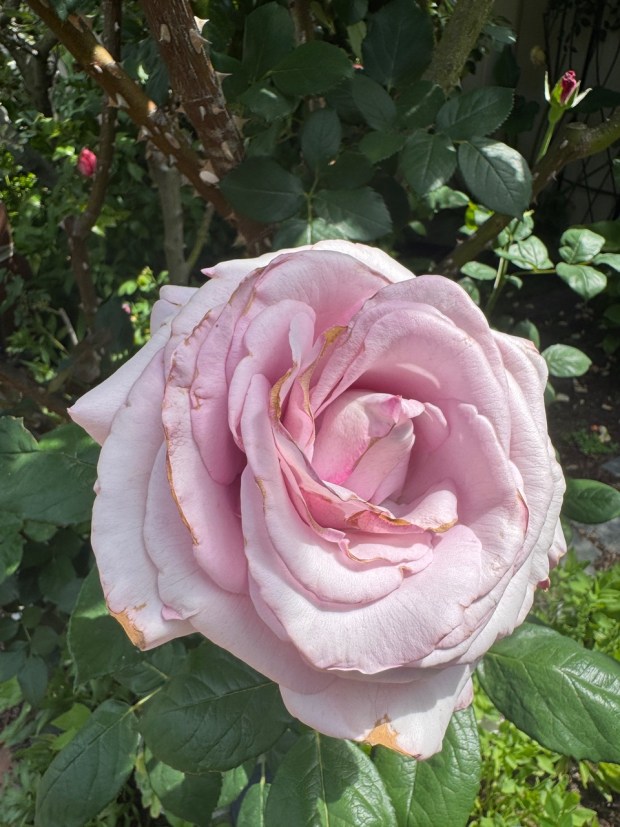 Botrytis affects rose blooms with gray, brown or tan moldy edges on petals. ‘Neptune’ is susceptible to this water-initiated disease with the heavy dew, fog and rain in the early spring months. (Rita Perwich)
Disease identification
Powdery mildew: Appears as a fine, white, powdery coating on the upper surfaces of young leaves, shoots, buds and sepals. Infected leaves may twist and curl. The disease typically begins at the top of the plant where new growth is most tender.
This disease thrives when nights are cool and days are warm and humid, particularly when rainfall is limited. Unlike most fungal diseases, powdery mildew does not require free water on leaf surfaces to germinate; in fact, moisture on leaves can inhibit spore development. The fungus overwinters in infected canes and leaf litter, becoming active again as temperatures rise in spring.
Powdery mildew is most often observed on roses grown in shady conditions or poor air circulation. ‘Iceberg’ roses, widely planted for their general health and serene white blooms, become susceptible to this disease when spaced too closely when they are planted en masse.
Black spot: Characterized by brown to black spots with feathery or diffuse margins on the upper surfaces of leaves. As the disease progresses, leaves often turn yellow and fall off, starting at the bottom of the bush and moving upward.
Black spot requires six to seven hours of continuous moisture to initiate infection. It is most active in warm, wet weather when humidity is high, and foliage remains wet for extended periods. The fungus overwinters on infected canes and fallen leaves, with spores splashing upward during rain or irrigation.
Anthracnose: A less common and less damaging rose disease.
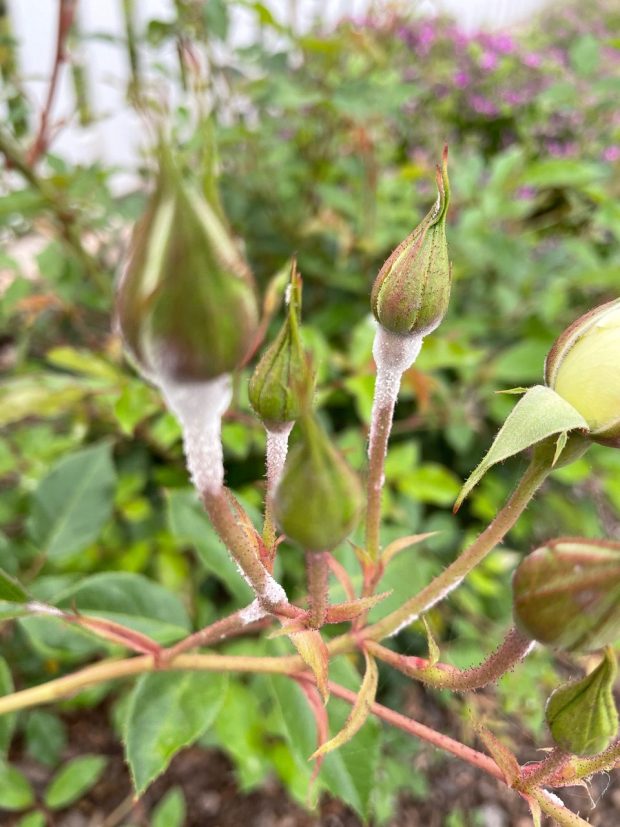 ‘Iceberg’ roses are widely planted for their general health and serene white blooms, but they are susceptible to powdery mildew when spaced too closely. (Rita Perwich)
It primarily affects leaves on a few susceptible cultivars in the spring to early summer and often fades as temperatures rise. Symptoms include round spots with defined red, maroon, or purple borders. The disease can spread to canes.
Cool, wet weather favors anthracnose development, and spores are spread by splashing rain. Anthracnose does not usually affect overall plant vigor.
Rust: Easily identified by orange pustules on the undersides of leaves, often accompanied by faint yellow or orange spots on the upper surfaces. As the season progresses, spores may darken to brown or black.
Rust typically begins on older leaves but can spread rapidly throughout the plant.
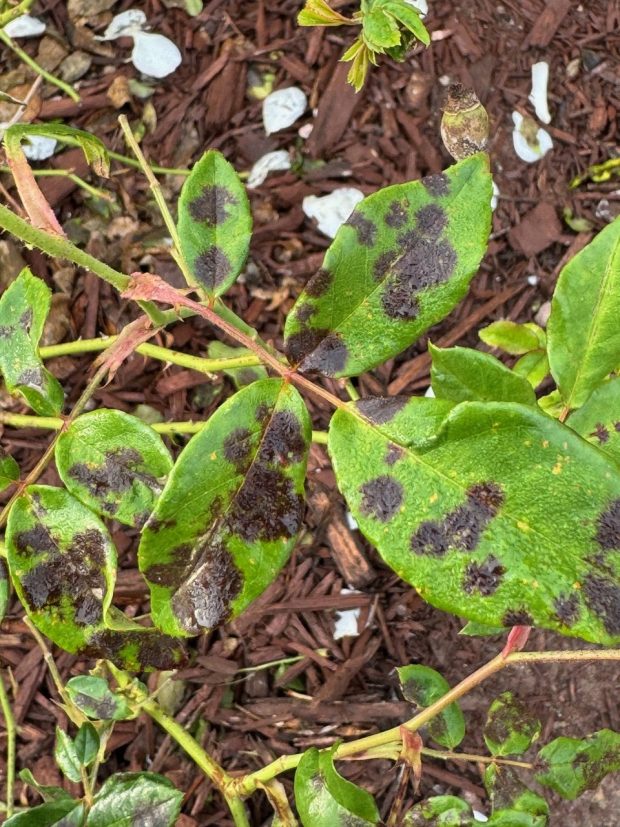 Black spot has feathery or diffuse margins on the upper surfaces of leaves. It is most active in warm, wet weather when humidity is high, and foliage remains wet for extended periods. (Rita Perwich)
This disease thrives in cool, moist conditions and is most common in regions with mild winters, particularly in the western United States. Rust spores overwinter in leaf debris and infect new foliage in spring with as little as two to four hours of moisture.
Botrytis blight: Affects rose blooms and canes. Symptoms include gray, brown or tan moldy edges on petals, and buds that become soggy, ball up and fail to open. Botrytis can also cause large, discolored patches on canes.
Most active during cool, wet weather — especially in early spring and fall, botrytis can live on both living and dead plant material and overwinters easily, making sanitation critical.
Ghost spotting: Appears as small pink or white spots with pink borders on rose petals but does not usually affect plant health.
This condition is associated with prolonged rain, cloudy weather and high humidity. Several water-initiated fungi can cause ghost spotting.
Downy mildew: A particularly aggressive disease that can cause sudden and severe defoliation. Symptoms include angular red, purple, or brown lesions on the upper surfaces of leaves, often between veins, with whitish fungal growth on the undersides. Unlike black spot, downy mildew often starts at the top of the plant.
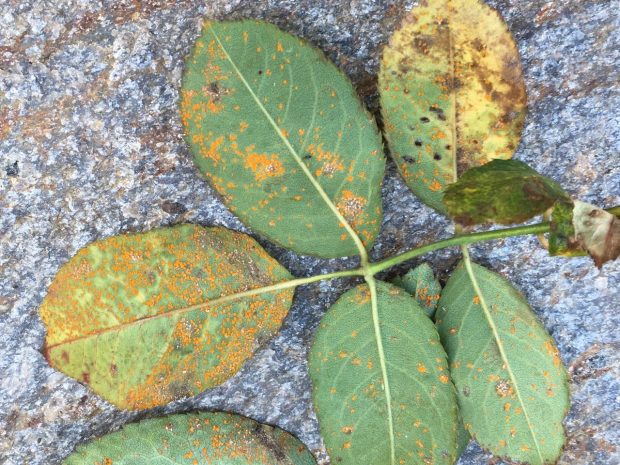 Your rose has rust when you observe orange pustules on the undersides of leaves which are often accompanied by faint yellow or orange spots on the upper surfaces. As the season progresses, spores may darken to brown or black. (Rita Perwich)
This disease favors cool, moist conditions and can infect plants at temperatures as low as 40 degrees, though symptoms may appear later. Spores require prolonged leaf wetness and are easily spread by air movement. The pathogen can overwinter in infected canes, roots and leaf debris.
Cercospora leaf spot: Produces small, round red, purple or maroon lesions with well-defined (not feathery) borders.
This disease thrives in hot, humid summer weather. Defoliation can occur when infections are severe.
Cane disease: Presents as spots, blotches or lesions on rose stems and canes. Affected canes may die back above the infected area. Disease is more likely on plants weakened by stress, poor nutrition, sunburn, pests or improper pruning. Spores from infected leaves and blooms can invade pruning wounds and damaged tissue.
Management
Management begins with preventing the environment conditions that help fungal diseases thrive. Observing disease early and responding promptly by cutting out and removing affected growth from the garden helps prevent minor infections from becoming persistent problems.
• Full sun, proper spacing and good air circulation help prevent or minimize fungal diseases and significantly reduce water-initiated diseases by allowing foliage to dry faster.
• Prompt sanitation — removing infected leaves, buds, blooms and fallen debris — limits spore buildup in the garden.
• Annual pruning opens the plant canopy to sun and air.
• For powdery mildew, blasts of water on infected foliage can interrupt the infection cycle and disrupt spore release.
• To avoid water-initiated diseases, drip irrigation is best. When blasting plants with water for powdery mildew, pest control or relief from Santa Anas, do so early in the day so foliage dries before nightfall.
• To avoid cane disease, use sharp, clean tools. Once detected, disease should be pruned out several inches below the infected area.
• If used, preventive chemical fungicide programs must be started before symptoms appear, applied every seven to 10 days, and rotated to avoid resistance.
• “Magic Gardener” is an OMNI-listed preventive bio fungicide that will be available in California in spring 2027. It claims to boost the plant’s innate immunity but must be applied every seven to 10 days to be effective.
Resistant, tolerant and susceptible cultivars
Rose cultivars vary widely in their resistance to fungal disease. Some possess genetic resistance that prevents disease development even when pathogens are present. At the opposite end of the spectrum are roses that are highly susceptible — losing vigor, producing fewer blooms, developing buds that ball up, and in some cases defoliating entirely. Taking the time to research and select roses for our gardens that are disease resistant and not susceptible hosts is our best management tool.
A tolerant rose lies between resistance and susceptibility. It may show some disease symptoms, but it retains foliage, maintains vigor and continues to bloom well. While tolerance is not immunity, tolerant roses can still perform beautifully with good cultural practices and without fungicides when diseased leaves, buds, blooms and fallen debris are removed promptly to reduce spore buildup.
Several of my roses fall squarely into the tolerant category. ‘Neptune’ is a lavender, large-bloomed, exquisitely fragrant rose that blooms profusely, but in my coastal garden, many of its first flush of spring blooms are infected with botrytis. Would I remove this rose from my garden? Not a chance! While it pains me to cut out and discard the otherwise beautiful blooms, doing so is necessary to limit spore buildup. And I know that as humidity drops later in the year, ‘Neptune’ will produce botrytis-free, beautiful blooms.
Other favorites, including ‘Firefighter’ and ‘Gemini,’ develop rust and black spot during spring and the “May gray” and “June gloom” periods. Like ‘Neptune,’ these floriferous and fragrant roses are definite keepers, though I do remove affected blooms and leaves to minimize the buildup of fungal spores. ‘Neil Diamond’ develops anthracnose on some foliage in spring, but the unsightly spots fade as summer approaches. Because I have not observed this disease spreading to neighboring roses, I do not remove anthracnose-affected leaves.
How to manage a susceptible, intolerant rose
Roses that are both susceptible and intolerant to disease despite proper care should be shovel-pruned and replaced with cultivars that thrive with little or no disease.
Extend your spring honeymoon with your roses throughout the entire growing season by selecting new roses with care — and by giving disease-magnet roses the heave-ho out of the garden.
Perwich is a member of the San Diego Rose Society, a Consulting Rosarian and a Master Gardener with UC Cooperative Extension. Her book, “The Natural Rose Garden: An Organic Guide to Amazing Blooms,” is expected out in fall 2026 from Chelsea Green Publishing. For more information and advice, visit rose-harmony.com.