
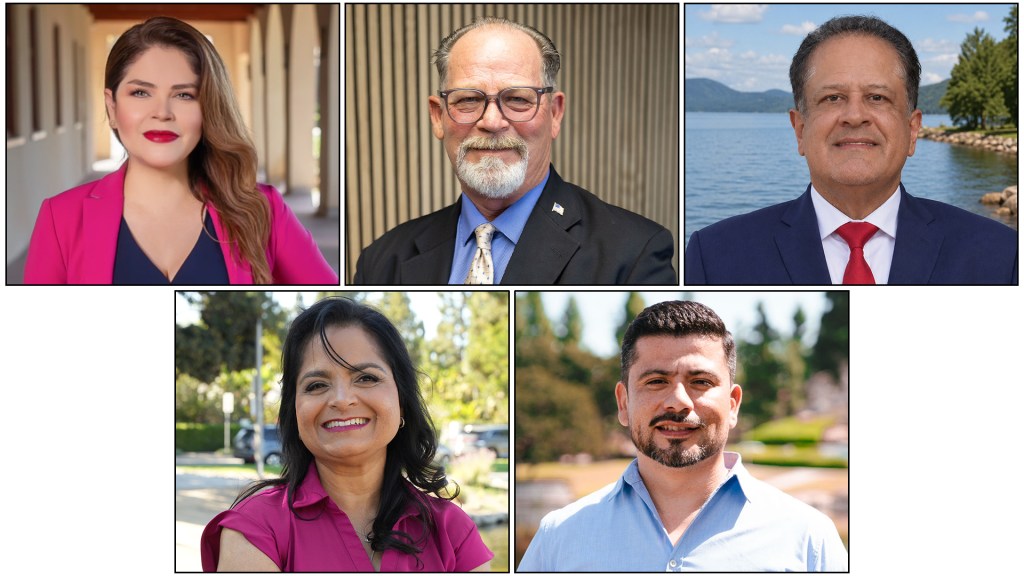
Five candidates are vying for the Chula Vista City Council’s District 1 seat in the June primary, with the winner set to serve a four-year term on a body where ideological divisions have increasingly shaped the direction of city government.
The District 1 seat is currently held by Carolina Chavez, a Democrat and first-term council member elected in 2022, whose re-election bid, if successful, would help preserve the council’s four-seat Democratic majority. While City Council races are officially nonpartisan, political leanings have played an unmistakable role on a council that also includes Mayor John McCann, a Republican and its longest-serving active member. The challenger slate represents a wide range of backgrounds and perspectives.
District 1 covers the northeastern region of the city east of Interstate 805, and includes the neighborhoods of Del Rey, Bonita Long Canyon, Eastlake, San Miguel Ranch and Bella Lago, among others.
Chavez is joined in the race by Joy Emmanuel, a board-certified family physician who has operated a medical practice in District 1 for 23 years; Gregory Martinez, a certified public accountant and small business owner who previously ran for the Otay Water District board in 2024; Chuck Sanfilippo, a planning commissioner and small business owner with more than a decade of appointed civic experience; and Sergio Vargas, a self-employed community activist and 20-year Chula Vista resident.
Council members are limited to two terms. The District 1 annual salary is $64,607.92, according to the city — a figure that typically rises annually under the city’s charter.
In the interest of consistency, each candidate was asked the same three questions covering the city’s development goals and its push to bring a four-year university to Chula Vista, the recently passed ordinance limiting cooperation with federal immigration enforcement, and the city’s multifaceted approach to homelessness — including the Palomar Point motel renovation and one of the county’s strictest encampment bans.
Each candidate was also given the opportunity to raise an additional issue of their choosing.
Carolina Chavez
Chavez, the incumbent District 1 councilmember, is seeking re-election to the seat she has held since 2022. Chavez, 42, holds a bachelor’s degree and currently serves as director of Sistemas Medicos Nacionales, S.A. de C.V. (SIMNSA), a California-licensed HMO health care provider based in Baja California, Mexico.
On the university project, Chavez pointed to her existing record, citing collaboration with “Assemblymember (David) Alvarez, Southwestern College, local education partners, and community partners,” and said she has continued “to push in Sacramento to keep this project moving forward.” She framed the university in human terms, describing it as serving “the working parent who put their education on hold, the student balancing school and family responsibilities, those looking to return to school or pursue a different path, and our binational students who cross the border every day full of ambition.” She added that growth in Chula Vista must be “inclusive, intentional, and benefit the people who call this city home.”
On the immigration ordinance, Chavez is its author. “I proposed this ordinance because I saw what was happening in communities across the country and knew we had to act,” she said. She framed it squarely as a public safety issue, arguing that “when residents are afraid to access city services, seek help, or get medical attention, it makes our entire community less safe.” She added: “This isn’t a partisan issue — it’s about dignity, safety, and who we are as a binational community.”
On homelessness, Chavez highlighted specific accomplishments from her tenure, including the Palomar Point conversion into “27 units of permanent supportive housing with on-site services, seven of them reserved for veterans,” which she described as “not just a bed, that’s dignity and a real chance to start over.” She also cited the opening of “the South Bay’s first city-operated food pantry at our civic library, in partnership with Catholic Charities Diocese of San Diego,” saying “food security is fundamental — you can’t stabilize your life if you’re hungry.”
On constituent services, Chavez made her record of responsiveness the centerpiece of her closing argument, pointing to her on-the-ground role during the Border 2 fire and everyday constituent work. “Strong communities and lasting progress begins with getting the basics right,” she said.
Joy Emmanuel
Emmanuel, a board-certified family physician who has operated a medical practice in Chula Vista’s District 1 for 23 years, is making her first run for elected office.
Emmanuel, 61, received her medical degree from Midwestern University Chicago College of Osteopathic Medicine. She describes her community involvement as spanning health care, education, parent involvement, youth sports and service clubs.
On the university project, Emmanuel identified permitting speed as “one of the pillars of my platform,” and called for local hiring requirements tied to union contracts, as well as prioritizing veterans and women as a condition of bidder contracts. Her most distinctive angle was a focus on health care infrastructure. “I have a specific focus on the influx of people we will receive and (ensuring that) the hospitals, the private physicians, and the ambulance services have what they need to manage the additional population who will need health care so that we all receive the health services in a timely manner,” she said.
On the immigration ordinance, Emmanuel is the only District 1 challenger to explicitly support it. She said she would go further by establishing “a hotline for people to call and a website listing reported activity and location, plus a place to sign up for text alerts for those who want to receive them.” She also said residents should be able to “make a complaint regarding any city police aiding or abetting ICE activity,” while carving out an exception for cases involving legally obtained warrants and verified criminal activity.
On homelessness, Emmanuel endorsed the city’s “surround with services” approach, calling shelter “just the minimum first step,” and proposed partnering with hospitals to attach dedicated mental health facilities with wrap-around services near existing hospital infrastructure.
On small business, Emmanuel drew on her own experience as a physician who had to learn business ownership on the fly. “In medical school, you’re trained to care for patients, not to navigate permits, manage overhead, or figure out how to keep a business running,” she said, adding that she would focus on “streamlining permitting processes, improving communication between the city and business owners, and creating a clear pathway for entrepreneurs to start and grow.”
Gregory Martinez
Martinez, a certified public accountant and small business owner, is positioning himself as a fiscal watchdog and self-described “citizen legislator.”
Martinez holds a bachelor’s degree in accounting from the University of Southern California and has served as vice chair of the Chula Vista Measure P Citizens’ Oversight Committee. He ran for the Otay Water District Board of Directors in 2024 and has served multiple terms on the board of the Rolling Hills Ranch Community Association, including as treasurer and president. “I believe in the concept of citizen legislators, not professional politicians,” he wrote in his candidate profile. “What we have now are more like actors than politicians.”
On the university project, Martinez called it “long overdue and critical to the city’s future,” and said he would prioritize “accountability and execution,” including “setting clear timelines, ensuring coordination between state, regional, and local partners, and demanding measurable progress.” He also emphasized that development must expand “our tax base without overburdening existing residents.”
On the city’s immigration ordinance, Martinez stopped short of explicit support, arguing that such policies “can have the effect of forcing federal authorities to use harsher tactics to overcome lack of local cooperation.” He added that “these types of laws always protect criminals who in turn prey on immigrant communities,” and characterized the current council’s approach as “political theater rather than focus on the issue residents care about.”
On homelessness, Martinez said he supports a balanced approach combining enforcement with services, but insisted on measurable results. “The goal should be to reduce homelessness — not just manage it,” he said.
Affordability is Martinez’s signature issue. As a CPA, he said he brings “a financial lens to government” and pledged “no new taxes.” He also called for sending Mayor McCann as a representative to SANDAG “to stop the mileage tax,” and warned that sanctuary policies “can also place additional pressure on local resources by increasing demand for housing and services.”
Chuck Sanfilippo
Sanfilippo, a Chula Vista planning commissioner and small business owner, brings more than a decade of appointed civic experience to his campaign.
Sanfilippo currently runs Charles Anthony Consulting Inc. and has served as a planning commissioner since 2024. He previously served nine years as chair of the city’s Board of Appeals and Advisors and was a member of the Development Review and Oversight Committee.
On the question of bringing a four-year university to Chula Vista, Sanfilippo expressed support while emphasizing academic standards. “I support the four-year university and attendance/entry should be academically merit based for creditability,” he said. He also highlighted the economic potential of the city’s film studio development, saying it “brings the type of variety in business Chula Vistans can be proud of,” adding that “on-set location filming with the possibility of local casting will bring new jobs and revenue-generating opportunities.”
On the city’s recently passed immigration ordinance limiting cooperation with federal enforcement agencies, Sanfilippo was critical, calling it “unnecessary and only a symbolic gesture.” He noted that “Chula Vista has one of the lowest crime rates in San Diego County” and argued the ordinance “simply brought unnecessary attention to the city.”
On homelessness, Sanfilippo supported the city’s encampment ban, passed “under the leadership of Mayor John McCann,” while arguing that mental health services are a county responsibility. “Mental health is the responsibility of the county and should be conducted on county property with county funds for long-term treatment(s) and assistance,” he said.
Housing affordability is the centerpiece of Sanfilippo’s platform. He supports implementing a rapid electronic permitting system to speed up building approvals, saying the city should be “maximizing the use of technology to ease burdens to new home development.” He said he opposes SB79 and AB 2097, state laws limiting local parking requirements and allowing higher-density housing near public transit, saying “we need to approve housing and development projects that fit the character of our community.” He also called for expanding the HUD first-time buyer program, noting that the current allocation “recently represented 4-5 applicants in a city with almost 300K residents,” and said he would like to see it increased to “30-50 qualified applicants to start with.”
Sergio Vargas
Vargas, a 39-year-old self-employed businessman and community activist, is making his first run for elected office. A 20-year resident of Chula Vista, Vargas holds a bachelor’s degree in international business.
On the university project, Vargas was enthusiastic, noting that the city has already “set aside approximately 300 acres that will be used for a four-year university in our community.” He called the project “an important asset for the entire city and neighboring communities,” and pointed to early momentum, noting that “nursing classes are already slated to begin in the new Millenia library at the end of the year.” He added that “a project like this will also generate jobs for our community and housing for students.”
On the city’s immigration ordinance, Vargas offered a perspective grounded in personal experience and concerns for public safety. “As a man of Mexican heritage and a child of immigrant parents, I fully understand the challenges of our immigrant community,” he said. Without explicitly endorsing or opposing the ordinance by name, he staked out a middle position, saying “there is a balance that can be obtained between shielding those good, hardworking community members while protecting residents from those who are here to create havoc and commit criminal acts.” He also called for simplifying “the path to citizenship for those who came here to make a better life.”
On homelessness, Vargas supported the city’s current approach. “This is a complex issue that must be looked at from all angles,” he said, adding that “it cannot be solved with one answer.” He also argued that responsibility has “wrongfully been handed down to the cities” from state and county government, and said those receiving services “must be held accountable.”
On public safety, Vargas pointed to a concrete concern: Chula Vista’s Priority 1 police response times are currently above the department’s own threshold standard. “Public safety is the number one priority overall for any city,” he said. To address the issue, he said he would work with Mayor McCann to support “a police substation on the eastern side of the city,” and would also work to increase officer pay “to promote retention in the department.”