
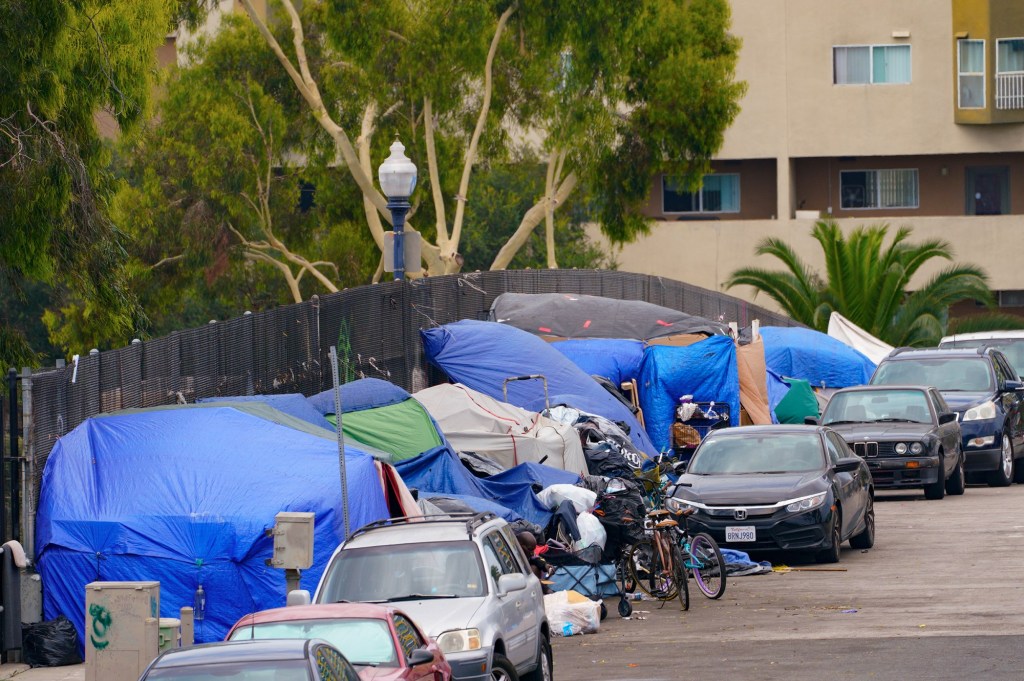
The city of San Diego’s nearly 3-year-old ordinance regulating homeless encampments appears to have helped move people off the streets and into city shelters and other legal sleeping sites, according to a report released Thursday by the city auditor.
But the ordinance’s efforts at reducing homelessness have been hampered by a persistent shortage of spaces in such programs, the audit said.
The report is the first by City Auditor Andy Hanau to evaluate the city’s Unsafe Camping Ordinance, which went into effect in July 2023. The audit examines the city’s responses to encampments in the two years prior to the ordinance and the two years after.
The city law prohibits homeless encampments on public property when shelter is available and always prohibits them in certain areas, such as schools and waterways.
The city already had broader rules prohibiting encroachments on public property and illegal lodging, which includes encampments.
But the 2023 ordinance was the first to set procedures for how the city can enforce encampment violations and conduct encampment abatements — both of which are supposed to involve offering services or shelter referrals beforehand.
Police enforce the violations, while the city’s Environmental Services Department conducts the sweeps that clean up and throw away items and trash left behind in encampments.
City officials have said the ordinance is meant to address the public health and safety associated with homeless encampments for both the people who live in them and the people who live and work near them, which includes potential for spread of disease and the accumulation of trash and debris.
It is also meant to direct more people to shelters and the city’s two “safe sleeping” sites, which are legal campgrounds for unsheltered people that include security, meals, tents, bathrooms, showers and case management; the safe sleeping sites opened the same year the Unsafe Camping Ordinance went into effect.
Critics of the ordinance, however, have said encampment enforcement and sweeps only displace people and don’t actually solve homelessness. For example, at Father Joe’s Villages, CEO Deacon Jim Vargas said street medicine teams have trouble finding their clients again because they moved due to encampment sweeps and enforcement.
“Moving people around is not the answer,” Vargas said. “The heart of the issue is that they need assistance in various ways.”
Data in the audit suggest some success for the ordinance’s goal of getting more people to accept and use shelters and safe sleeping tents.
The number of people living on streets, near freeways and in other public areas decreased since the debut of the encampment ordinance and the opening of the safe sleeping sites. There were 2,510 people living in public areas last year, down from 3,028 in 2023, the audit said.
But safe sleeping participation numbers only account for part of that decrease; the audit said it’s likely that some people also moved to areas outside of downtown, which critics had predicted would happen.
The audit noted that 565 people were counted last year in the city’s safe sleeping sites, while an additional 279 were using the city’s safe parking program, which provides secured parking lots for people living in their vehicles.
Downtown San Diego’s unsheltered population, as measured by monthly census counts, decreased significantly since the encampment ordinance took effect, the audit said; the monthly median unsheltered count for downtown decreased from 1,721 in the fiscal year that ended June 2023 to 850 in the fiscal year that ended June 2025, the audit noted.
The city’s unsheltered population has declined since the ordinance. In 2023, 3,285 unsheltered people were counted in the city, which includes people sleeping on the streets and in the city’s safe sleeping and safe parking sites. This year, 3,132 unsheltered people were counted in the city, as of the latest homeless point-in-time count results released last week.
City leaders say the decrease is evidence that their homelessness strategies are working, while some homeless advocates say the decrease is not substantial enough.
Meanwhile, police encounters with unsheltered people about violating encampment and encroachment rules have become more common. Such encounters happened about 6,700 times in 2025, up from 5,500 times the year before the ordinance.
But those interactions were slightly less likely to result in a citation or arrest for violating the city’s encroachment and encampment rules than before the encampment ordinance. About 30% of police encounters in 2025 resulted in a citation or arrest, compared to 34% the year before the ordinance.
Overall, police issued 1,605 citations and arrested people 391 times during the 2025 fiscal year for such violations, compared to 1,674 citations and 196 arrests during the 2023 fiscal year.
San Diego’s Neighborhood Policing division, which is dedicated to addressing issues of homelessness, uses a “progressive enforcement” approach when enforcing the city’s encampment or encroachment rules. Police say that means they offer to connect unsheltered people with services before ticketing or arresting them, and they will only ticket or arrest them if the person has a history of being contacted or refusing shelter and services.
“It’s never our goal to criminalize homelessness,” Neighborhood Policing’s Capt. Stephen Shebloski has said.
At the same time, the city has been referring people to shelter and services far more often than before the encampment ordinance, the audit found — police and city-contracted nonprofit providers referred people to shelter more than 24,000 times last year, up from about 16,000 times the year before the encampment ordinance.
Year after year, unsheltered people have also increasingly been accepting offers of shelter or services from police — last year people rejected homeless services offered by police 42% of the time, down from 62% before the unsafe camping ordinance, the audit said.
But the vast majority of shelter referrals do not actually result in someone moving to the shelter because the city doesn’t offer enough shelter spaces, the audit found.
“Ultimately, due to the limited number of shelter space available, the vast majority of people’s requests for shelter cannot be met,” the audit said.
The city currently funds about 2,600 spaces between its shelters, safe sleeping and safe parking programs, Mayor Todd Gloria wrote in his response to the audit report.
Shelters and safe sleeping sites are also significantly less likely to have space available than they did previously — average occupancy rates have risen from 77% in the year before the encampment ordinance to 95% in 2025.
In his response to the audit, Gloria said the report “highlights meaningful progress” since the ordinance passed, including the decrease in the downtown unsheltered population, decrease in people living in public areas and faster response times by police and Environmental Services to Get It Done complaints about encampments.
Gloria also pointed to visible reductions in encampments downtown.
“Before the ordinance took effect, several areas across the City were so heavily impacted by encampments that entire stretches of sidewalk became inaccessible to children and people with disabilities,” he said. “One of the clearest benefits of the ordinance is that it gave the City a more consistent and timelier framework to address those unsafe conditions and restore basic access to public spaces.”
The only recommendations the audit offered were about how Environmental Services decides which belongings to save and store during encampment sweeps.
Before the encampment ordinance, the department only gave three-hours notice before an encampment sweep; the ordinance extended that required notice to 24 hours, and since then, people have left far fewer belongings that need to be saved, said Franklin Coopersmith, deputy director of Environmental Services.
Coopersmith has said his department saves items that don’t pose a public health hazard and that are irreplaceable, personally identifiable or sentimental. The department keeps and edits a list of items it will not save, based on what people tend to leave behind at encampments, according to the audit.
Other major California cities will store tents, luggage and backpacks, which best practices recommend storing. San Diego does not store these items, but the auditor was satisfied with its reasoning for not including them — these items are frequently left at encampments, Environmental Services says, and crews search bags and tents for personal belongings that need to be saved before throwing them away.
San Diego stores impounded belongings for at least 90 days, which is longer than best practices suggest in California, the audit said. To retrieve an impounded item, the owner has to call the number provided on a posted paper notice, then Environmental Services will deliver the item to the person, according to the audit.
The audit recommended that the department provide notices of how people can retrieve impounded belongings in languages besides just English — something the department said it has begun to do. It recommended that the department formalize how it reviews and edits its list of items that it will not store, which the department also agreed to do.