
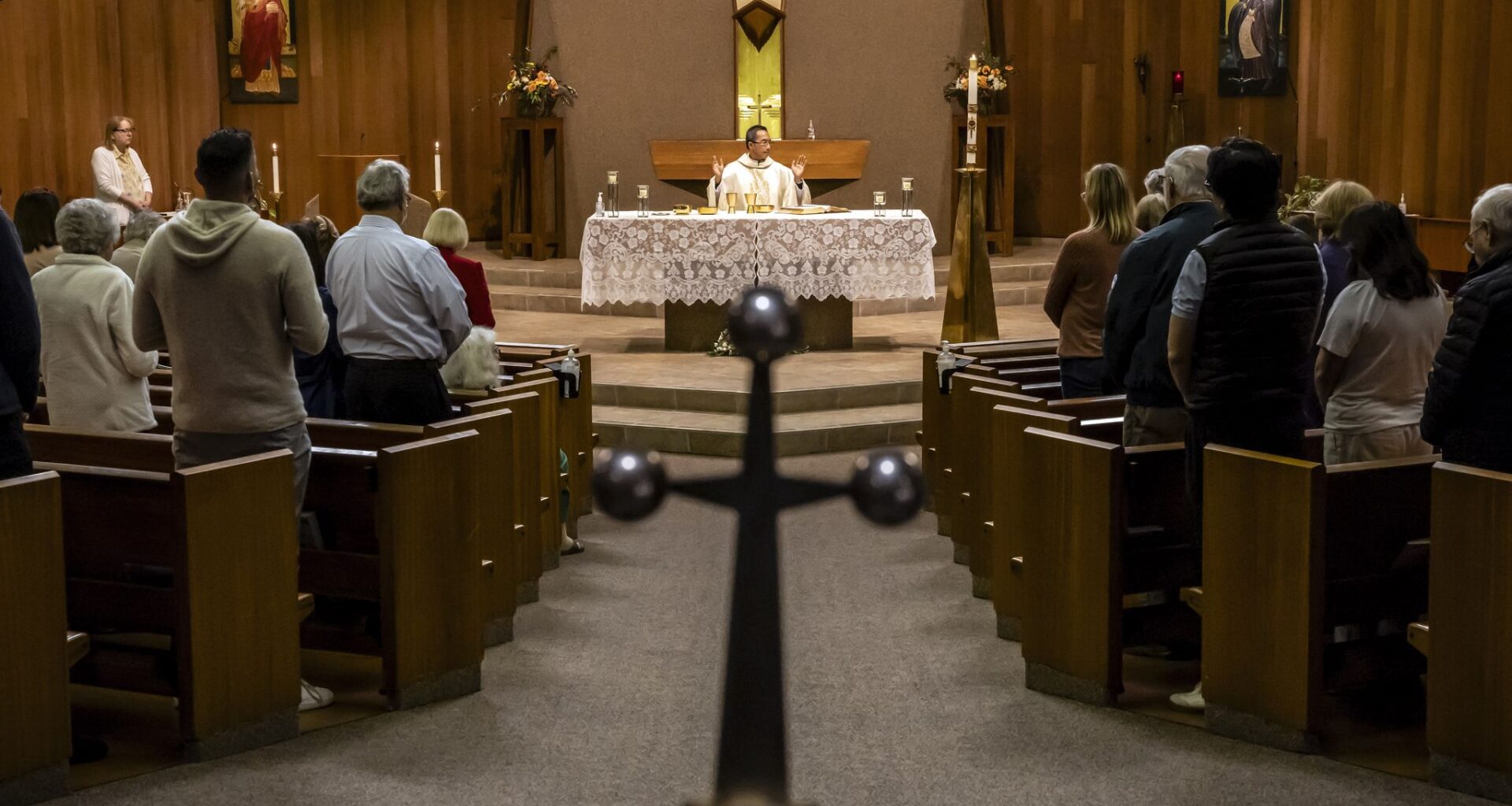
Father Lee Chompoochan blesses the sacraments during Sunday Mass at St. Stephen Catholic Church in Walnut Creek, one of 13 parishes the Oakland Diocese is closing.
Carlos Avila Gonzalez/S.F. Chronicle
Zachary Thompson kisses his daughter, Naomi, as his wife, Erin, holds the girl’s hand during Sunday services at St. Stephen Catholic Church in Walnut Creek.
Carlos Avila Gonzalez/S.F. Chronicle
Father Lee Chompoochan and volunteer Kathy Gomes leave the sanctuary at the completion of Sunday services at St. Stephen Catholic Church in Walnut Creek.
Carlos Avila Gonzalez/S.F. Chronicle
This was supposed to be a festive year at St. Stephen Catholic Church. After weathering pandemic-spurred periods of financial strain and declining attendance, this small parish nestled along a residential hillside just south of downtown Walnut Creek had plenty to celebrate: a milestone anniversary, a fruitful partnership with a nearby church, a steadily growing congregation.
Yet, there associate pastor Lee Chompoochan was toward the end of Sunday morning Mass, encouraging churchgoers to pick up a copy of a recent letter detailing the once-unthinkable: St. Stephen will soon shutter. As the Diocese of Oakland tries to climb out of a fiscal crisis hastened by costly sexual abuse lawsuits, even its more profitable parishes are at risk of closure.
Article continues below this ad
St. Stephen, which sits in an affluent neighborhood where homes often sell in the seven figures, now finds itself among the 13 East Bay churches slated to cease operations. Making matters worse: Its roughly 300 parishioners know almost nothing beyond the vague explanation Bishop Michael Barber provided in a now-infamous letter posted to the diocese website Tuesday.
“We’re all just stunned,” said Father Paulson Mundanmani, St. Stephen’s lead pastor.
Father Lee Chompoochan blesses the congregation with holy water during Sunday services at St. Stephen Catholic Church in Walnut Creek.
Carlos Avila Gonzalez/S.F. Chronicle
In Tuesday’s letter, Barber explained that mounting financial woes — the diocese filed for bankruptcy in 2023 — have made continuing to staff 80 parishes unsustainable. The decision to shutter more than a dozen of those parishes followed “deep and extensive” conversations with church leaders, Barber added, as well as data analysis pinpointing which churches were struggling most.
San Francisco Chronicle Logo
Make us a Preferred Source to get more of our news when you search.
Add Preferred Source
But St. Stephen liaison Chris Lang remains adamant that her parish recently moved into the black, thanks to a merger with neighboring Christ the King Church of Pleasant Hill.
Article continues below this ad
“We were not losing money,” said Lang, who has been attending St. Stephen since its inception in a nearby mall in 1966. “If anything, we were feeling really optimistic about the future.”
As Chompoochan told around 150 of his congregants Sunday that he had no information about the timeline of their parish closure, some churchgoers could be seen blinking back tears. For 60 years, St. Stephen has been an essential gathering place for local Catholic families: the kind of church where congregants held funerals for loved ones, watched their children receive the sacraments they once took themselves there, and tried to bring about social change.
Lang said it was among the first Bay Area parishes to have female altar servers and kids-only liturgies during the Sunday service. The 1971 brainchild of well-known architect Aaron Green, St. Stephen’s current building also has a reputation for being one of the region’s most picturesque churches. With sleek lines, wood-paneled walls and a gently sloped roof, it looks reminiscent of buildings designed by Green’s famous mentor, Frank Lloyd Wright.
St. Stephen Catholic Church in Walnut Creek has been an essential gathering place for Catholic families for decades.
Carlos Avila Gonzalez/S.F. Chronicle
Still, like many other churches, St. Stephen long grappled with uneven Mass attendance and staffing shortages that were exacerbated by the pandemic. A couple of years ago, it scaled back services to share priests with Christ the King.
Article continues below this ad
Around then, more and more of St. Stephen’s most loyal parishioners began to worry about the church’s future. A new state law, whichtemporarily lifted the statute of limitations on civil lawsuits against institutions accused of enabling abuse, had triggered a flood of more than 300 lawsuits against the Oakland Diocese from 2019 to 2022.
By 2023, the diocese was filing for bankruptcy. Its estimated liability ranged anywhere from $100 million to $500 million.
But in recent years, St. Stephen parishioners saw reasons for hope. A congregation loaded with elderly members was welcoming more and more young families. Last summer, when Christ the King shuttered for about four months to have a new roof installed, St. Stephen often had so many attendees at Sunday services that churchgoers had to triple-park. At the same time, the banquet hall was routinely busy with gatherings for local realtor groups and Catholic school meetups.
Then there were the church upgrades. In rapid succession, St. Stephen got a new air conditioning unit, new carpeting, even a newly paved parking lot.
“All that just made us feel really good about where we were at,” said Blaine Carter, a member of St. Stephen’s pastoral council. “It was like, ‘Finally, we can exhale a bit.’”
Article continues below this ad
St. Stephen Catholic Church, in an affluent neighborhood in Walnut Creek, is one of 13 parishes closing as the Oakland Diocese struggles with financial troubles due to sexual abuse lawsuits.
Carlos Avila Gonzalez/S.F. Chronicle
Few could fault Kathy Gomes, then, for breaking down in tears at her dental office Tuesday when she saw St. Stephen’s name listed among those 13 looming closures.
Some of her earliest childhood memories were of attending St. Stephen when it was known as “St. Thrifty”; its early years were spent next to a Thrifty Drug Store in the Palos Verdes Mall. In the decade and a half since her father died, Gomes found a much-needed sense of community by volunteering at the church.
“I don’t have any kids, and I’ve never been married,” Gomes said. “For me, the church really is my family. To lose this community because of what I can only guess is its real estate value is just really painful.”
The depth of that impending loss was apparent during Sunday morning’s service. Aside from a couple remarks from Chompoochan and a mention during the Prayers of the Faithful, no one discussed this past week’s biggest news.
Article continues below this ad
However, there were a few watery eyes during the homily, which centered on the idea of trusting God through tumultuous times. “Even when life is unclear, as long as we stay close to Him, we’re on the right path,” Chompoochan said. “Even if we might feel small or unnoticed, God chooses us.”
Parishioners gather for coffee and doughnuts in the church hall after Sunday services at St. Stephen Catholic Church in Walnut Creek.
Carlos Avila Gonzalez/S.F. Chronicle
After the service, several dozen parishioners gathered in the banquet hall. Between bites of doughnuts and sips of coffee, the church’s choir chatted in concerned tones, exchanging ideas about what they should do once St. Stephen closes.
Complicating matters: No one knows exactly when that day will come. Parishioners can only hope to have more details by St. Stephen’s next town hall meeting, which is scheduled for May 17 after Sunday services.
In the meantime, parishioners are taking solace in a simple truth: Things could be even worse. Many of the other churches on that closure list don’t have a sister church, like Christ the King, that can accommodate a bigger congregation. Some even have schools, which also now face an uncertain future.
“At least we have a church we can go to that people are already comfortable with,” longtime congregant Faith Jacobs said. “Still, I’m outraged. We put so much into this place over the years, only to get an email saying it’s all about to end.”