
Emmanuel Galvan methodically scanned dozens of bags, passing over containers of crimson, purple and yellow heirloom corn, until he paused and scooped a handful of deep blue kernels. The colorful selection of heirloom corn is at the heart of Galvan’s new Berkeley restaurant Cafe Bolita, where he uses rare varietals to make corn masa, the key ingredient for tortillas, tostadas and tortillas chips.

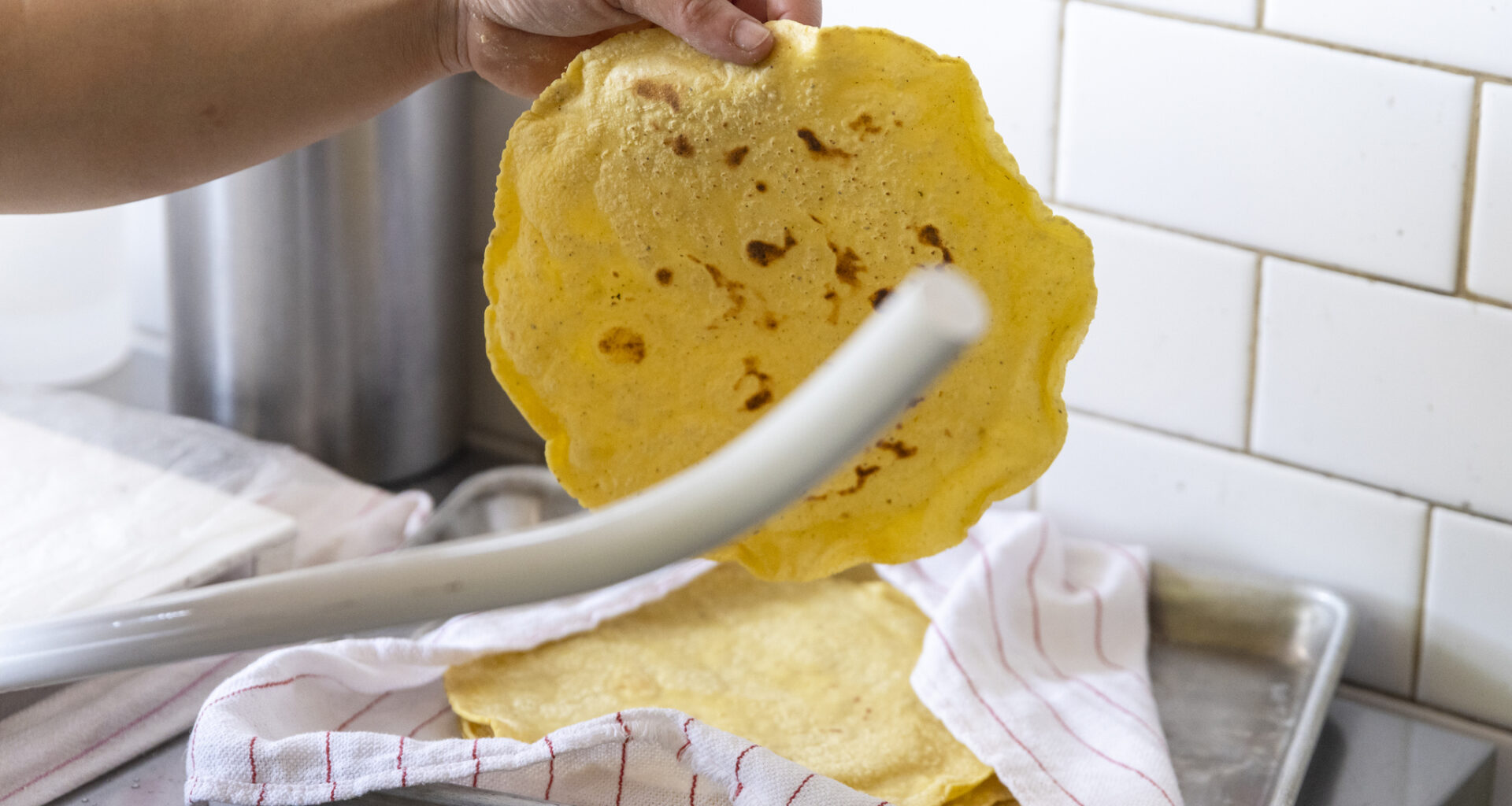
Galvan opened his restaurant in late February after first operating as the popular pop-up Bolita. For the past six years, the ethos of Bolita has been to make artisan corn masa from heirloom corn varietals in the traditional nixtamalized way: soaking kernels until soft and later grinding them into masa with a volcanic rock molino, or mill. Now, Galvan’s permanent space inside the former Standard Fare location has given him more room to create traditional corn masa, which he uses for elevated takes on Mexican comfort dishes, highlighting the humble tortilla in all its forms.
“Whenever people would talk about Mexican food, they would rarely talk about the tortilla — it was what was on the tortilla,” Galvan said. “The tortilla was always an afterthought. Let’s make that the forefront.”
Article continues below this ad
Customers fill the tables inside Cafe Bolita in Berkeley, Calif., on April 24, 2026.
Douglas Zimmerman/SFGATE
A pork enchilada in a mild green tomatillo sauce with beans at Cafe Bolita in Berkeley, Calif., on April 24, 2026.
Douglas Zimmerman/SFGATE
J Embry plates a freshly made corn tortilla at Cafe Bolita in Berkeley, Calif., on April 24, 2026.
Douglas Zimmerman/SFGATE
On a recent Friday, customers were queued outside Cafe Bolita at noon, ready to order from a small menu of Mexican dishes prepared with Galvan’s artisan masa. His delicious and kaleidoscopic creations present customers with some tough decisions. A menu special that day featured a blue tostada topped with earthy golden beets and garnished with green pepitas. Another item was a large pork enchilada made with a tender yellow corn tortilla doused in a mild green tomatillo sauce. There was a vegan orange tamale prepared with carrot-emulsified masa that, unlike its traditional pork tamale counterpart, was delicate and moist. The tamale was topped with a black bean and chile salsa for an earthy and spicy kick.
Article continues below this ad
Owner Emmanuel Galvan shows a machine used to grind down corn into masa at Cafe Bolita in Berkeley, Calif., on April 24, 2026.
Douglas Zimmerman/SFGATE
“We are offering something that isn’t the most common thing,” Galvan said. “The beauty of fresh masa is that it’s being consumed fresh. That’s why I fell in love with this in the first place — the flavor is unparalleled.”
A sommelier of corn
Galvan rose through the ranks of the San Francisco restaurant world before launching his pop-up in 2020. Previously, he was a front-of-house manager at Kin Khao, a garde-manger cook at Bar Tartine, and a server at both Del Popolo and Pizzeria Delfina. He was also a consulting manager at Tacos Oscar in Oakland. And while cooking has long been a passion of Galvan’s, he never envisioned himself making it the focus of his career, preferring to work on the customer-facing side of the industry. That changed when he started toying around with nixtamalized corn in 2018. He became obsessed with the traditional, yet arduous, ways of making masa from scratch that require both patience and intuition.
Article continues below this ad
Owner Emmanuel Galvan holds a 25-pound volcanic mill that is used to grind heirloom corn from Mexico into corn masa at Cafe Bolita in Berkeley, Calif., on April 24, 2026.
Douglas Zimmerman/SFGATE
Owner Emmanuel Galvan holds crimson heirloom corn from Mexico that will be eventually be turned into corn masa, at Cafe Bolita in Berkeley, Calif., on April 24, 2026.
Douglas Zimmerman/SFGATE
Galvan’s years of soaking and grinding maize have given him the ability to talk about heirloom corn the same way a sommelier describes the nuances of wine. Back at the Cafe Bolita kitchen, Galvan spent time describing how each corn type comes with a distinctive shade and flavor profile. Purple corn has earthier notes and is better suited for dishes like tostadas because the corn is firmer. Yellow corn is sweeter and more tender, thus making it ideal for tortillas. Hominy, a large white corn typically used for pozole, produces fluffy masa and is used for Cafe Bolita tamales.
Galvan’s fascination with heirloom corn goes beyond the colors. For him, it’s a passion project that keeps him connected to his roots.
Article continues below this ad
“Corn is such a big staple of the Mesoamerican diet, and I think if we don’t keep promoting these beautiful products, they will get lost and become commodified,” Galvan said. “I want to show people as many varietals as possible.”
Galvan isn’t the first Bay Area restaurateur to embrace heirloom corn, but he’s one of a few businesses around that nixtamalize corn in house and use the pliable masa for elevated Mexican dishes. Chef Dominica Rice-Cisneros of Michelin Guide restaurant Bombera nixtamalizes hominy, a larger and denser corn, for homemade pozole. Chef Gonzalo Guzman of San Francisco’s Nopalito has nixtamalized corn to make tortillas, empanadas and tamales since 2009 when the restaurant opened.
Owner Emmanuel Galvan looks at bags full of heirloom corn from Mexico that can be turned into masa, at Cafe Bolita in Berkeley, Calif., on April 24, 2026.
Douglas Zimmerman/SFGATE
Owner Emmanuel Galvan shows a 25-pound volcanic mill that is used to grind heirloom corn from Mexico into corn masa at Cafe Bolita in Berkeley, Calif., on April 24, 2026.
Douglas Zimmerman/SFGATE
Owner Emmanuel Galvan shows containers of crimson, purple and yellow heirloom corn from Mexico that will be eventually be turned into corn masa, at Cafe Bolita in Berkeley, Calif., on April 24, 2026.
Douglas Zimmerman/SFGATE
Each month, Galvan nixtamalizes nearly 2,000 pounds of heirloom corn sourced from Mexico City-based Tamoa, a company that works directly with small farmers across the region. Cafe Bolita uses 13 different corn varietals. Galvan starts the process by pouring dried corn and calcium hydroxide into a vat of hot water that sits for a full 24 hours. The calcium hydroxide helps de-shell corn and makes it edible, as well as increasing the nutritional value of corn by releasing vitamins and calcium. After a 24-hour soak, the corn becomes soft and is ready to grind with a round, 25-pound volcanic mill that has deep grooves chiseled on the sides to help break down the corn. Galvan kneads the ground-up corn with water to create a dough called masa. This masa is then made into the restaurant’s tamales, tortillas, tostadas and tortilla chips. During its busiest weeks, Galvan’s team can produce 300 pounds of fresh masa and upwards of 1,400 tortillas.
Article continues below this ad
The restaurant’s customers aren’t the only people buying Galvan’s artisan masa. He also sells it to restaurants like La Vaca Birria and Cavaña in San Francisco. Galvan previously provided masa for two-Michelin-star restaurant Californios, but he said he has cut back on his overall wholesale business to focus on ramping up production at Cafe Bolita. Cavaña executive chef Edwin Bayone told SFGATE that his kitchen used to make tortillas from masa he sourced from other Mission District businesses, but after meeting Galvan at the Ferry Plaza Farmers Market, he was struck by his passion for corn and soon became a client. For the past year, Cavaña has made corn tortillas for its al pastor and carnitas tacos using yellow and blue Bolita masa.
A blue tostada topped with golden beets and garnished with green pepitas at Cafe Bolita in Berkeley, Calif., on April 24, 2026.
Douglas Zimmerman/SFGATE
J Embry prepares to place a freshly pressed corn tortilla on a grill at Cafe Bolita in Berkeley, Calif., on April 24, 2026.
Douglas Zimmerman/SFGATE
“My team and I worked with the samples he provided and knew on the first bite that we couldn’t go back,” Bayone said. “… It became clear that their masa was the cleanest tasting and they delivered weekly, which was a game changer.”
Article continues below this ad
Galvan is also a purist when it comes to making corn masa, even when it means turning down an opportunity. Bolita’s masa was briefly sold at San Francisco’s Tahona Mercado, but the specialty Mexican store stopped carrying it due to its short shelf life. Tahona Mercado co-owner Emily Sardi told SFGATE in an email that although she loved Bolita masa due to the “incredible sourcing” and “insane attention to detail,” she had to stop carrying it when the store couldn’t sell through it. Sardi hypothesized that customers might have been more interested in buying ready-to-eat tortillas or may not have been knowledgeable about using the raw masa to make tortillas at home.
That’s one of the challenges Galvan has had with scaling up his business. While he sells Bolita salsa macha and fresh salsas at Rainbow Grocery, Berkeley specialty shop Of All Places and Tahona Mercado, you won’t find Bolita tortillas in the grocery aisle. That would require Galvan to add preservatives to his masa, which he refuses to do.
“I don’t want to ever make a compromise of going in that direction,” Galvan said. “In Mexico, you buy your tortillas on the day of and probably consume all of them. Part of our challenge has been how to get people to consume masa more regularly. I hope people meet us where we’re at instead of me meeting them where they’re at because there’s enough of that commercial stuff available.”
Customers line up to order at Cafe Bolita in Berkeley, Calif., on April 24, 2026.
Douglas Zimmerman/SFGATE
A vegan tamale with carrot-emulsified masa, topped with a black bean and chile salsa, at Cafe Bolita in Berkeley, Calif., on April 24, 2026.
Douglas Zimmerman/SFGATE
A corn tortilla puffs up on the grill at Cafe Bolita in Berkeley, Calif., on April 24, 2026.
Douglas Zimmerman/SFGATE
Galvan has plans to ramp up production at Cafe Bolita this fall with a new 18-foot tortilla oven inside his kitchen that can produce 10,000 tortillas every two hours. Once the oven is installed, Cafe Bolita will be able to make more heirloom corn tortillas for in-house sales, but also for wholesale, where Galvan hopes to sell to grocery stores like Rainbow Grocery or Berkeley Bowl. Those tortillas would be frozen, however, to not compromise the quality of his artisan masa.
Article continues below this ad
Galvan may have never seen himself running a restaurant kitchen, but his passion for heirloom corn has created a new beacon for a hallmark of Mexican culture.
“What inspired me to open this was kind of seeing the value in the ingredients and the techniques that have been undervalued,” Galvan said. “I think the inspiration was like internal acceptance of my culture and also seeing my Mexicanness is a valuable asset.”
Cafe Bolita, 2701 Eighth St., No. 118, Berkeley. Open Wednesday to Saturday, 9 a.m.-1:30 p.m.
Article continues below this ad