
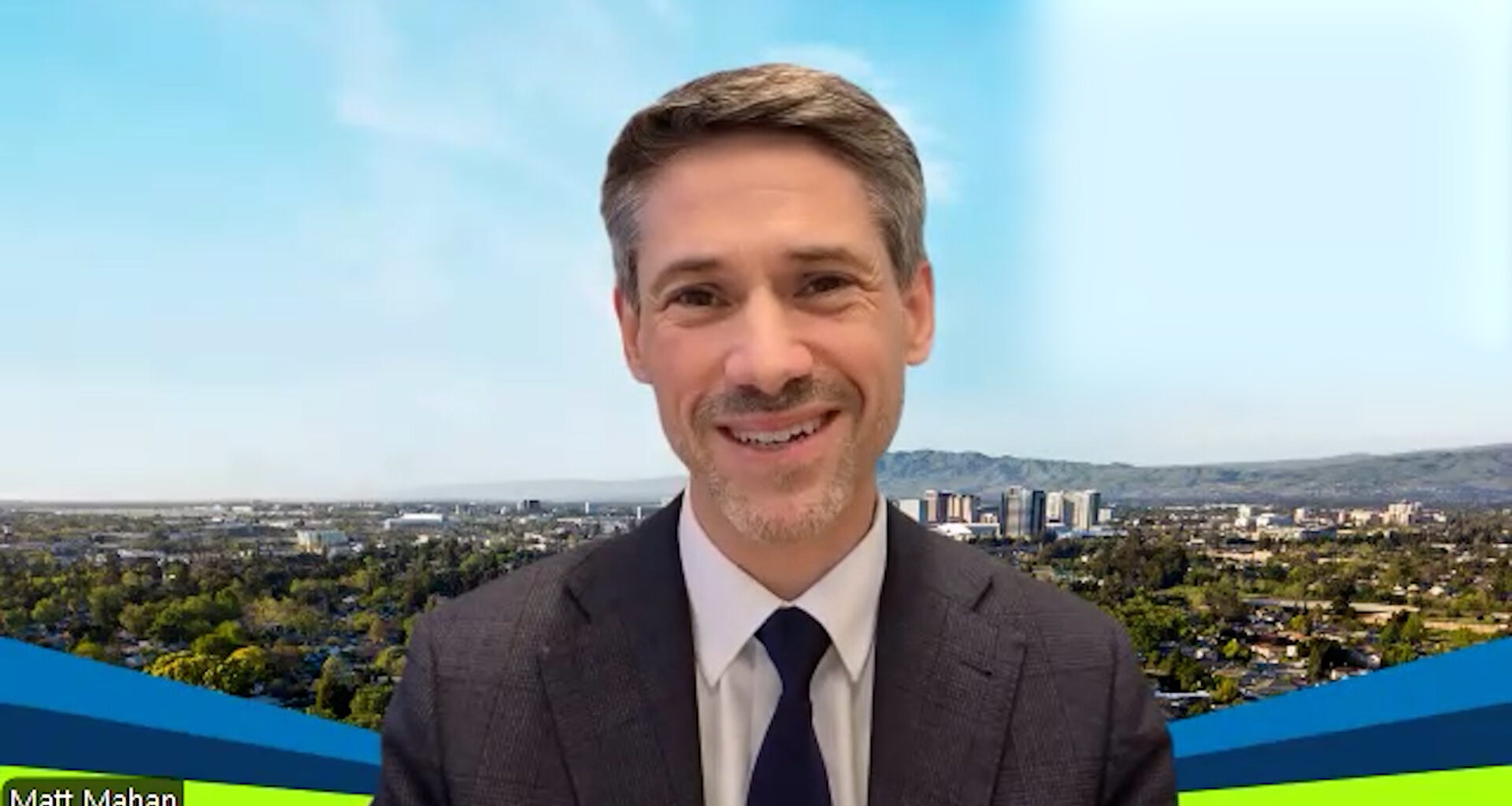
Politics reporter Sophia Bollag interviewed Matt Mahan, one of the candidates in the governor’s race, ahead of California’s June primary.
Sophia Bollag, Joy Jeong, Wendi Jonassen
San Jose Mayor Matt Mahan’s decision to stake out the most business-friendly stances of the Democrats running for governor has won him the support of some of the country’s most powerful billionaires.
Mahan, 43, declared his candidacy in late January. Tech industry titans quickly poured millions into efforts supporting him, including Google co-founder Sergey Brin, venture capitalist Michael Moritz, Reddit co-founder Steve Huffman and Stripe CEO Patrick Collison.
Mahan has made a name for himself as a frequent critic of Gov. Gavin Newsom. He’s promised not to raise taxes and has come out in strong opposition to a proposed billionaire’s tax headed for the November ballot.
Article continues below this ad
In an interview with the Chronicle, Mahan explained why he identifies as a Democrat despite becoming a harsh critic of his own party, and criticized both far right and far left political ideologies. He advocated for bolstering the state’s safety net, improving Americans’ nutrition to bring down healthcare costs and treating undocumented immigrants more humanely. He also suggested implementing a universal basic income policy, known as UBI, in which people are paid an income by the government.
Here are the highlights from Mahan’s interview with the Chronicle, part of a series the paper is conducting with the leading candidates in the race for governor. The conversation below has been edited for length and clarity.
You have been very critical of your own party for not delivering enough results for Californians in lots of different areas, including housing and affordability. Why do you still identify as a Democrat given how critical you’ve been?
Mahan: Well, I think when you love something, you fight to make it better. And I love California, I love the Democratic Party.
Article continues below this ad
I grew up in a small rural community, Watsonville. My mom was a teacher, my dad was a union mailman. Thanks to his healthcare, which he only had because of his union, we didn’t lose our home when I started having lung collapses in high school. So I understand the importance of having a strong social safety net, and public services more broadly. Our public library was our after-school program for years because my parents worked long hours. When it was time for high school and our local public high school was struggling, I was only able to take advantage of a work-study scholarship for low-income students because of the access that the public bus system gave me. I had to take public buses to a neighboring county to get a college prep education.
So I want government to work, and that’s why I’m critical of the complacency that I’ve seen within Sacramento in particular. Look, I’m running for governor because California isn’t working well enough for working people. And when we’re at our best, we’re creating economic opportunity and upward mobility for people. I see government as a platform for people to build a life and achieve the American Dream. And you need a lot of things in that platform. You need infrastructure, good schools, safe neighborhoods, the ability to build housing, start a business. I don’t believe government can fix everything or make everything fair as an outcome, but can certainly give everybody a fighting chance that if they work hard, they can build something better. They can have a brighter future. And for far too many California families, that’s just not the case.
When you say when the Democratic Party is at its best, what are you thinking of? Can you give me a specific example?
Well, I think much of our history, there have been bright moments of doing that. I grew up in a household that was essentially FDR Democrats. You think about how the Democratic Party led on building out a social safety net, building modern infrastructure. More recently, in California, it was under a Democratic governor that we built our world-leading public research universities, expanding education and healthcare access.
Article continues below this ad
But as we’ve just seen most recently, expanding healthcare access doesn’t work if you don’t also have a functioning system that’s efficient and effective. It becomes so cost-prohibitive thatthe governor had to pause enrollment. So I’m interested in fixing the underlying problems so that government can continue to expand opportunity. I think we have to be willing to admit when our policies aren’t working in practice, because we have great values and we generally agree on the outcomes that we want, and they’re pretty common-sense. We want everybody to live in a safe neighborhood, to get a good education, to have career paths, to be able to afford housing, ideally achieve homeownership, be healthy.
But when the policies that we are embracing and in California, investing in at an incredibly high level, aren’t producing those outcomes, we’ve got to be willing to look in the mirror and frankly one of my great fears is we’re seeing rising populism on both ends of the political spectrum because the common-sense, pragmatic, good-government leadership is sort of dissipating. We’re failing to deliver for people. And so we’ve given a lot of oxygen to the MAGA movement. And then in response, we’re getting a far-left reaction, and they’re feeding off one another. And I think the best resistance to Donald Trump is to deliver results in people’s lives.
You mentioned healthcare and how current policies in the state have not lived up to the promises that were made in terms of expanding health care. On that issue specifically, what would you do differently? What, in your mind, did Democrats in Sacramento get wrong?
On healthcare, we have some fundamental issues. One of which is the complexity of the system is leading to incredible overhead administrative costs: 25 to 30 percent of healthcare spending in the state goes not to delivering care, but to managing a system.
So using emerging technology like AI, digitizing everything, really streamlining billing, reporting, the information systems in healthcare, modernization is really important for bringing down cost. There’s a lot of potential there. Price transparency and creating a little more competition, empowering the consumer to be able to see that a procedure at one hospital, the list price a few miles down the road, may be half of the cost, is really important. Providing relief to our very expensive hospital system, and particularly our emergency rooms, by covering more people, by getting them to clinics and empowering nurse practitioners to practice at the top of their license and provide more of the care that they are capable of providing is a way to meet people where they are in a more efficient way than much of what we do. And then the big thing is really get the incentives right overall. We need to move toward a healthcare system — and California is big enough as a market to be a model for this — we need a move toward a system that prioritizes long-term health outcomes over the provision of individual services.
Article continues below this ad
Part of this, let’s be honest, is public health. If we think we’re gonna reduce healthcare costs just by redesigning who’s paying or how we’re billing or even the administrative overhead in the healthcare system, without a broader conversation about public health, we are fooling ourselves. We need to incentivize and educate and encourage healthier lifestyles. It starts with diet, exercise, sleep, very fundamental things. But the standard American diet is killing people. We’re spending a tremendous amount of money on chronic illness. And we have got to get upstream of that, or we’re never going to rein in healthcare spending.
You’ve talked a lot on the campaign trail about the work that you’ve done on housing in San Jose, but housing there is still really, really expensive. There was one recent study that’s been cited by some of your critics, of more than 150 large cities that ranked San Jose as the least affordable place to buy a home. To those critics who say you haven’t done enough on housing affordability, what would you say to them?
Yeah, well, that’s a silly way to look at the stats. San Jose has had the least affordable housing market since before I was born. This is not a new phenomenon. It is a result of having the most productive economy and job creation that is always outpacing home construction. This is a multi-decade issue.
As a mayor over the last three and a half years, I didn’t make excuses for the problem. I didn’t admire the problem. I took the most aggressive action of any mayor in the state of California, and we’re starting to see the results of that. We dramatically reduced fees. We got thousands of units under construction. We were the first big city in the country to eliminate parking minimums.
(Editor’s note: This is true depending on how you define a big city. Buffalo, New York; Raleigh, North Carolina; and Minneapolis all eliminated parking minimums before San Jose.)
Article continues below this ad
The aggressive steps we took two years ago are starting to work. And that’s the kind of approach we need in Sacramento. There’s a lag there. It’s not like regulatory reform, there’s more to do. I’ve put out by far the most comprehensive plan for addressing our housing affordability crisis on mahanforcalifornia.com. It’s a 15-point plan, very detailed. It really is about removing barriers to building. We need to be able to build more things more quickly at lower cost. This is a self-inflicted policy failure.
The most recent point-in-time count data shows that unsheltered homelessness in San Jose is down significantly. But overall homelessness has gone up a little. What do you say to critics who have argued that you’re too focused on funding homeless shelters and not enough on permanent housing solutions?
I think the right answer is what we’re doing in San Jose, which is a balanced all-of-the-above approach. We haven’t just built shelter. In fact, we haven’t built any traditional shelter. We haven’t built congregate shelter. San Jose and Santa Clara County have designed and funded a homeless prevention system that Notre Dame University did a controlled experiment around and has been highly successful.In fact, now 10 other major cities across the country are adopting our model of prevention.
(Editor’s note: There are 10 pilot communities adopting San Jose’s model, but some are regions rather than major cities.)
We have reduced the inflow to homelessness by roughly half in the last few years, which is really important for turning the corner on this crisis. In the middle of this continuum is a commitment to having a safe, dignified place for every person experiencing homelessness. And this has been the biggest gap in California for years. Other places, New York, Boston, so forth, have comparable levels of homelessness per capita, but they don’t have people living outside in tents. The sheltered rate is over 95% in those cities. Because of the weather, they are shelter-first states. They have extensive shelter capacity, and they’re required by law to offer a warm indoor bed to every person on the streets because of the weather.
(Editor’s note: While it’s true those cities have very high shelter rates, there are still tent encampments in New York and Boston.)
We have to find the political will in a place with great weather to do something similar. No one should be living outside in a tent encampment for all of the obvious reasons. It is a huge moral failing. We see that people’s lives completely fall apart. If they didn’t start with a behavioral health issue, they pretty quickly develop one, and understandably, given how difficult conditions are out there, and the impacts and costs on the broader community are completely unacceptable. So in San Jose, we have, in absolute terms, solely on a per capita basis, built more capacity than any other city on the West Coast. Last year alone, we built 1,000 interim housing units, many of them converted motels that can be turned into long-term permanent affordable housing. We’ve moved thousands of people indoors and we’ve reduced the number of people living on the streets by roughly a third.
You’ve gotten a lot of financial support from the tech industry in this race. One concern a lot of Californians have is about the possibility of AI taking their jobs. Given your experience working in the tech industry, what do you think of that particular concern that people have and do you have any policy proposals to address it?
I do. I’m worried about it as well. It’s something I focus on every day at City Hall in addition to public safety, homelessness, removing barriers to building housing, the other things we’ve been starting to talk about.
Look, the reality is that technological change is incredibly disruptive and hard on people. I’m very sensitive to that. Having grown up in a rural community, I know that a lot more people used to work in agriculture and it’s increasingly been mechanized. I mean, going way back, the introduction of the modern tractor just completely changed labor markets in the United States.
Our job in government is to manage and shape that change and regulate it and buffer people from the worst impacts. Now, I believe that we don’t succeed at that by putting our head in the sand or trying to stop it. If we simply try to stop technological change, it will just happen somewhere else. Whether that’s Texas and Florida, or it’s China, it’s going to happen in some other place and then it happens to us and we have a lot less leverage and we’re behind the curve.
I firmly believe that the best way to manage through rapid technological change is to invest in human capital. It’s to invest in people. In San Jose, we started with partnering with San Jose State University, our incredible public university across the street, to create a 10-week AI upskilling curriculum for every city worker. We’ve already had dozens and dozens of city workers report productivity gains, greater job satisfaction. They are using, they are building custom GPTs to automate the boring parts of their jobs. They don’t feel intimidated by this technology. They feel ready to deploy it in their work. So upskilling, re-skilling is going to be a critical component of what we do as a state to stay ahead of this.
No. 2 is really to get upstream of it through K-12 and post-secondary education. And I don’t pretend to have all the answers here. I am a former public school teacher. I served through Teach for America for two years, was a middle school teacher in Eastside San Jose. The approach here, I’ll leave to others, but we will need to build curricular models that expose young people to the concept of machine learning and how to build basic applications on top of a machine learning model to solve problems.
I think similarly, we’ve got a number of jobs that are not going to be automated. They may change, but they certainly won’t be automated away. And we’ve got to beef up our workforce development programs. In San Jose, I’m really proud of work2future. One of its signature programs that’s working so well is this apprenticeship program where we pay people over $20 an hour for a one-year job where there is a need. Employers want to hire, but the folks in the community who we’re hiring don’t have the requisite skill set. We pay them over $20 an hour for one year to be on the job. The employer doesn’t have to worry about paying their salary, but they provide the training and management. At the end of the year, they get an up or down vote on hiring the person. Eighty-five percent of the people who have gone through our semiconductor technician pathway have been hired by that employer full-time with a higher pay and benefits. So we’re gonna need a lot more workforce development programs like that.
I believe that the most likely path here is that because we have declining birth rates, lower immigration rates, an aging population, that we are actually going to end up facing labor shortages in certain industries and we’ll need many more workers. But we will have to shift our educational system to prepare people for the jobs that will be there and recognize that some jobs will be displaced. And for the jobs that are displaced, the primary goal should be to reskill, retool and help people make the transition. Some workers may not be able to. And that’s where the safety net comes in. And if it is severe enough, that may mean we need to have a conversation about a UBI.
Federal judges have blocked laws at the state level to ban ICE agents from wearing masks and to require agents to identify themselves. You’ve supported an ordinance in San Jose to do both of those things that now seems likely unenforceable. Is there anything you would do if elected governor to address the issue of masked ICE agents on California streets given this court decision?
Well, I would like to test the legal theory further because the state law that I believe has been overridden specifically mentioned ICE.
(Editor’s note: One state law was overturned because it applied to only federal and local officers, not state law enforcement agents. The other applied to all law enforcement agents but was still overturned.)
Our approach in San Jose was very different. We believe we have a more durable legal theory. We did not mention ICE. We mentioned and created protocols around the conduct of law enforcement broadly, including applying to our own police officers and others in the city. All of these approaches, restrictions on use of public space, not being able to commandeer city property that has another intended use like a library or use of masks or other restrictions are what we believe to be a constitutionally defensible rule that ultimately has to be tested in the courts. But the nuances matter. While I understand that federal courts don’t like the specificity of calling out ICE, I think that we have a potentially more legally durable approach in San Jose. So I think we need to test that.
But look, I think ultimately, as Democrats, we will win by better connecting with voters across the country, and presenting to them a different view of the world and helping them understand the immense harm that is being caused by the way that this administration is enforcing immigration, helping them really see the humanity of the people who are being affected. For me, it’s obvious and personal because I grew up in a farming town I mean, I remember my mom driving my sisters and me to school at 6 a.m. in the dark, and the sun would be coming up and you’d already see people out in the fields doing back-breaking work to put food on everyone else’s table, food they could barely afford. Most of the kids I grew up with, or many of them at least, played soccer with, were undocumented, or their parents were. My wife runs a high school for low-income first-gen students in Eastside San Jose, so, I very much know our undocumented neighbors. But I don’t know that the average voter in America broadly sees them as human beings, sees their humanity. And I think we need to better tell that story and really turn public opinion.
You think about the gay rights movement, that was a fight. And it took a lot of storytelling and empathy building and you had to reach people emotionally. We didn’t win because of legal theories. Ultimately, legal theories and the law was really important. But that really started with changing hearts and minds. And I think we have to do a better job of that.