
Editor’s Note: This story went to press at the end of April
should any changes occur after that.
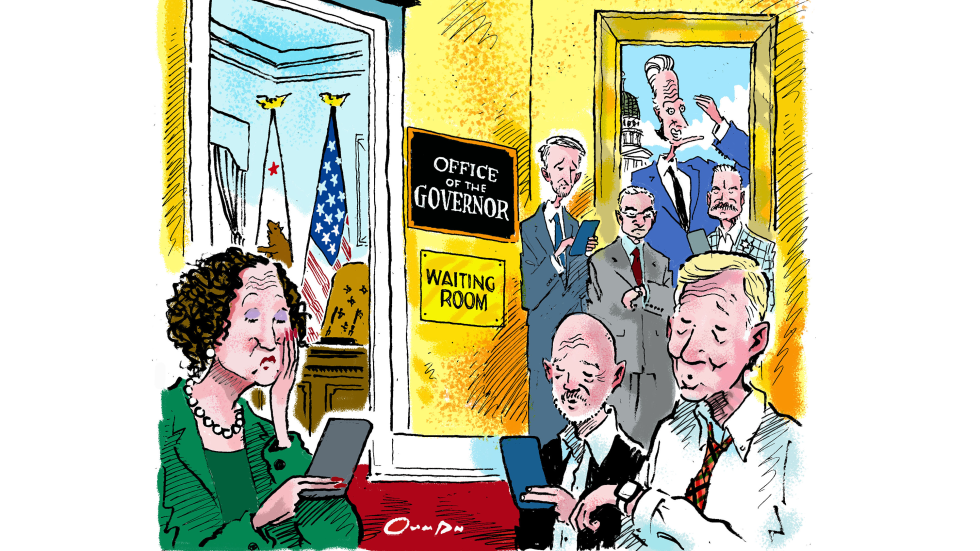
It’s a race for the California governorship unlike any other in
recent memory. Six Democrats and two Republicans will appear on
the ballot for the primary election June 2. The race shifted to
near chaos in April when the San Francisco Chronicle reported
that several women accused Democratic frontrunner Eric Swalwell
of rape and sexual misconduct. Swalwell suspended his campaign
after all major endorsements were rescinded, and he resigned from
Congress. While several candidates sit near the top, as of late
April, no dominant frontrunner has emerged among the crowd.
“This is the first time in nearly three decades it’s been a
wide-open race,” says Steven Maviglio, a political consultant
from Sacramento. “The field is filled with virtual unknowns
statewide, and with the exception of one, not very well
financed.”
Arnold Schwarzenegger and Gavin Newsom emerged as the top
contenders early on in their successful campaigns. It’s a
different situation this time around. Gov. Newsom is ineligible
to run after serving two four-year terms. This year, he’s been on
a nationwide tour promoting his book “Young Man in a Hurry: A
Memoir of Discovery.” He attended the World Economic Forum in
Davos amid widespread speculation of a 2028 presidential run.
His successor will inherit a roughly $3 billion budget deficit.
(That’s the figure from the Newsom administration. The
Legislative Analyst’s Office estimates the deficit at $18
billion.) Maviglio says that deterred some would-be candidates,
but the greater impact was widespread speculation on high-profile
office seekers.
Former Vice President Kamala Harris, fresh off her failed
presidential run, was widely expected to enter the California
governor’s race.
“That basically froze the field for months. Candidates couldn’t
fundraise. They really couldn’t get support. Everybody put off
their endorsements,” Maviglio says. “So the whole election was a
slow-mo movie for a while because there wasn’t a clear path for
anyone.”
Harris declined to run, and so did California’s U.S. senators
Alex Padilla and Adam Schiff, as well as state Attorney General
Rob Bonta. Lt. Gov. Eleni Kounalakis, whom Maviglio says some saw
as Newsom’s successor, withdrew early from the race. Former state
Controller Betty Yee also withdrew from the race in April.
Democrats failed to endorse a single candidate at the party’s
February convention. Politics can be unpredictable. It’s
currently unlikely for a Republican gubernatorial candidate to
prevail in a one-on-one with a Democrat in a heavy blue state.
But with so many Democrats in the race, there’s real potential
for vote splitting, leading to a final battle between two
Republicans. Unlike in other states where separate party
primaries lead to the top Democrat and Republican facing off in
the general election, in California, it’s a single free-for-all
where the top two advance in what’s dubbed a “jungle primary” in
political parlance. So there’s real pressure from Newsom’s party
to rally behind a winner.
The main issue that has emerged in this election appears to be
affordability, according to Tim Rosales, a Republican political
consultant from Sacramento. How do we bring down the cost of
living? Generally, this is seen as building more housing and
cutting electricity rates and gas prices. All the candidates are
tackling this issue in various, nuanced ways. “But there’s really
no one who has cut through on a particular part of that
affordability issue or any other issue,” Rosales says.
It’s tough to get public attention in a crowded field and stand
out, especially when their messages are too similar. “What
California voters want is some real, clear, actionable plans or
even a demonstration of results. And to date, no candidates are
really offering that substantively,” Rosales says.
Candidates will drop out once they run out of money, fail to get
included in debates or fail to land key endorsements. Until then,
the election is unpredictable. Even among Republicans, there’s no
clear frontrunner. “Voters are having a hard time
differentiating, really, who is at the end of the day going to,
in their minds, make California better,” Rosales says.
Latino GOP political strategist Mike Madrid said in an X post
that voters are just starting to tune in. He said it was wrong
for California Democratic party leaders to try and force low
ranking candidates to drop out because it turned out former
California Attorney General Xavier Becerra, who had been polling
low, surged to the top after Swalwell dropped out. “Many Dem
voters feel like the establishment picked the last frontrunner
and it blew up on them,” Madrid said.
Here’s a rundown of the candidates, listed alphabetically.
Xavier Becerra

Democrat Becerra, 68, an attorney, served as the U.S. Secretary
of Health and Human Services during the Biden administration.
Before that, he served in the U.S. House of Representatives and
then worked as California attorney general. In that position, he
filed over 100 lawsuits against the first Trump administration.
Becerra attended C.K. McClatchy High School in Sacramento. Last
year, he gained national attention when news broke that a dormant
campaign account held by Becerra was allegedly used to steal
$225,000. Becerra was not accused of wrongdoing and said he was
unaware of the scheme.
Chad Bianco

Republican Bianco, 59, is the Riverside County sheriff. He gained
public attention for his vocal support of Proposition 36, known
as the Homelessness, Drug Addiction, and Theft Reduction Act. The
voter-approved ballot initiative increased penalties for retail
theft and possession of hard drugs. The California Rifle & Pistol
Association Political Action Committee has endorsed him, along
with several law enforcement officers, including El Dorado County
Sheriff Jeff Leikauf and Placerville Police Chief Joe Wren.
However, Trump-aligned influencer Laura Loomer has criticized him
for not being MAGA enough. As governor, Bianco wants to cut taxes
and loosen regulations, according to his campaign website.
Steve Hilton

Republican Hilton, 56, is a former Fox News host. He was endorsed
by Pres. Donald Trump in April. Hilton previously worked in
conservative politics in the United Kingdom as an adviser to
Prime Minister David Cameron. In 2012, he moved to the Bay Area
after his wife, a tech executive, got a job at Google. Last year,
he published a book called “Califailure: Reversing the Ruin of
America’s Worst-Run State.” His campaign has received financial
support from conservative media magnate Rupert Murdoch, and he
has also been endorsed by entrepreneur Vivek Ramaswamy, a 2024
presidential candidate. The late political commentator Charlie
Kirk was a vocal Hilton supporter before he was assassinated.
Matt Mahan

Democrat Mahan, 43, is the mayor of San Jose. He is known as a
moderate and supported Proposition 36. As a mayor, he reduced
homelessness by building tiny homes and proposed arresting those
who repeatedly refuse to be placed in shelters. He has received
millions in campaign donations from Silicon Valley elites. Mahan
graduated from Harvard University and worked briefly as an
English teacher before starting and selling several business
ventures. He is a frequent Newsom critic. Unlike most Democrats
in the race, Mahan has shied away from overtly attacking
President Trump.
Katie Porter

Democrat Porter, 52, is a former U.S. representative for Orange
County and teaches at UC Irvine School of Law. She was elected to
the House amid the “blue wave” during the first Trump
administration. She gained national attention for asking tough
questions of corporate and tech executives at congressional
hearings and using her signature whiteboard. She was considered a
frontrunner for governor until last October, when she walked out
on a TV interview and was caught berating a staff member over a
Zoom call. Porter has since apologized, and U.S. Sen. Elizabeth
Warren has endorsed her.
Tom Steyer

Democrat Steyer, 68, is a billionaire investor and climate
activist. He founded Farallon Capital, a hedge fund that manages
billions in assets. In 2012, he sold his stake in the company and
then started NextGen America, a liberal nonprofit that supports
progressive issues. Steyer unsuccessfully ran for president in
2020. After that, he was an economic adviser to Gov. Newsom. In
2024, he published a New York Times best seller titled “Cheaper,
Faster, Better: How We’ll Win the Climate War.” U.S. Rep. Ro
Khanna and the California Nurses Association have endorsed him.
Tony Thurmond

Democrat Thurmond, 57, is the state superintendent of public
instruction. His mother was a single parent who immigrated from
Panama and died when he was 6. His extended family raised him.
Thurmond became a social worker and was elected to serve on a
school board, a city council and the State Assembly. He has
openly supported the proposed billionaire’s tax in California and
is the only candidate currently holding statewide office.
Antonio Villaraigosa

Democrat Villaraigosa, 73, is a former state assembly speaker who
served as mayor of Los Angeles from 2005 to 2013. His best-known
accomplishment as mayor was the “Subway to the Sea,” a public
transit expansion project that he successfully funded. He also
expanded the police force to more than 10,000 officers, which at
that time was believed to be the largest size in the city’s
history. Villaraigosa ran unsuccessfully for governor in 2018.
–
Stay up to date on business in the Capital Region:
Subscribe to the Comstock’s newsletter
today.